


What is Services-as Software (SaS)? 

If SaaS (Software as a Service) gives you a calculator, Services-as Software (SaS) delivers the accountant. This distinction captures the shift happening in enterprise technology today. SaS describes solutions that don't just assist people—they perform end-to-end services through autonomous AI agents, under light supervision. While Software as a Service offers tools that augment human productivity, Services-as Software platforms use agentic AI to handle job functions previously carried out by knowledge workers. In essence, customers pay for results—a resolved ticket, a reviewed contract, a matched invoice—not for platform access or seats. This transforms labor into a scalable product, aligning prices with outcomes. 

SaS differs from traditional models in three fundamental ways: 

  • Automated Outcomes: The software is the worker, replacing tool-centric workflows.

  • Agentic AI at the Core: SaS solutions built on AI architectures can make decisions, reason through ambiguity, learn and adapt in real-time, and execute multi-step workflows.

  • Outcome-Linked Economics: Pricing shifts from subscription models to usage, transaction or outcome-based models directly aligning vendor incentives to customer success. 

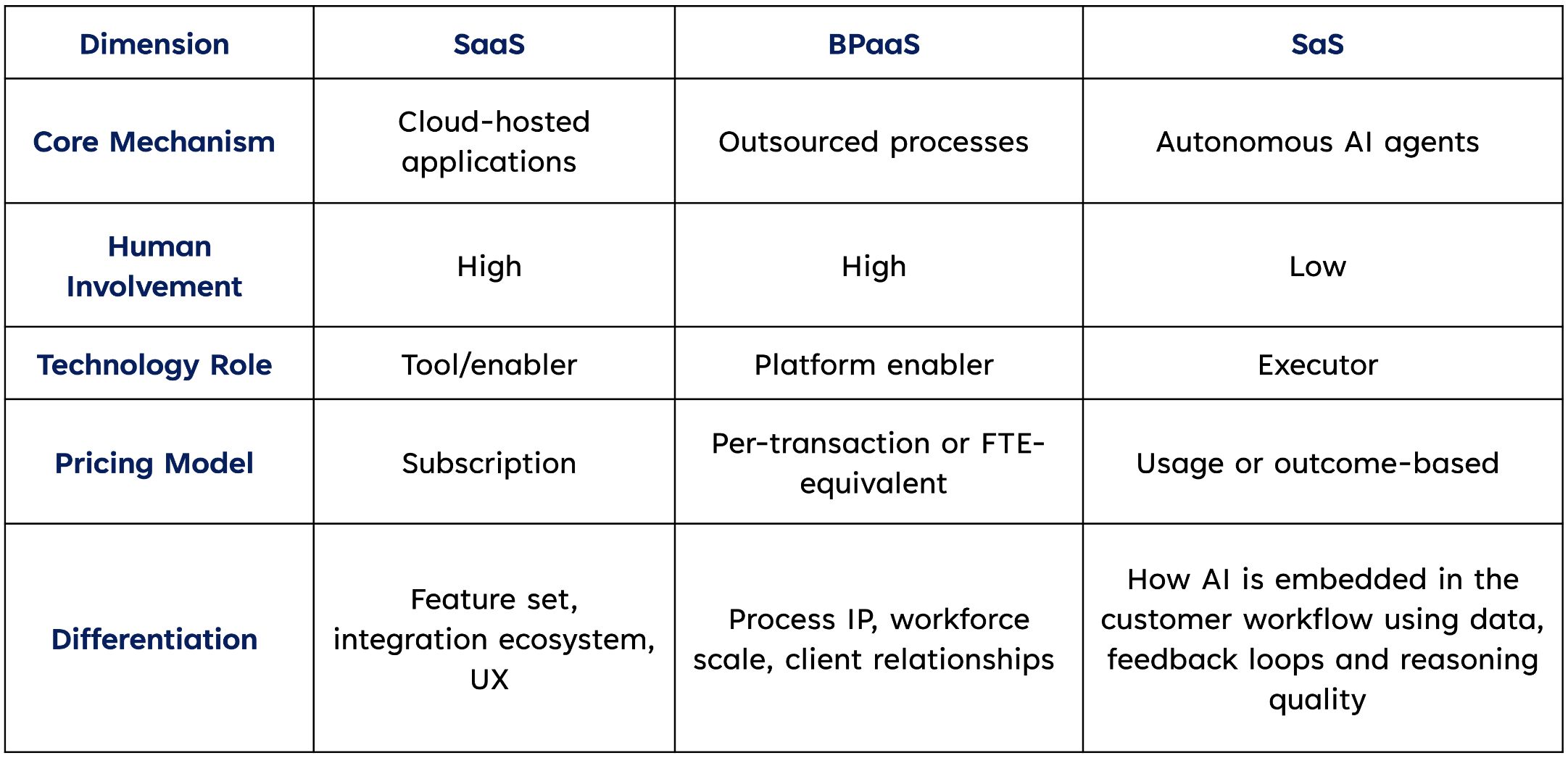
SaaS vs. BPaaS vs. SaS—What Actually Changes? 

Business Process as a Service (BPaaS) showed that technology platforms plus human operations could deliver outcome-based services. SaS keeps the outcome promise but makes AI agents the executor.

Here's what changes:
The Market Opportunity 

Why the urgency? Because SaS aims at the services market, not just the software market. This represents a $4.6 Trillion opportunity. By 2035, SaS could become a $1.5 trillion market category, largely by absorbing revenue from traditional IT and BPO services. Over the last decade, we have seen the transition of software to cloud; now labor itself is getting "cloudified." 

Investors are showing interest. Several startups in this space have raised notable amounts of capital at substantial valuations: As of September 2025, Sierra is valued at $10B, Harvey at $5B, and Decagon at $1.5B. There are caveats. AI agents inherit compute costs; enterprise deployments can be complex, and achieving healthy gross margins remains challenging. While disciplined unit economics aren't currently a primary focus in this category, they will need to be addressed over time. 

Why SaS Winners Will Look Different from SaaS Winners 

SaS moats are built through codifying a client's unique processes, incentive structures, non-standard data, and domain language into the agent's operating playbook. This requires deep integration, production tuning, exception handling and operational workflows, all of which raise the bar for go-to-market. It can lengthen sales cycles and, if unmanaged, tilt a startup toward low-margin services work. That operational reality is where Technology Service Providers have a natural edge. 

Where Technology Service Providers/ Systems Integrators Can Lead

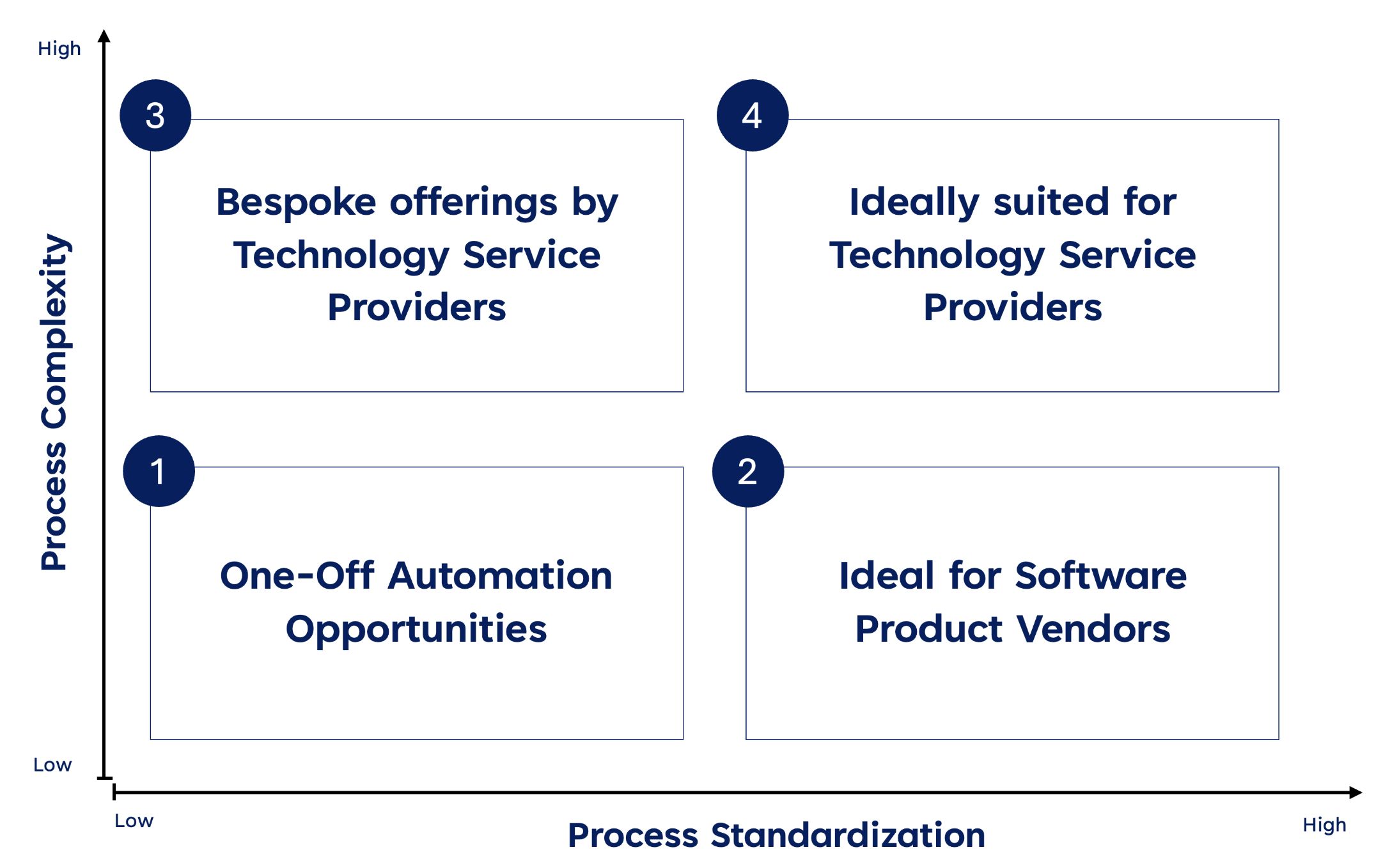
This diagram represents a framework that depicts how different players can succeed. It is represented via the two axes: Process standardization (Is there uniformity in the process steps and a common understanding of the process across customers?) and Process complexity (# of process steps, IT Systems, variability and complexity of the data, etc.). 

Zone 1 - One-Off Automation: At low standardization and low complexity, these remain as project-based opportunities but don't scale as products. 

Zone 2 - Ideal for Software Product Vendors: At high standardization and lower complexity, Software startups will shine with productized agents with standardized processes across industries. 

Zone 3 - Bespoke Offerings: For complex processes that aren't standardized, Technology Service Providers can leverage their relationships, domain expertise, human oversight and ability to handle complex custom integration projects. 

Zone 4 - The Sweet Spot for Technology Service Providers: Complex-yet-standardized use cases that Services firms can productize across a broad client base leveraging their domain knowledge, system access, integration skills, and deliver "human-in-the-loop" guardrails where error costs (legal, ethical, financial) are meaningful. 

Wipro Ventures: Our Investment Thesis and Takeaway! 

Our strategy recognizes that SaS represents an architectural shift, not just a product category. As the industry evolves, we are focusing on below categories: 

(A) The Building Blocks: Solutions like EMA, Kognitos, Skan AI and Pay-i that provide the foundational blocks for building and governing autonomous AI systems.  

(B) Agentic Solutions for IT and Cybersecurity: Solutions from Factory, Functionize, Simbian or Tuskira can be embedded within managed services platforms and power larger workflows.  

(C) Solutions that deliver the end-outcomes in specific industries: These solutions necessitate crucial human-in-the-loop oversight for quality, compliance, and scale—particularly in regulated domains. 

We stitch these categories together to build end-to-end offerings, wrap the required guardrails, and deliver outcomes that helps clients adopt SaS with enterprise-grade integration, controls, and accountability. This is how we intent to deliver our offerings as per zone 4 mentioned above.  

SaS is not "SaaS but smarter." It is a re-platforming of services into software-delivered outcomes—powered by AI agents, anchored in systems of record and made relevant by the customer context. For Technology Service Providers, the question is not whether AI will disrupt services delivery, but how quickly we can adapt our models to leverage AI's capabilities while providing the domain expertise, integration skills, and human oversight that ensure successful outcomes. 

At Wipro Ventures, we are investing across the stack and partnering with our services business to translate those investments into real, measurable results for clients. By combining capital and capabilities, we aim to help enterprises deploy SaS in production.  

About the Author

Biplab Adhya

Managing Partner

Biplab is a Managing Partner at Wipro Ventures, the corporate investment arm of Wipro. Wipro Ventures invests in Early to Mid-stage Enterprise Software startups that are aligned with Wipro’s strategic priorities and has $500M Assets under Management. Since launching Wipro Ventures in 2015, Biplab has been involved in 40+ investments and 15 exits. In addition, he has helped build a productive GTM channel that has enabled 600+ deployments of the portfolio solutions across 250+ clients of Wipro.  Some of Biplab's notable investments include Demisto (acquired by PANW), IntSights (acquired by RPD), CloudKnox (acquired by MSFT), Cloudgenix (acquired by PANW) and Vulcan (acquired by TENB). Prior to this position, Biplab held several operating roles, primarily in the enterprise applications services domain at Wipro and other global corporations. He is a certified Six Sigma Green Belt and a Kauffman Fellow.