The automotive fleet industry is entering a new era of innovation, driven by evolving OEM strategies and rising customer expectations. For OEMs, this shift represents an opportunity to differentiate through service innovation, deepen customer relationships, and unlock new revenue streams. Manufacturers are redefining their roles as vehicle fleet suppliers and integrated mobility partners. From factory-installed connectivity and telematics to AI-powered platforms and electrification solutions, OEMs are building ecosystems that prioritize uptime, data monetization, and personalized customer engagement.

At the same time, fleet customers are demanding more than just vehicles, they expect seamless integration of hardware, software, and services. Real-time data access, proactive maintenance, and strategic support are no longer optional; they’re essential. As a result, contact centers and service models must evolve to deliver personalized, multi-channel experiences that align with these new expectations. The advent and maturation of AI and GenAI technologies have the potential to transform contact centers as we know them today, revolutionizing how OEMs serve fleet customers.

Why Today’s Contact Centers Are Losing Their Edge

The current contact centers in the automotive fleet industry often fall short of delivering strategic value, limiting fleet operators from fully realizing the potential of their vehicle investments. These limitations not only frustrate fleet customers but also hinder OEMs from capturing aftermarket value, reducing churn, and scaling service operations efficiently.

  • Agents are frequently burdened with fragmented tools, siloed communication channels, and incomplete customer views, which hinder efficient issue resolution and proactive support.
  • Manual ticketing systems, minimal integration with vehicle data or enterprise platforms, and reactive problem-solving approaches further exacerbate these limitations.
  • The lack of visibility across fleet operations and a constrained knowledge base contribute to a suboptimal experience for both fleet customers and agents—and ultimately, missed opportunities for OEMs to deliver differentiated service and generate additional revenue streams.

The Smart Shift in Fleet Customer Engagement

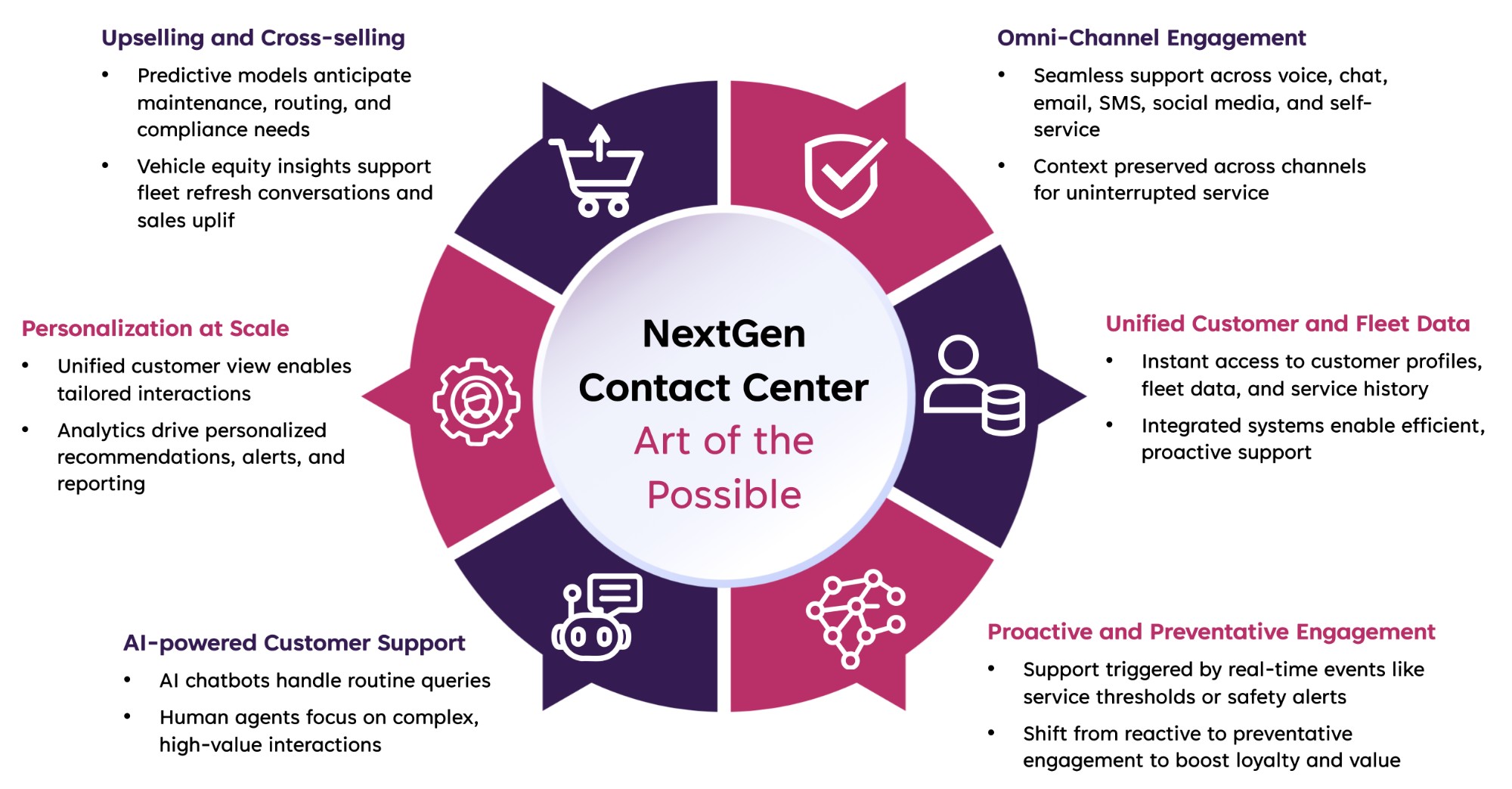
To overcome current limitations, next-generation contact centers are being reimagined as strategic partners in the fleet customer journey. By harnessing AI, automation, and analytics, they are shifting from reactive support to intelligent, proactive engagement. Agents are equipped with deeper product and service insights, enabling faster and more personalized interactions. Built on agility, intelligence, and integration, these centers can transform the customer experience.

The rise of AI and GenAI is especially impactful, reshaping agent workflows and helping fleet operators unlock greater efficiency and value. This transformation delivers operational gains through automation, scalability, and data-driven innovation. It also drives revenue growth through improved engagement and sales opportunities, while enhancing customer satisfaction and loyalty.

As fleet customers engage OEMs through various communication channels, next-generation contact centers can respond more effectively by leveraging available vehicle, fleet, and customer data. A GenAI based conversation tool can enable fleet customers to self-serve routine requests and access information without needing to contact agents.

Armed with fleet vehicle usage and driver behavior data, agents can proactively engage customers with recommendations on optimizing fleet performance, transitioning to electric vehicles, and reducing insurance premiums.

Using connected vehicle and telematics data, agents can personalize service at scale. They will be able to view fleet usage at the vehicle level and suggest actions such as geofencing, automatic engine shut-off after extended idling, and proactive repairs, helping fleet customers reduce operational costs and extend vehicle lifespan.

By combining insights such as fleet repair history and residual vehicle value, agents can also recommend cost-effective fleet modernization strategies tailored to each customer’s needs.

Vision for OEM Contact Center Engagement with Fleet Customers

Transforming Contact Centers: A Strategic 5-Phase Journey

In today’s fast-evolving customer landscape, transforming contact centers is a strategic imperative for OEMs. This roadmap outlines a structured, phased approach to drive meaningful change, enhance agent experience, and unlock operational excellence through AI, modernization, and continuous improvement.

1. Assessment & Vision Alignment

This foundational phase involves assessing the current state, developing a clear vision, and aligning stakeholders around it. For OEMs, this means ensuring the transformation supports brand promise and customer lifecycle strategy. Executive sponsorship and support are secured to drive momentum. Business processes are redesigned to meet future state requirements. This approach, built on industry expertise and past transformation experience, ensures a structured and impactful journey, anchored by a robust plan for Organizational Change Management.

2. Discovery and Design

This phase begins with a thorough assessment of current state processes and the identification of key performance indicators (KPIs). It includes selecting the appropriate software and designing user experiences (UX/UI) and agent screenflows that align with business needs. For OEMs, this ensures that business rules and workflows are configured to support strategic goals such as uptime, customer satisfaction, and aftermarket engagement.

Transforming a contact center presents a once-in-a-generation opportunity for OEMs to adopt new ways of engaging fleet customers. However, it also can also place business stakeholders in a challenging position, as they navigate large scale change. A comprehensive organizational change management (OCM) strategy is vital to the success of such a program. This phase of the project lifecycle offers an ideal window to craft and implement that strategy.

3. Technology Modernization

Once the design is finalized, the modernization of technology takes center stage. This involves rigorous testing of systems, comprehensive training for users, and execution of Organizational Change Management (OCM) activities. For OEMs, this phase ensures that new platforms are scalable, integrated, and aligned with enterprise-wide digital transformation efforts.

4. AI & GenAI Enablement

In this phase, advanced AI and GenAI functionalities are developed and integrated into the system. A user test run is conducted to validate the new technology and screenflows. Training and deployment are carried out alongside OCM efforts to ensure that users are equipped to leverage these innovations. For OEMs, this marks a significant leap in capability—enabling predictive service, intelligent routing, and personalized support at scale.

5. Continuous Improvement

Post-deployment, the focus shifts to tracking KPIs, monitoring performance, and conducting root cause analysis to identify areas for enhancement. User feedback is actively collected to refine processes and functionality. A backlog of user stories is maintained to guide future releases, ensuring that the system evolves in response to real-world needs and insights. For OEMs, this phase supports long-term agility and responsiveness in a dynamic fleet environment.

Fleet Innovation in Action: OEM Success Stories

A North American automotive OEM aimed to enhance agent productivity and streamline global contact center operations for their fleet customers. Wipro built a unified platform offering a single-pane view of cases, multi-channel support, and simplified business processes. Key features included global uptime interfaces, financial assistance tools, AI-powered email summaries, and productivity dashboards. The transformation led to 50% faster case creation, reduced handling times, and improved visibility for sales teams and managers. Phase 2.0 introduced messaging, customer surveys, unified search, AI summaries, and migration of legacy knowledge bases, significantly improving fleet customer engagement and creating new revenue opportunities.

A leading Japanese automotive OEM contact center was facing inefficiencies due to a legacy CRM, manual processes, disconnected systems, and limited automation. These challenges impacted agent experience, customer experience and led to missed sales opportunities. Wipro conducted a comprehensive assessment across 12 business functions, uncovering over 130 pain points. The team redesigned case management and agent workflows, delivering a fully integrated business process and technology platform. The solution included Cloud recommendations and embedded AI features. Outcomes included projected savings of over $1 million, reduced errors and operational costs, and a drop-in agent proficiency time from 10 days to just 3.

Driving the Future of Fleet Engagement

The automotive fleet industry stands at a pivotal crossroads, where innovation is a necessity. OEMs and fleet operators alike must embrace a holistic transformation that integrates technology, data, and customer-centricity. By reimagining contact centers as strategic enablers powered by AI and automation, OEMs can unlock new levels of efficiency, fleet customer engagement, and growth. The journey is complex, but the rewards are compelling: smarter operations, empowered agents, new revenue streams, increased overall earnings, and loyal customers. OEMs that act now can embrace the transformation, starting with a strategic assessment of their contact center maturity and readiness for AI-driven customer engagement.

About the Author

Vinod Kadadi
Partner, Automotive - Wipro Consulting

Vinod Kadadi is a digital advisory and transformation leader with over 20 years of experience in the automotive and manufacturing sectors. Recognized among the Top 25 Automotive Consultantshe brings deep expertise in advising C-level executives on ERP readiness, digital engineering, supply chain transformation, smart manufacturing, OCM, and customer experience.

He has successfully led and managed consulting practices, working closely with clients across the automotive ecosystem to develop digital solutions and address emerging challenges within the enterprise ecosystems.

As a thought leader, Vinod has authored several white papers on topics such as Tariff Mitigation Strategies for American Automotive and Manufacturing CompaniesEffective EV Battery Lifecycle Management, the Role of Metaverse in Manufacturing, and Alternative Perspectives on Cloud Adoption