


Today, customer experience defines how organizations are perceived. It builds trust, drives loyalty, and directly influences revenue, retention, and advocacy. As a result, enterprises are repositioning customer service—from a cost center to a strategic growth lever.

Customer service operates across two interconnected worlds:

  • Front office: Customer‑facing interactions that manage engagement, capture intent, and initiate resolution while shaping real‑time experiences across channels.
  • Back office: Fulfilment and operational processes—investigations, approvals, and updates—that ensure promises are delivered.

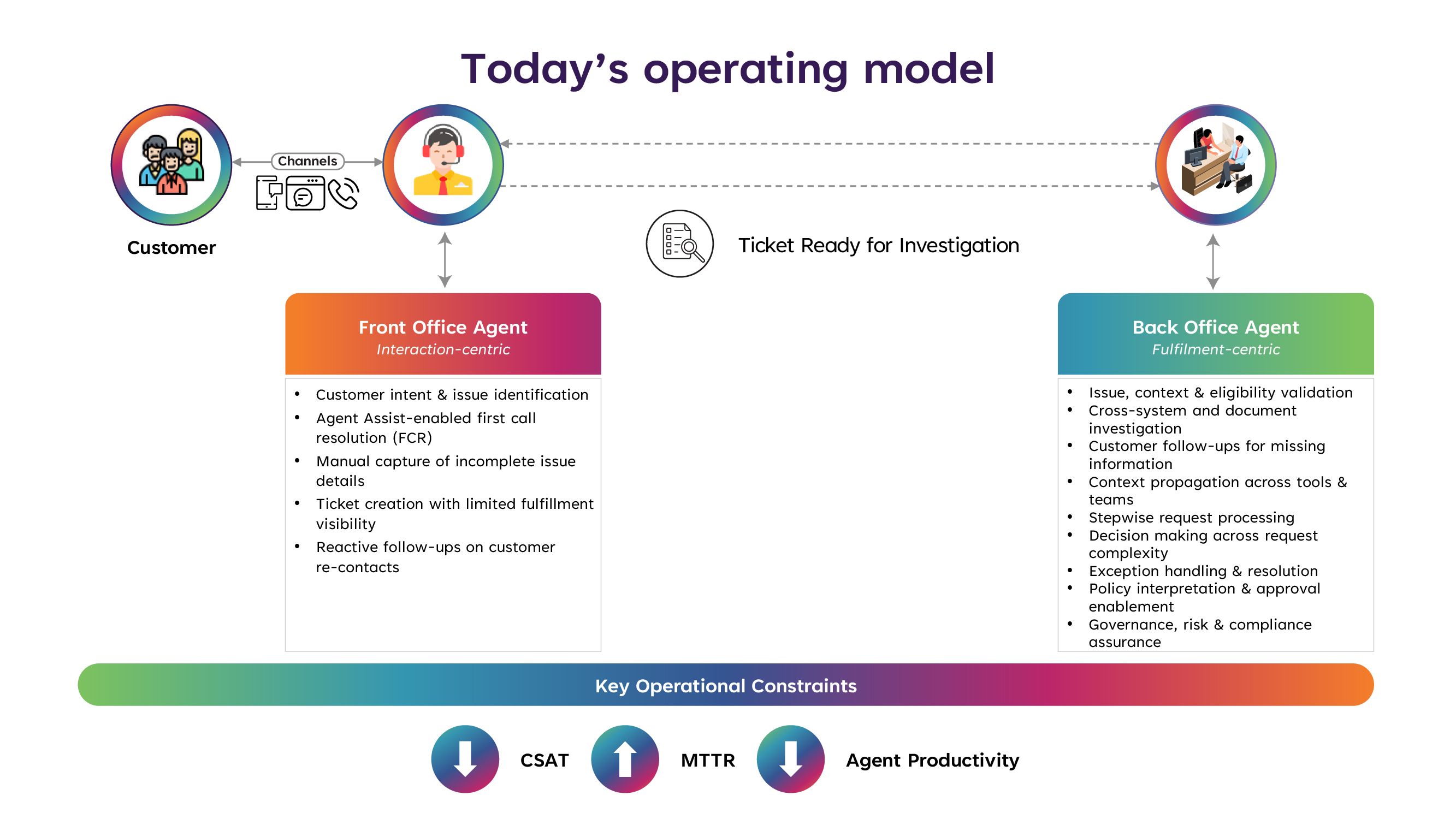
On the surface, the two functions are designed to work together so any hand-off between them may appear seamless. In practice, customer experience erosion often occurs downstream. Manual back‑office workflows, fragmented ownership, and missing information introduce delays—widening the gap between what customers are promised during engagement and what is ultimately delivered.
Unified Resolution: Where Engagement Meets Fulfilment

These downstream breakdowns reveal a deeper structural issue: engagement and fulfilment are designed and operated in isolation.

In today’s operating model (illustrated above), front‑office agents lack clarity on resolution requirements, leading to incomplete intake, repeated follow‑ups by customer and back-office, and delayed fulfilment. These gaps expose the need for a Unified Resolution Engine—one that aligns engagement and execution from the outset to close the gap between customer promise and outcome.

Agentic AI: Unifying Front Office and Back Office at Scale

Modern AI has moved beyond task automation to deliver real‑time intelligence, contextual guidance, and decision support during customer interactions. While many organizations use AI‑powered Agent Assist to improve front‑office efficiency, this approach often optimizes engagement in isolation—leaving fulfilment and resolution fragmented.

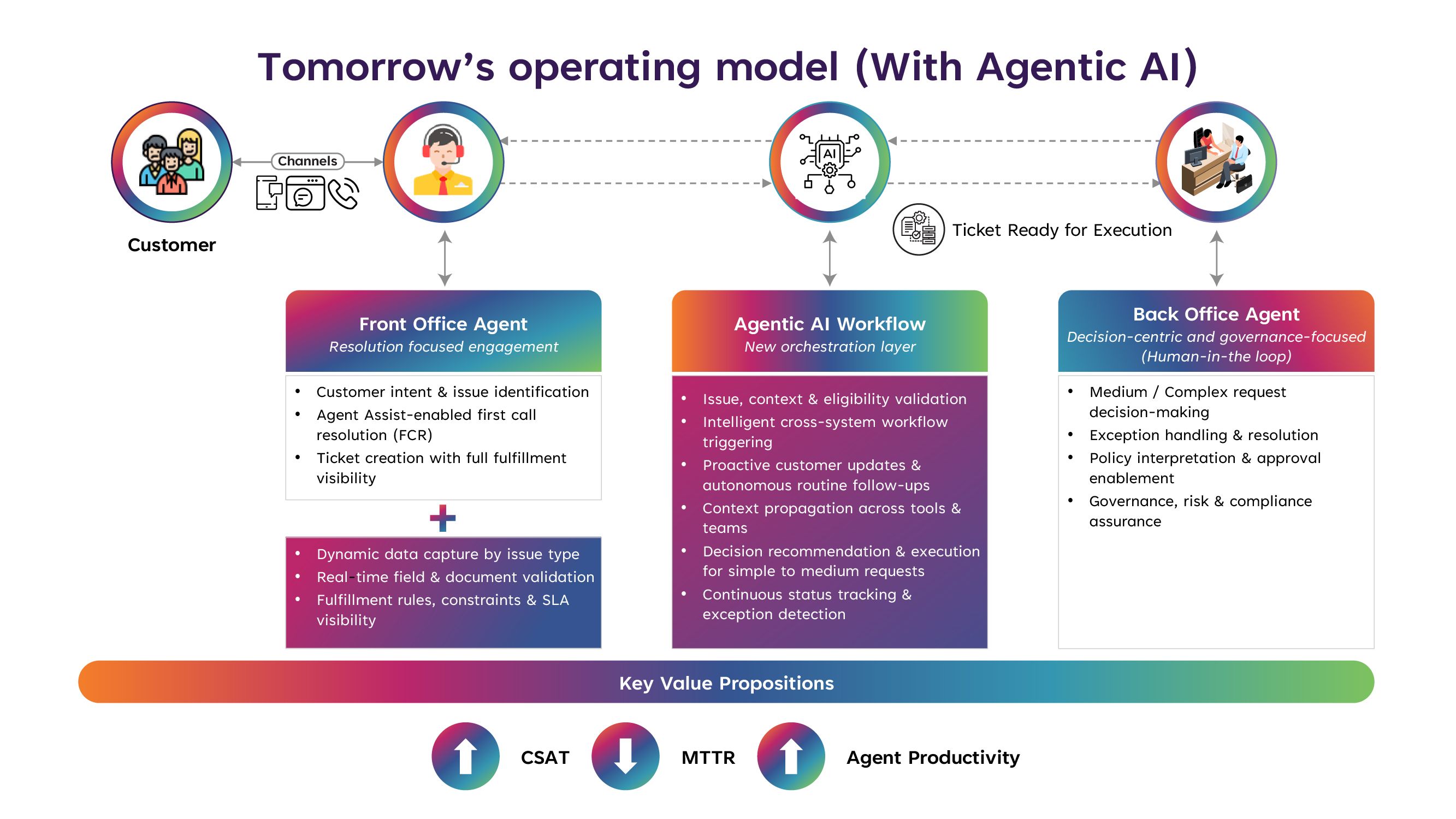
Agentic AI changes this as illustrated below. It brings back‑office intelligence into the front‑office moment—guiding agents on required data, documents, and validation rules, and leveraging historical resolution context. This ensures requests are captured right the first time, progressing as execution‑ready rather than investigation‑ready.

Agentic AI then orchestrates resolution end‑to‑end—triggering workflows, coordinating downstream actions, and carrying context seamlessly across systems. What once required multiple hand-offs becomes a single, unified resolution flow—accelerating fulfilment, reducing rework, and delivering consistent experiences.

With unified Customer 360° visibility, Agentic AI also enables proactive engagement—providing timely and more accurate updates to customers, reducing back-and-forth for clarifications and resolving issues autonomously when possible, creating faster, smarter, and frictionless customer outcomes.

Crucially, accountability remains human‑led. Decision‑making authority, policy interpretation, exception handling, approvals, and governance, risk & compliance  (GRC) oversight continue to reside within the back office. Agentic AI operates within these guardrails—augmenting execution and coordination without displacing ownership or control.

Today’s Agent Assist delivers clear value—surfacing knowledge, guiding conversations, and improving agent productivity—typically driving 20–30% efficiency gains through AHT reduction. However, the larger impact comes with Agentic AI–driven autonomy, where effort reduction can reach 40–50% by eliminating rework, follow‑ups, and hand-offs across the resolution lifecycle. This translates directly into improved CX, as customers experience faster, first‑time resolution with fewer transfers and follow‑ups—resulting in a more seamless and consistent experience across the entire journey.

As AI scales, enterprises can rethink their operating model—shifting information‑intensive work upfront while retaining governance in the back office. The result is a unified resolution engine that dissolves front‑ and back‑office boundaries, delivering predictable outcomes, fewer repeat contacts, greater trust, and sustainable revenue growth.

About the Authors

Amit Thapak- Practice Head, AI Solutions, Wipro
Amit leads AI‑driven contact center transformation initiatives at Wipro, bringing over two decades of experience across consulting, AI solutioning, and emerging technologies. He is accountable for defining the transformation vision, shaping end‑to‑end solution strategy, and driving measurable business outcomes for clients.

Bhoomika Arora- Solution Manager, AI Solutions, Wipro
Bhoomika contributes to AI‑led contact center transformation programs, with a focus on solution design and transformation strategy. She plays a key role in translating transformation objectives into scalable, execution‑ready solution approaches.