



For over two decades, enterprises have invested in observability tools to monitor software systems: dashboards, alerts, traces, and logs. Today the Site Reliability Engineering (SRE) teams responsible for supporting enterprise systems have plenty of data when issues occur. However, resolving them still requires significant manual effort to correlate those signals, find the root cause, and fix the problem.

Agentic AI has created a new generation of solutions promising to close that gap, which has significantly widened due to the complexity of modern software development.

The Reliability Crunch: More Complexity, Fewer Hands, Bigger Stakes

Fragmented Infrastructure: Kubernetes, microservices, multi-cloud, and hybrid environments have made modern software infrastructure vastly more complex and distributed. Troubleshooting issues requires engineers to navigate a web of system dependencies, data sources, and experts across functional teams.

Observability and Alert Fatigue: To maintain visibility over their large software footprints, enterprises often use multiple observability tools, each generating its own siloed telemetry and dashboards. When errors and incidents occur, SREs are overwhelmed with alerts, logs, and traces from each of these observability sources that they must analyze to resolve issues. 

Talent Scarcity and Burnout: The accelerating pace of software development has created executive pressure to meet faster release schedules and underinvestment in system stability. As incidents occur more frequently, so does the overreliance on senior SREs with the required expertise and institutional knowledge to resolve them.

Amplified Impact of Incidents: Overwhelmed SRE teams often spend more time fighting downtime than improving system stability, which results in more frequent incidents, degraded system performance, and reductions in the overall engineering organization’s productivity. 

Agentic AI SREs have emerged in direct response to these modern operational pressures, offering to reduce engineering toil, system outages, and incident resolution times. 

Addressing the Shortcomings of Previous AI Solutions 

Before the current boom of LLMs and agent-based solutions, the popularity of deep-learning neural networks led to a generation of “AI Ops” solutions that were used to automate IT operations using the large volumes of observability data that enterprises collected. AI Ops solutions and their underlying models were largely successful in making accurate predictions, but they suffered from three critical barriers to widespread adoption:

  • Unique Incidents and Dynamic Systems: Faster software development led to constant changes in enterprise infrastructure and applications, so even the best predictive models required constant retraining to avoid degraded accuracy.
  • Distributed and Heterogenous Telemetry Data: Training and maintaining predictive models became very labor-intensive due to the significant effort required to aggregate, prepare, curate, and label datasets.
  • Black-Box Predictive Models: Previous AI models were successful in making predictions based on input data, but they lacked the explainability in critical decisions to build trust for adoption with infrastructure teams.

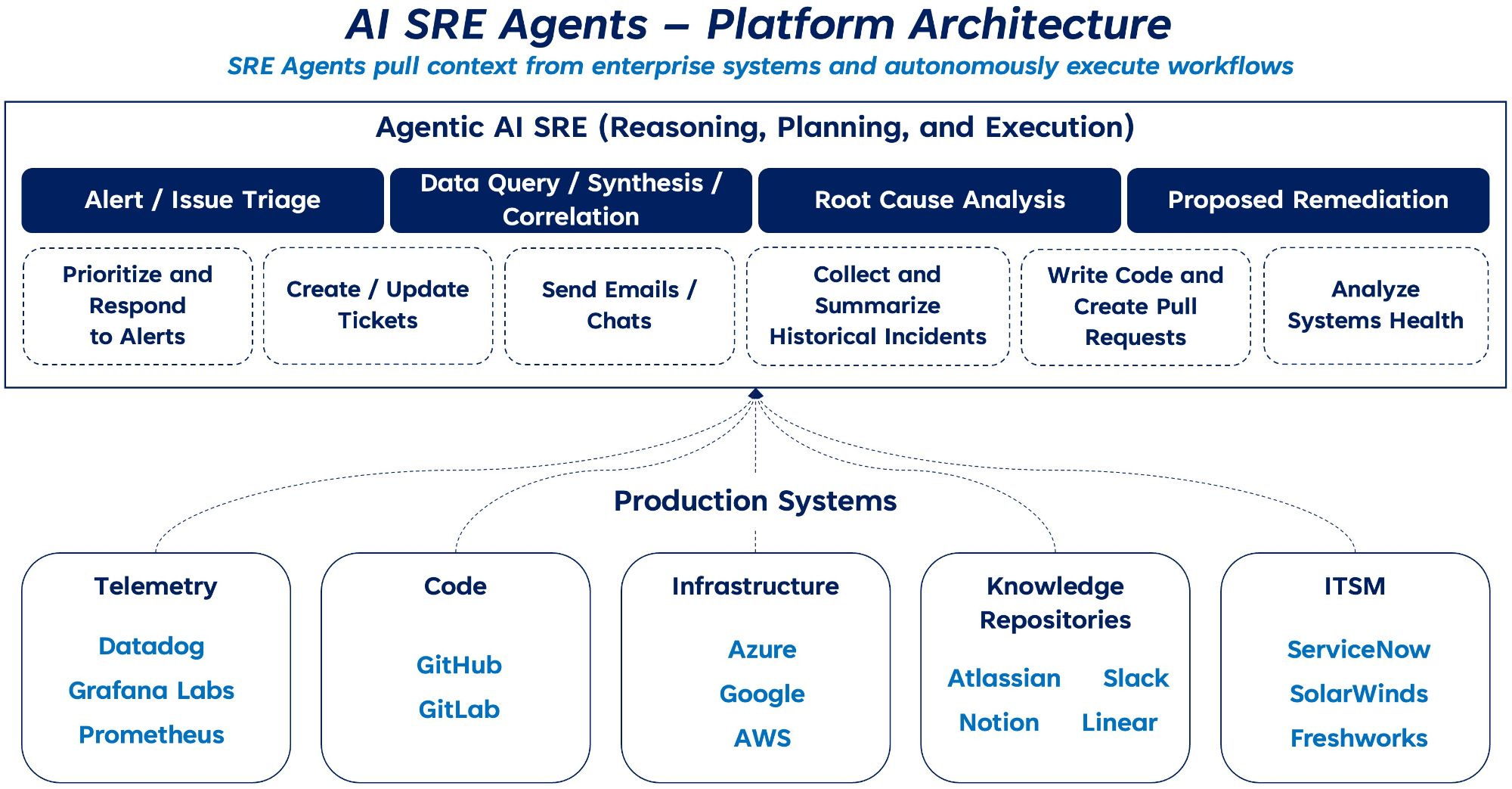
Large Language Models (LLMs) and the latest AI infrastructure have enabled more explainable and flexible solutions. The latest agentic SREs are not only better suited to consuming the unstructured data output from enterprise observability, but can dynamically extract enterprise context from code repositories, knowledge bases, and IT Service Management (ITSM) tools given the going improvements in context engineering infrastructure. SRE teams can focus on proactively improving system stability while AI agents react to and orchestrate the incident lifecycle – triaging alerts, detecting anomalies, correlating data, performing root cause analysis (RCA), proposing remediations, updating tickets, and even drafting pull requests.
The Current Landscape

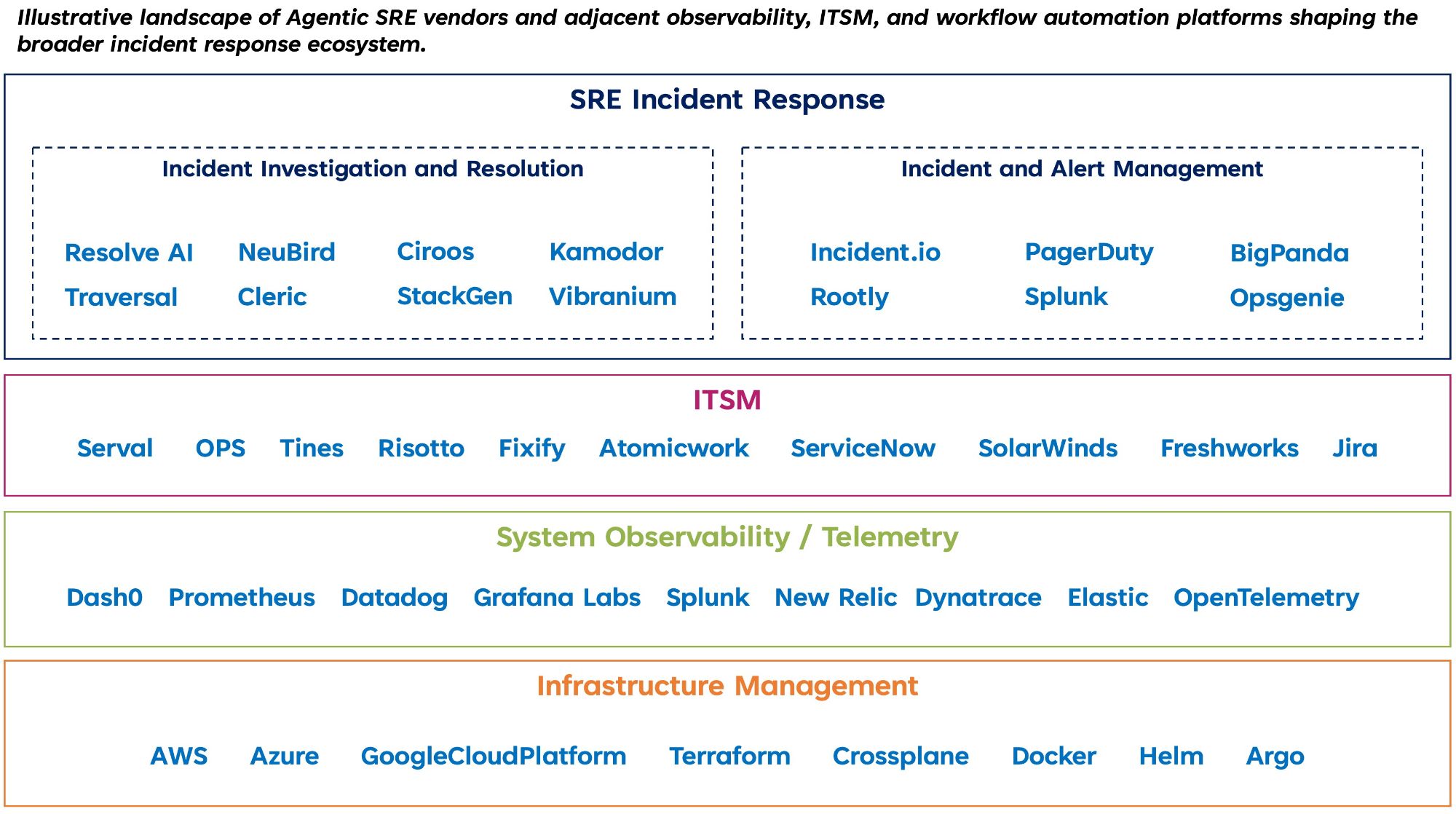
The latest AI-native SRE platforms like Traversal, Resolve AI, and NeuBird are focused on autonomous incident investigation and resolution, while Serval and Atomicwork are focused on agentic automation in the adjacent ITSM platforms that own incident management workflows. They are competing against incumbents with significant structural advantages: observability vendors like Datadog and Dynatrace generate and own the telemetry data and platforms like ServiceNow and Atlassian are systems of record and own the existing user workflows.

This broader ecosystem is important because incident response and reliability teams do not operate in isolation. While not every company in the landscape falls strictly within the Agentic SRE category, adjacent observability, ITSM, and workflow automation platforms will continue to shape how incidents are detected, escalated, investigated, and resolved across the enterprise. As the market converges toward end-to-end autonomy, incumbents in observability and ITSM are enhancing their platforms with agentic AI capabilities while AI-native startups are expanding beyond their RCA-focused agents to include broader IT and SDLC workflows.

The barriers to adoption are significant, as enterprises will demand guardrails, auditability, proven reliability, and viable unit economics before trusting agents with access to production telemetry and deployment pipelines. Legacy enterprise environments will also create challenges with integration and data readiness before SRE agents can be effective. The winners of this dynamic market will not necessarily have the most advanced automations or accurate models, but they will earn the trust of their customers and deliver outcomes over more logs and dashboards – fewer on-call escalations, less system downtime, and faster resolutions.

The Wipro Ventures Takeaway

We believe the latest agentic SRE capabilities represent some of the most exciting enterprise opportunities within the industry’s shift toward Services-as-Software, in which AI agents gradually absorb on-call duties and allow engineering teams to focus on reducing technical debt and building DevOps automation to prevent future incidents. 

Every enterprise infrastructure team has a long backlog of system upgrades, patches, and known bugs that are consistently de-prioritized just to keep the business running and online. Agentic SRE can be the first step to help these organizations spend less time on reactive firefighting and more on proactive investments in infrastructure that will create more resilient systems and enable business teams to deliver new products and customer experiences.  

Our team is optimistic about the potential of autonomous agents paired with human domain expertise and oversight to transform enterprise system reliability and infrastructure operations, and we continue to engage with companies building in this segment.

If you are building in this category, we would love to hear from you.

About the Authors

Ali Wasti

Ali is the Managing Partner of Wipro Ventures, the corporate venture investment arm of Wipro. Prior to this role, Ali was the Senior Managing Director and Head of Hewlett Packard Enterprise's Pathfinder Ventures where he led investments focusing on AI, data infrastructure, cybersecurity, and cloud computing. Ali also led investments at Azure Capital Partners in enterprise B2B, cloud infrastructure, and AI. Before his venture career, Ali spent over a decade in engineering, product, and business development roles at IBM, driving innovation in data management and analytics. Ali holds an MBA from Harvard Business School and a BS in Computer Science from McMaster University.

Jason Chern

Jason is on the investment team at Wipro Ventures, the corporate investment arm of Wipro. He is focused on companies building the future of machine learning, software development, and enterprise infrastructure. Before joining Wipro Ventures, Jason held various roles shaping and evaluating enterprise software products as a product manager, investor, and consultant. He holds a bachelor’s degree in economics and computer science from the University of California, Berkeley.