



A look at Digitization of Public Services and how we see technology architecture evolving for State and Local Governments, accentuated by citizen needs in a post-COVID scenario.
This pandemic has changed the world order. It has enhanced our day-to-day activities, such as shopping, traveling, entertainment, and how we work. There is no denying that COVID-19 has had a far-reaching impact. It has accelerated the experiences we are expecting out of digital means. Direct-to-consumer business models are becoming a trend in the business scenario; similarly, citizen services are also expected to undergo a significant shift owing to a consumer-like expectation while engaging with the government. Moreover, the responsibility of governments will see a change post COVID, due to higher expectations in health, safety in public places, and public transportation. Social distancing needs will also make government office visits an undesirable activity.
Digital government is surely undergoing change, more rapidly in the last 5 years, and citizen centricity is going to look beyond simple digital enablement. The objective will be to bring about improvements in public service delivery, increasing people’s engagement, enhancing transparency, accountability, and inclusion, and ultimately making life better for everyone.
We see a higher role for a centrally controlled technology agency to unify the digital experience of citizens. This article focuses on an architecture view that can enable a unified view of the government to citizens, without significantly impacting the core functioning, data sovereignty, or the IT setup of the state and local departments.
The pandemic has made this change an immediate necessity, also more grounded by practicality. As United Nations Secretary-General António Guterres recently noted, the post-COVID-19 world will be different and much more digital than before.
Some of the new approaches Governments are taking in pursuit of digital government transformation include:
- The delivery of e-government as a platform
- The integration of online and offline multichannel delivery
- The agile development of digital services (supported by whole-of-government and whole-of-society engagement and integration)
- The expansion of e-participation and partnerships
- The adoption of data-centric approaches
- The strengthening of digital capacities to deliver people-centric services, and
- The innovative use of new technologies such as artificial intelligence (AI) and blockchain.
Designed with customer-first paradigm, focusing on citizen journeys as a continuum-
- Ease of use and intuitiveness
- End-to-end digitization and straight-through processing
- True Omni-channel interaction capability and transaction continuity
- Incredibly fast time to close
- Engaging and rewarding citizen- government experiences, driving transparency & trust
This ‘new normal’ is here to stay, with consumers quickly expecting these as the baseline of customer service and are expecting governments to provide the same ease of interaction as well. Based on McKinsey’s Public Sector Benchmark Journey 2018 – “Residents who are satisfied with a public service are nine times more likely to trust the government overall than those who are not.”
In addition to that, this pandemic has shown how vulnerable the current ‘office visit’ based model of government to Citizens is. While the office visits have either been curtailed, only by appointments, with 50% government employees working from office, citizens have relied on digital interactions with the government. Unlike physical offices, digital ones are open to the public 24/7—and stay open during public-health crises such as the COVID-19 pandemic.
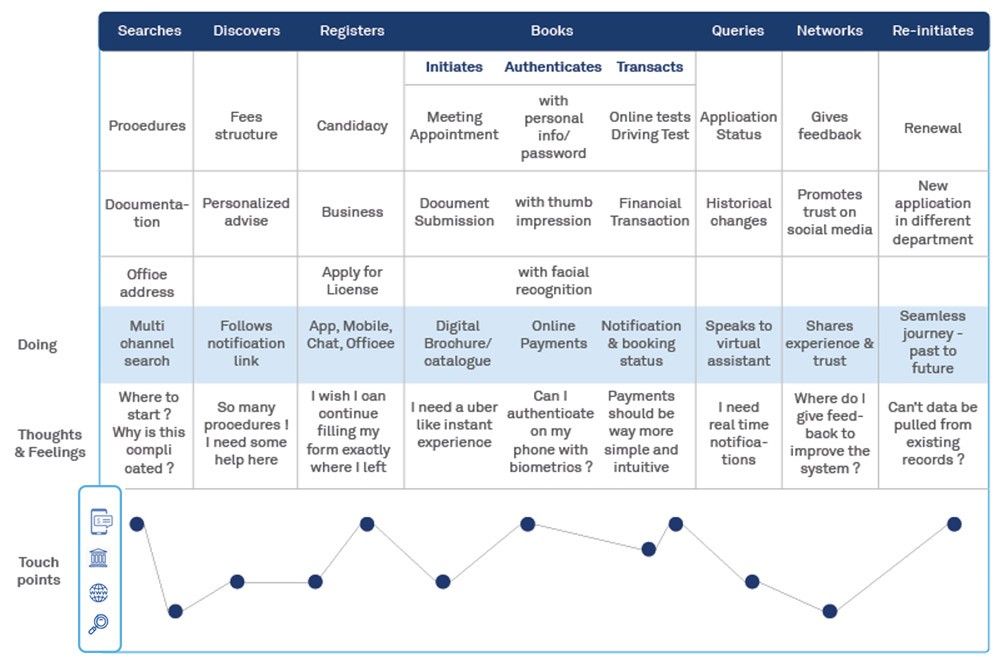
A typical citizen journey is depicted in the figure below, bringing out how the expectations of the citizen from all government interactions are getting increasingly influenced by their experiences as a consumer.