



It requires a great deal of balance to strike a win-win partnership between buyers and service providers. The partnership that is mutually beneficial flourishes only when both the parties are satisfied. When buyers see compelling results from their investments that positively impact their top line and bottom line, and when the service providers are empowered and incentivized to innovate, think out of the box and outperform.
Traditionally, the buyers and the service providers have always engaged in the souring models that are based on staff augmentation and Full Time Equivalent (FTE) pricing. Undoubtedly, this model is safe and linear but it is substandard as it approaches outsourcing as a method to receive the appropriate skills, with the appropriate pricing. This traditional model does not allow the buyer to link the IT services with its business outcomes, and the service provider gets stuck and never moves up the value chain and become a trusted partner.
With the new wave of matured outsourcing and the rise in customers’ expectations of getting higher value from the service providers, the next generation buyers and best-in-class service providers are challenging the status quo, moving towards the co-development and co-GTM models, and utilizing emerging commercial models.
The service providers are compelled to innovate and provide greater business value and impact.
There are various commercial models that are available in the industry with their respective pros and cons, however, a specific commercial model that helps to unlock an asset’s revenue potential is discussed here.
Commercial models - pros & cons
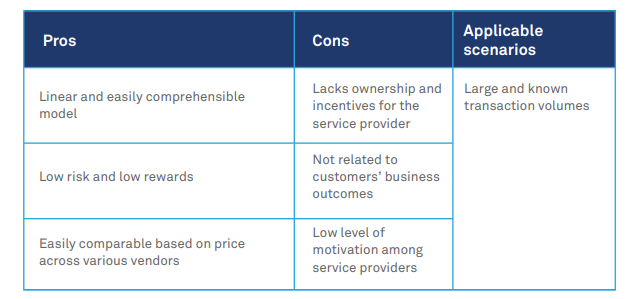
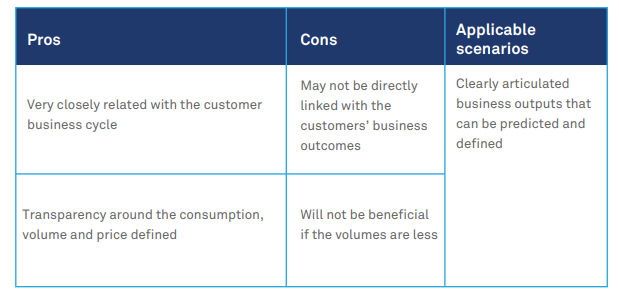
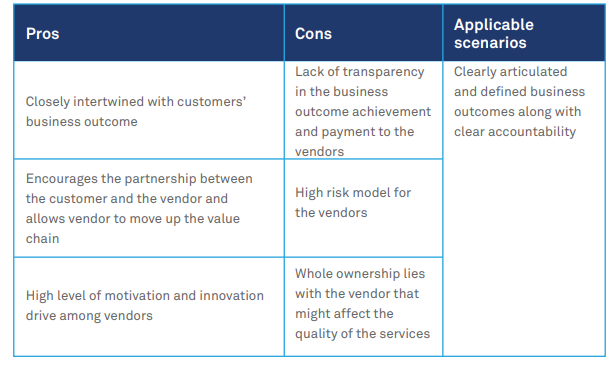
The commercial models that are available today in the industry can be largely divided into three categories, input-based, output-based, and outcome-based.
Input-based pricing model: This model is based on the amount of input provided. This is a traditional pricing model wherein the price that is charged to the customer is based on the FTE’s rates/hour and the number of FTEs provided. This is also called staff augmentation model.