



Your patient support programs are automated, not intelligent. Here’s why that’s a competitive liability and how to fix it.

Medication non-adherence costs the U.S. healthcare system over $500 billion annually. A significant share of that value erosion, in the form of failed outcomes, lost revenue, and diminished brand equity, lands directly on the balance sheets of life sciences companies.

The tools to solve this problem have never been more powerful. Yet, most patient support programs remain reactive, fragmented, and incapable of learning. The reason is not a lack of AI investment; it's a flawed architecture.

Most firms are deploying AI as a channel upgrade: a smarter chatbot, an automated reminder, a better-segmented email campaign. These are tactical efficiencies. They are not transformative. What the market leaders are building is something architecturally different: a unified intelligence layer. This is a central nervous system that sits across the entire patient journey, continuously learning from behavioral, clinical, and engagement data to anticipate needs, personalize interventions, and prove outcomes in real-time.

This is not a technology debate. It is a business model decision. And the companies that make the right architectural choice now will build a competitive moat that point-solution adopters simply cannot cross.

Why a Flawed Architecture Is a Commercial Liability

The stakes are higher than most leadership teams appreciate. When up to 50% of patients with chronic conditions do not take medications as prescribed, it directly undermines the clinical and commercial case for a drug's market position.

Traditional support programs, including reactive call centers and static brochures, were designed for a different era. Today's digitally native patients expect the same hyper-personalized experiences they get from every other industry. The gap between patient expectations and program delivery is widening, creating brand-damaging friction.

Regulatory pressure adds another layer of risk. Health authorities are no longer just asking for clinical trial data; they are demanding real-world evidence of treatment efficacy. Programs that cannot generate this data are not just leaving value on the table. They are exposing the firm to significant regulatory and reimbursement risk.

The Difference Between Automation and Intelligence

An intelligence layer is not a product. It is a strategic design choice.

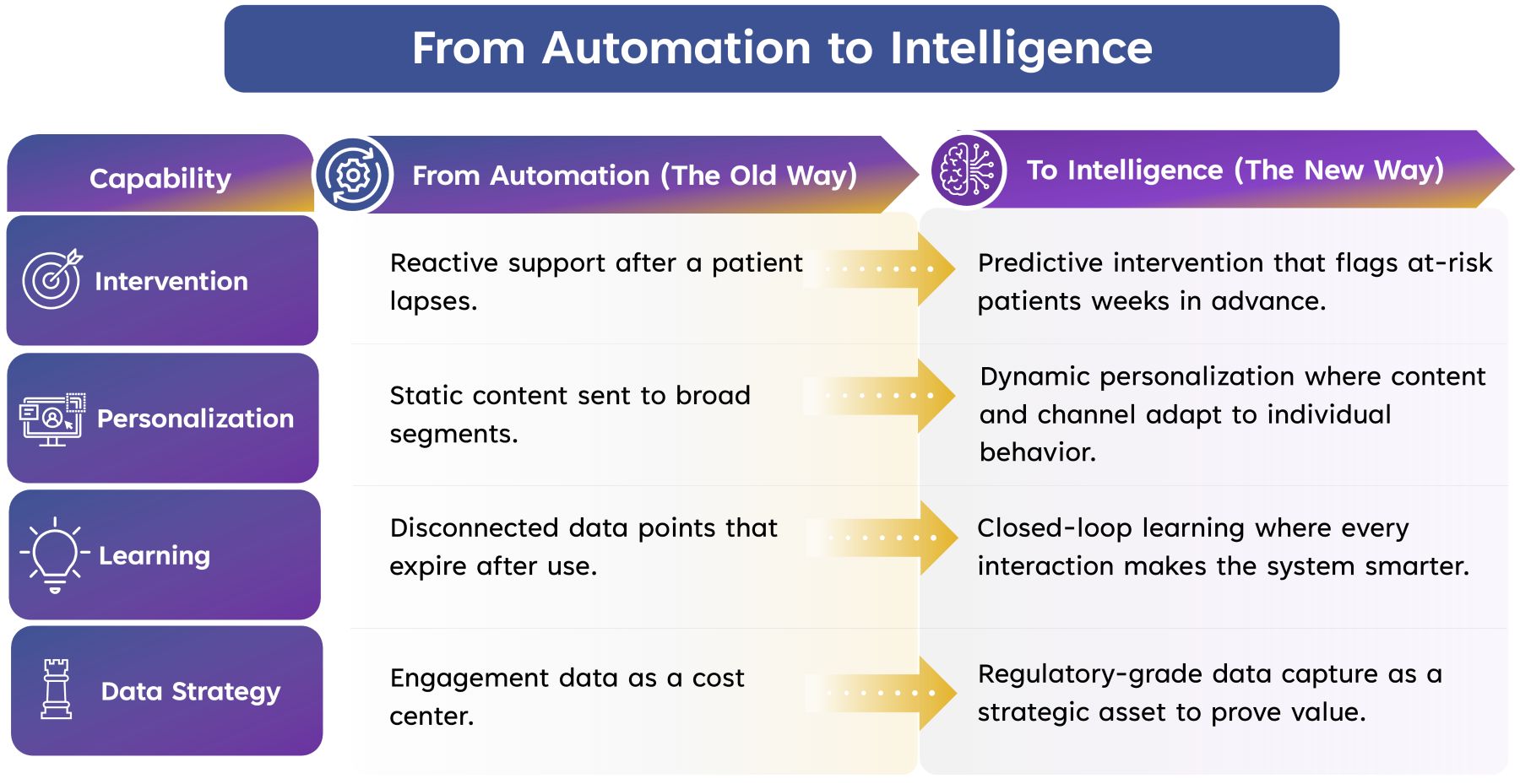
Most organizations operate with siloed AI applications. A predictive tool here, a messaging platform there. Each creates a data puddle. None of them contribute to a unified, adaptive understanding of the patient. This is automation.

An intelligence layer creates a data ocean. It integrates across EHRs, CRMs, and real-world data sources to build a dynamic model of each patient's journey. It doesn’t just respond to patients; it anticipates their needs. The results are a competitive differentiator:

Three Imperatives for Building Your Intelligence Layer

Building this capability is not about buying more software. It requires a clear strategic blueprint. Our work with leading life sciences organizations reveals three non-negotiable imperatives:

1. Unify the Data Foundation First. The most common failure is deploying sophisticated AI on a fragmented data infrastructure. An intelligence layer demands clean, integrated patient data. This is foundational work. Companies that skip it are building on sand.

2. Design for the Patient Journey, Not the Product Lifecycle. Patient support is often organized around a drug's commercial phases (launch, growth). The intelligence layer must be designed around the patient's experience (diagnosis, onboarding, maintenance). This reorientation changes everything.

3. Turn AI Governance into a Competitive Advantage. In a regulated industry, many treat AI governance as a compliance checkbox. Market leaders are inverting this. They build transparent, auditable AI systems that generate trust with patients, providers, and regulators, turning governance into a powerful differentiator.

Proof, Not Theory: Intelligence in Action

Wipro has partnered with global pharmaceutical and biotech organizations to operationalize this approach with measurable business impact.

  • For a global pharma client with a portfolio of chronic disease therapies, our AI-powered intelligence layer drove a 20% improvement in patient satisfaction. More critically, it delivered a statistically significant reduction in non-adherence, directly protecting the revenue base for mature brands.
  • For a specialty biotech firm launching a complex biologic, our omnichannel intelligence architecture was implemented pre-launch. The platform not only reduced patient onboarding time but also generated a continuous loop of real-world evidence that became central to the firm’s successful market access and reimbursement strategy.

In both cases, the differentiator was not an individual tool. It was the strategic decision to build a unified intelligence architecture from the outset.

The Window Is Closing

The life sciences companies that will lead the next decade are not waiting. They are making the architectural decisions today that will determine whether their patient support programs are merely automated or genuinely intelligent.

Automation saves money. Intelligence builds moats.

For senior leaders, the question is not if you should invest in AI. The question is whether your investment is building a compounding strategic asset, or a temporary fix that will need to be rebuilt in three years.

If you are not certain of the answer, that uncertainty is your signal to act.

Wipro Consulting's Life Sciences practice partners with the world's leading organizations to design and build intelligent patient engagement architectures. To explore how this approach can secure your competitive advantage, connect with our experts.

About the Authors

Sanjay Martis
Senior Partner and Head of Life Sciences, North America, Wipro Consulting

Sanjay brings over 30 years of experience in commercial life sciences, both as a practitioner and a consultant. A seasoned senior executive, Sanjay has extensive expertise across the international life sciences sector, including information technology, pharmaceuticals, biotechnology, and medical devices.

Yachna Jatwani
Domain Consulting Partner, Life Sciences, North America, Wipro Consulting

Yachna brings deep expertise in life sciences consulting, with a strong focus on clinical trial optimization, regulatory strategy, and digital transformation. She partners with pharmaceutical, biotechnology, and medical device organizations to accelerate development timelines, enhance patient engagement, and ensure GxP compliance. Her experience spans integrating platforms like Medidata and Veeva, leveraging AI and real-world evidence, and designing impactful Patient Support Programs to deliver safe, effective therapies to market faster.