In the relentless pursuit of offshore resources, geohazards remain formidable obstacles, capable of derailing even the most advanced operations. With most new discoveries now occurring in high-risk offshore basins, the industry requires a smarter approach. A small, specialized language model trained on geohazard data represents a significant leap forward, enabling real-time analysis and predictive capabilities. This point of view highlights how AI-driven solutions can revolutionize hazard management, ensuring safer, more efficient offshore exploration.

Why Current Approaches Are Falling Short

Despite digital investments, upstream operators face persistent challenges:

  • Siloed and Manual Workflows
    Geological, geotechnical, and legislative data are dispersed across systems. Manual interpretation slows decisions and introduces inconsistencies, especially when integrating multimodal data like seismic readings and bathymetric maps.
  • Data Governance and Regulatory Complexity
    Privacy concerns and competitive pressures limit data sharing. Regulatory fragmentation across regions further complicates AI deployment.
  • Infrastructure and Readiness Gaps
    Large Language Models (LLMs) demand high compute power and long training cycles, often incompatible with on-premise infrastructure. Many companies still operate without robust data infrastructure or well-defined governance frameworks.
  • Contextual Misinterpretation and Talent Shortage
    Generic AI models often misread domain-specific context. This is worsened by a shortage of geoscience experts, increasing reliance on immature automation.
  • Operational Pressures
    Volatile oil prices and the urgency of energy transition demand faster project timelines, without compromising safety or cost.

Harnessing Small Language Models for Geo-Hazard Intelligence

To address these challenges, we propose a domain-specific AI framework built on Small Language Models (SLMs). While our previous article outlined the transformative potential of Small Language Models (SLMs) across oil and gas digital workflows, this extension focuses specifically on their application in geo-hazard intelligence, where real-time, context-aware decision-making is paramount. 

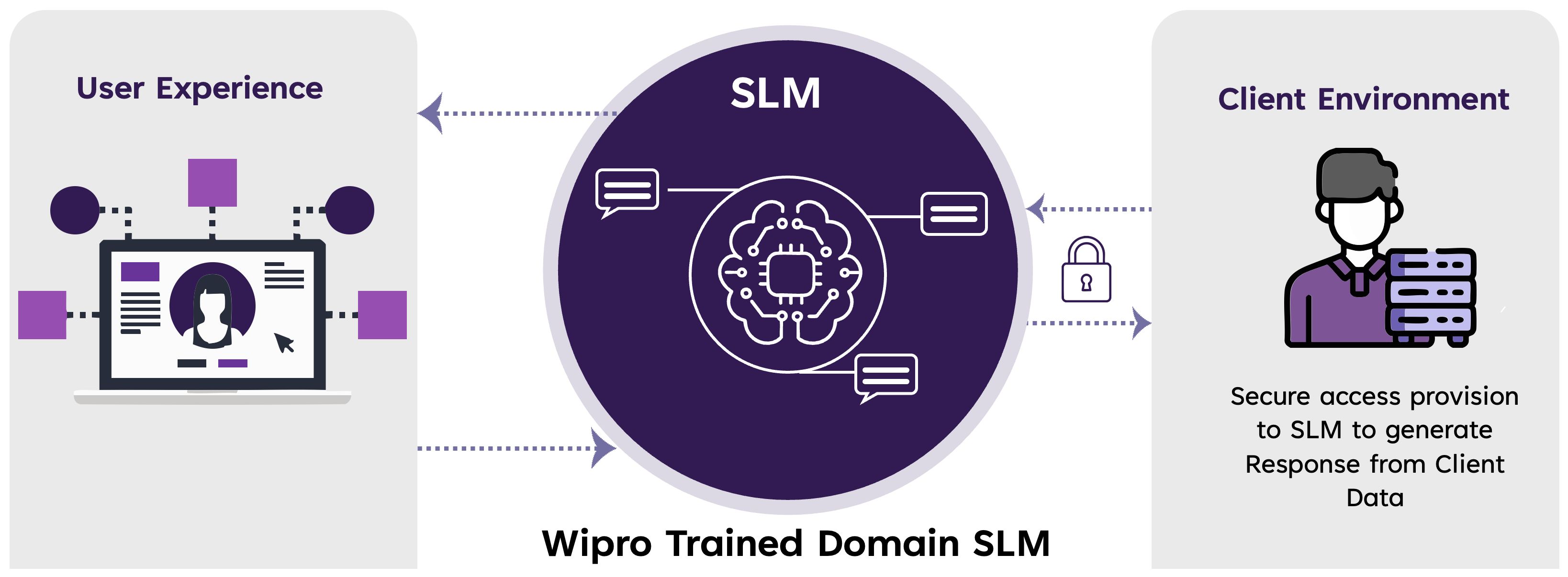
The image below illustrates the architecture and training pipeline of SLMs for geo-hazard risk management. It demonstrates how geoscientists and field operators interact with multimodal inputs. A base Small Language Model (SLM) is initially pre-trained on extensive datasets and then fine-tuned to create a specialized SLM that delivers precise, context-aware responses. This integration of foundational AI with targeted client data enables fast, accurate, and scalable insights for managing geo-hazards in upstream operations.

 SLM-Powered SaaS Workflow for Geo-Hazard Intelligence

Core Capabilities of SLMs
Geo-hazard SLMs are built with specialized features that enable them to process complex data and deliver domain-relevant insights. Below are the key capabilities that make them effective in upstream operations:

  • Domain-Specific Fine-Tuning
    Trained on 10,000+ Q&A pairs across related topics such as geology, gas hydrates, submarine landslides, and regional legislation, SLMs offer deep contextual understanding.
  • Multimodal Processing
    SLMs interpret text, tables, and images, enabling holistic hazard analysis across complex datasets.
  • Retrieval-Augmented Generation (RAG)
    RAG enables real-time synthesis from external sources without retraining, supporting agility and accuracy in dynamic environments.

Strategic Deployment Framework 

Deploying SLMs successfully requires alignment with existing infrastructure and workflows. This section outlines a practical approach to integrating these models in real-world settings:

  • Secure SaaS Integration 
    Begin with a secure SaaS integration to ensure sensitive geological and regulatory data remains secure and compatible with existing systems.
  • Specialized Model Deployment 
    Deploy SLMs to specific domains such as geohazards, drilling, petrophysics, and supply chain management. Intelligent agents coordinate these models to enable cross-domain synthesis and collaborative reasoning.
  • Real-World Implementation
    Initiated as a proof of concept with a Southeast Asia National Oil Company (NOC), the deployment was tailored to local geological and legislative requirements and aligned with client-specific workflows.

In addition to their specified functions, Geo-Hazard SLMs are engineered to support scalable deployment and optimize cost-effectiveness. Developed using Low-Rank Adaptation (LoRA), these models require fewer resources to fine-tune and deploy. A value-based cost estimation framework further supports decision-making by factoring in infrastructure, training effort, and operational impact.

AI-Powered Geo-Hazard SLM in Action

The following use cases illustrate how Geo-Hazard SLMs deliver tangible value across operational efficiency, decision-making, and workforce enablement in upstream oil and gas.

1. Automated Hazard Reporting

Geo-Hazard SLMs simplify the generation of standardized geological risk reports by combining seismic, geotechnical, and legislative data. Instead of relying on manual compilation, the model can ingest raw inputs and documentation, synthesizing them into standardized, traceable reports. This automation not only reduces manual effort but also ensures consistency and clarity across hazard assessments.

Benefits:

  • Faster reporting cycles
  • Improved clarity and traceability
  • Enhanced stakeholder confidence

2. Real-Time Expert Q&A

Through a chat-based interface, Geo-Hazards SLM delivers instant, domain-specific answers to technical queries during planning and operations. Users can ask questions related to geological risks, mitigation strategies, or regulatory compliance, and the model retrieves accurate responses from a curated knowledge base. This capability empowers field teams to make informed decisions quickly without relying solely on centralized experts.

Benefits:

  • Accelerated decision-making
  • Reduced reliance on centralized experts
  • Empowered field teams

3. Customizable Deployment

Geo-Hazards SLM offers flexible deployment options that can be tailored to local geological conditions and regulatory frameworks. The model can be fine-tuned with region-specific data and workflows. This ensures compliance, data privacy, and operational scalability across diverse geographies.

Benefits:

  • Data privacy and sovereignty
  • Alignment with local regulations
  • Scalable across geographies

4. Training & Knowledge Transfer

Designed to support onboarding and upskilling, Geo-Hazards SLM simulates expert-level guidance across workflows, hazard classification, and data interpretation. New geoscience professionals benefit from consistent knowledge transfer, reducing dependency on senior staff and accelerating their ramp-up time.

Benefits:

  • Faster onboarding
  • Consistent knowledge dissemination
  • Reduced dependency on senior staff

Turning Risk into Resilience with SLMs

Geo-hazard risk in upstream oil and gas is no longer a niche concern, it’s a strategic imperative for safe, efficient, and future-ready exploration. As upstream operations expand into deeper and more complex terrains, organizations must evolve beyond traditional hazard management. Small Language Models (SLMs) offer a transformative path forward, enabling faster hazard response, informed decision-making, and scalable resilience. The time to act is now: deploy specialized SLMs and future-proof your operations.

Wipro’s Upstream AI team is currently working on multiple AI-powered solutions that span the upstream value chain, from prospect identification to production. For further details, please get in touch.

About the Authors

Dr. Lakshmikantha Rao Hosur
Senior Partner – Energy, Resources, and Decarbonization

Lakshmikantha (Kantha) has over 20 years of consulting experience related to energy and the energy transition across Europe and North America. He has worked with clients and assets globally. Drawing on his deep knowledge of the energy value chain, Kantha is a strategist with a proven track record for delivering technology solutions — from ideation to go-to-market — and achieving delivery targets through consulting and portfolio management. Kantha holds a master’s degree in Geotechnical Engineering and a PhD in Soil and Rock Mechanics. He has previously worked with Repsol and Schlumberger (SLB) and is based in Amsterdam.

Kumar Nagaraju
Global Head – Upstream AI, Energy, Wipro

Kumar has over 20 years of Consulting and progressive leadership experience, working with some of the largest oil & gas operators and service companies on digital transformation initiatives. He brings a unique blend of techno-functional capabilities, coupled with vast practical experience leading application, technology, data, and infrastructure teams. He excels in developing strategy, implementing solutions, and providing IT operational services. Kumar is dedicated to transforming Upstream Energy Industry by leveraging emerging technologies such as OSDU, cloud, and AI.

Richard Griffiths
Upstream AI Product Manager

Richard has over 30 years of experience in operational data management, data product development, and consulting within the energy industry. He specializes in product management, operational program and project management, and digital business transformation consulting. Richard holds an MSc in Systems Thinking in Practice and has previously worked for Robertson Research and Fugro. He is based in the UK.