


Executive Summary

While the mining industry has heavily invested in digital transformation, fragmented data systems and a lack of interoperability continue to hinder progress, preventing companies from realizing the full return on their technology investments. The solution lies in building a connected data ecosystem with interoperability as a core design principle, which will unify the extraction value chain from exploration to processing. By creating a single source of truth, mining organizations can unlock significant gains in operational efficiency, improve decision-making, and secure a lasting competitive advantage in a rapidly evolving market.

Mining organizations are accelerating digital transformation across the extraction value chain, investing heavily in automation, advanced analytics, and connected systems to unlock efficiency and resilience. Yet, this potential is often unrealized by fragmented systems and poor interoperability, which create data silos that hinder collaboration.

Disconnected platforms trap critical data, leading to costly integrations and manual transfers that demand extensive cleansing and reconciliation. The result? A heavy operational burden that erodes the return on digital investments.

The way forward is clear: make interoperability as a core design principle. Data must flow effortlessly across exploration, planning, operations, and processing. Achieving this in an ecosystem of more than 50 technical service providers, each with proprietary models, demands a standardized, strategic approach rather than ad-hoc fixes.
The Extraction Sequence: Where Data Interdependencies Matter

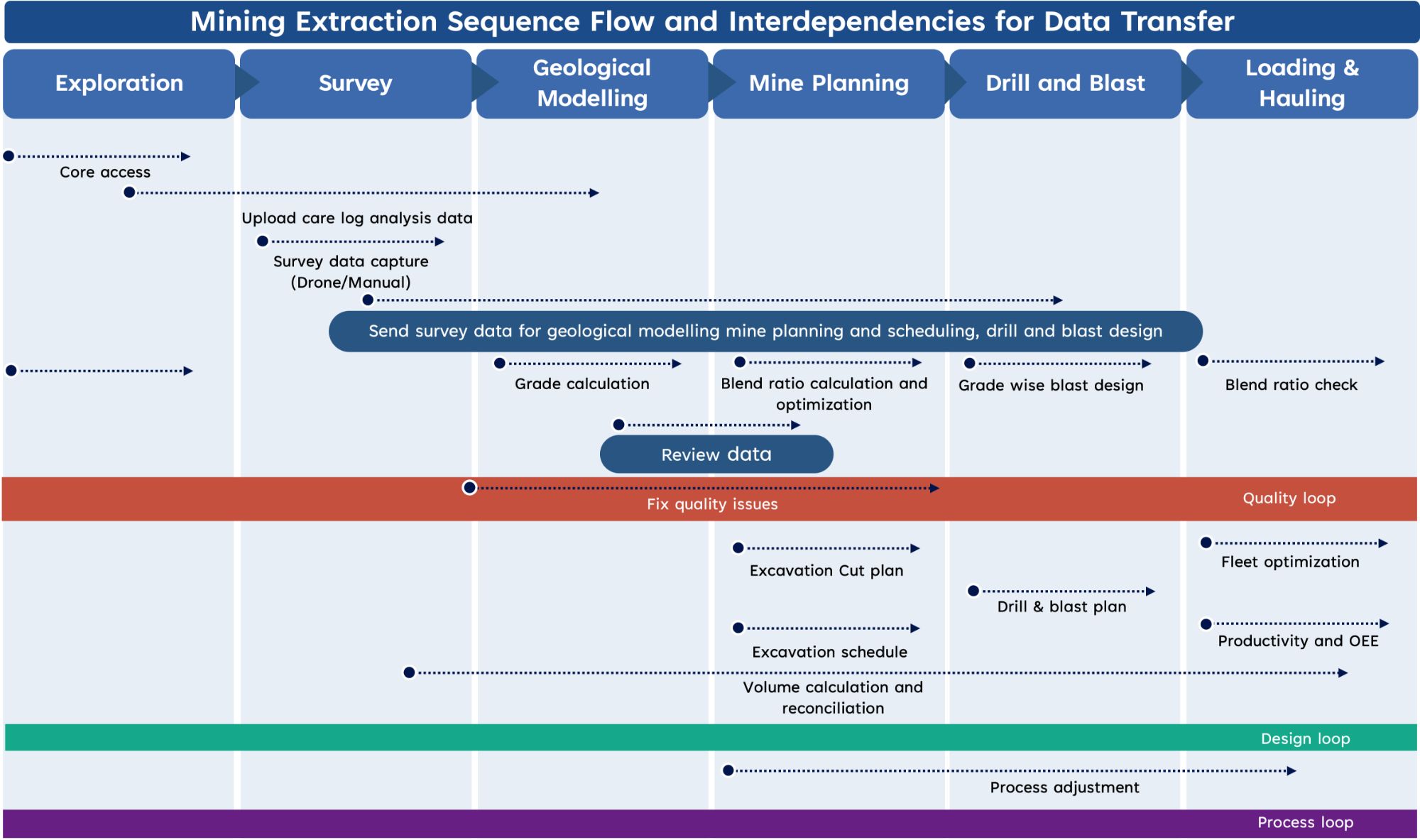
Extracting marketable ore is a multi-stage process:

  • Exploration: Core access, grade assessment, and data logging.
  • Geological Modelling: Uploading core log analysis data, integrating survey data (drone/manual), and grade estimation.
  • Mine Planning: Block design, blend ratio calculation, scheduling, cut plan, excavation schedule, and volumetric reconciliation.
  • Drill and Blast: Blast design, process adjustment, and productivity optimization.
  • Loading and Hauling: Fleet management, productivity, and operational efficiency.

Each stage relies on data from the previous one, making seamless data transfer and quality assurance critical for operational efficiency and recovery.


The Hidden Obstacles in Mining

Despite widespread digitization, mining companies continue to grapple with fragmented systems. These issues manifest in several ways:

  • Manual Data Handling: Core log assessment and data logging are often performed manually in spreadsheets before uploading into geological modelling applications, increasing the risk of errors and inefficiencies.
  • Survey Data Reconciliation: Automated drone data and manual survey data frequently differ, requiring time-consuming reconciliation to ensure accuracy.
  • Grade Estimation Risks: Integrating core log analysis, survey data, and geological modelling data poses risks to mine planning and scheduling, often necessitating iterative manual corrections.
  • Cut Plan Adjustments: Volumetric surveys and shovel productivity data must be reconciled for the next block design, frequently leading to corrections in previously established designs.
  • Blend Ratio Variability: Blend ratio analysis, initially based on core log samples, often proves inaccurate once exposed mineral quality and in-pit samples reveal variations. This discrepancy impacts downstream mineral processing and recovery, potentially leading to valuable mineral loss in tailings.

Building the Digital Core for Future-Ready Mining

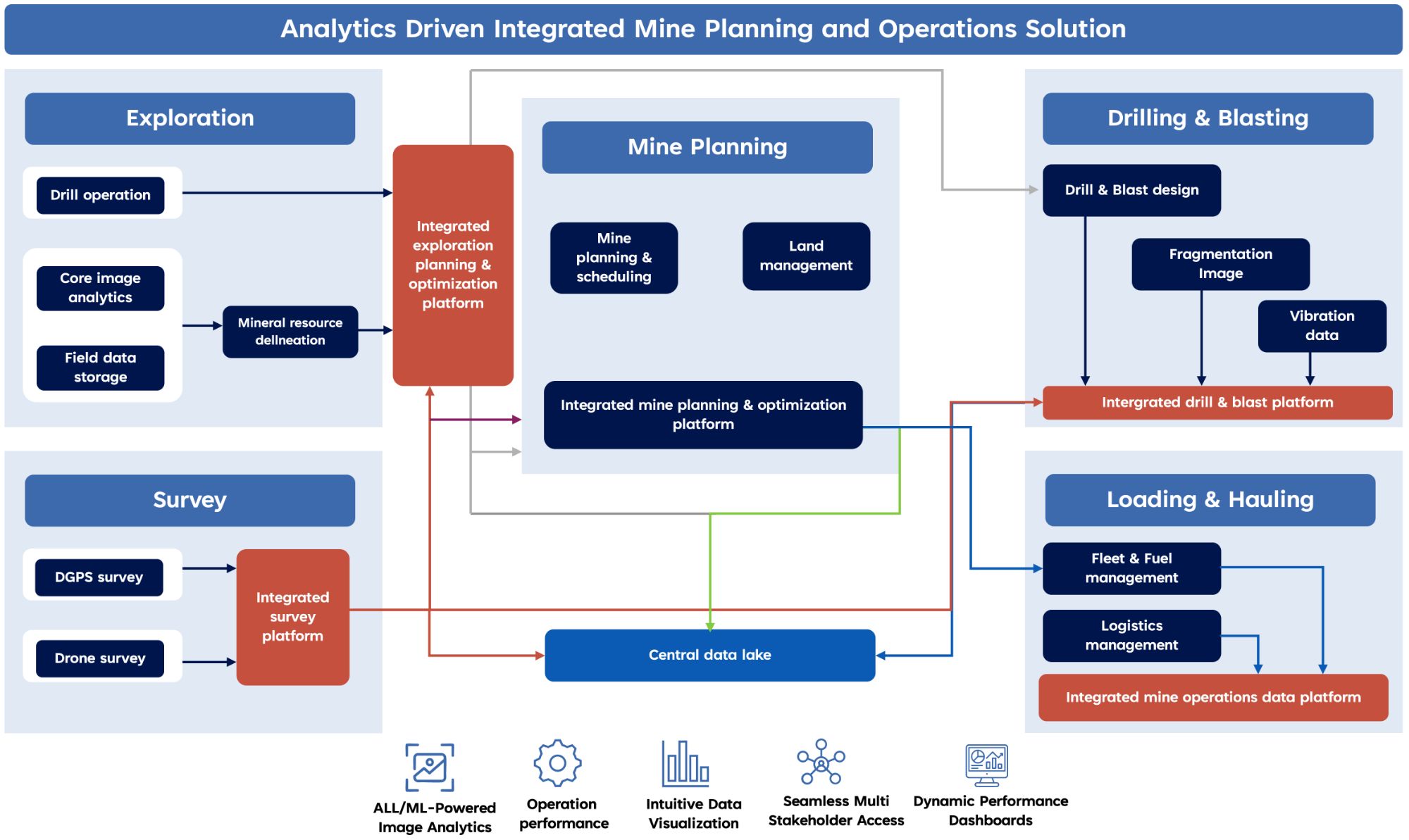
The path forward isn’t adding another tool, it’s orchestrating existing systems through a governed backbone that makes data movement a core capability. By connecting disparate COTS systems, mining companies can enable seamless data flow, minimize manual intervention, and build a unified digital ecosystem that drives measurable improvements:

  • Single Source of Truth: Data is entered once and shared across all relevant systems, ensuring consistency and accuracy.
  • Automated Workflows: Routine processes such as data validation, reporting, and compliance checks can be automated, freeing up staff for higher-value activities.
  • Enhanced Decision-Making: Real-time data integration provides management with holistic insights, supporting timely and informed decisions.
  • Improved Compliance and Auditability: Integrated systems make it easier to track and document processes, supporting regulatory compliance and audits.
  • Future-Ready Architecture: Central data lake forms the foundation for organization-level advanced analytics and the deployment of AI agents, enabling dynamic operational simulations for aligned decisions across technical and financial teams.

The Four Pillars of Mining Integration

Sustainable integration starts with clear principles—design for interoperability, prioritize quality, ensure explainability, and make simulation a routine practice.

  • Interoperability by Design: Define canonical data structures and event exchanges first. Connect applications to the backbone rather than chaining tools to one another.
  • Quality Before Speed: Automate validation and reconciliation (e.g., drone vs. ground survey deltas, model variances) so downstream plans inherit fewer defects.
  • Explainability and Trust: When agentic AI suggests adjustments, capture provenance (data sources, rules, constraints) to sustain planner control.
  • Simulation as a Habit: Use dynamic operation simulation to test blast designs, haul routes, and blend strategies before execution, aligning technical, operational, and financial stakeholders.

The Payoff: How Integration Transforms Mining Performance

Applying these principles delivers faster data workflows, improved planning accuracy, and measurable gains in productivity and cost efficiency across operations

  • Exploration: Agile data ingestion reduces time for core log mapping, data analysis, and generating log profiles for modelling by 10–15%. Improved operational performance enhances exploration drilling resource utilization.
  • Survey: Survey turnaround time is reduced by 2–3x with AI agents analyzing drone data. Improved survey planning enables more frequent surveys and cost efficiencies.
  • Mine Planning: 10–15% increase in plan adherence to business objectives. 2–5% improvement in Heavy Earth Moving Machinery (HEMM) productivity and utilization via optimized scheduling and dynamic planning. 20–40% reduction in time to prepare short-term operational plans.
  • Drill & Blast: Achieving 5–10% improvement in powder factor and explosive utilization per ton. 30–40% reduction in re-drilling when blast design leverages integrated survey and block design data.
  • Loading & Hauling: 3–7% improvement in load-and-haul cost metrics. 7–12% improvement in HEMM productivity across cycle times.

The Integration Advantage: A Gold Mining Success Story

A leading Middle Eastern precious metal miner launched a digital transformation to unify exploration, planning, and operations through an integrated platform. By connecting tools like GEOVIA Surpac, Leapfrog Geo, Datamine Fusion, and SimBlast, the company automated lab analysis, improved geological modeling accuracy, and streamlined blast design inputs.

The initiative streamlined the data flow across siloed activities in exploration, quality, geological modelling, and mind planning to create a unified source of information for all stakeholders, which removed data redundancy and increased accuracy.

A custom web-based survey system integrated drone and fleet data, cutting volume reconciliation turnaround by 50% and creating a single source of truth in a central data lake. This approach strengthened collaboration, simplified document management, and boosted the accuracy and agility of mine planning, advancing the miner’s shift to a resilient, data-driven operating model.

Integration: The Key to Mining’s Future

For mining companies seeking to maximize the value of their ISV solution investments, integration is no longer optional but essential. An integrated mining solution streamlines operations, reduces manual workload, and empowers organizations to make data-driven decisions, remaining competitive in an evolving industry. By embracing integration, mining companies can unlock new levels of efficiency, accuracy, and strategic advantage. The journey toward integrated extraction is not about adopting a single solution, but about building a resilient, interoperable ecosystem that supports continuous improvement and future-readiness.

About the Authors

Pallab Kumar Saha
Partner – Mining & Metals, Wipro Limited

Pallab leads Wipro’s global Operations Improvement Practice as part of the Natural Resources vertical and has extensive experience in creating, designing, and implementing operational improvement solutions for mining and metals customers. He has a strong background in Mining and Metals digital transformation and operational excellence. Pallab has deep expertise in operational systems such as MES (Manufacturing Execution Systems) and in leading data science initiatives and analytics for these systems. With global experience, Pallab has worked on projects across Australia, South Africa, Russia, Brazil, India, Canada, the USA, France, and the Middle East.

Sudip Chaudhuri
Global Practice Head – Mining, Wipro Limited

Sudip Chaudhuri heads the Mining Practice for the Energy, Natural Resources, and Utilities business unit at Wipro. With over 23 years of diverse information technology experience in mining and mineral processing, Sudip has worked with numerous clients in the mining and minerals industry on transformational and advisory assignments, designing end-to-end programs. With deep domain expertise across the mining supply chain and execution, Sudip has effectively applied new technologies to improve productivity and safety in mining operations.

Sidharth Mishra
VP, Managing Partner – Energy & Sustainability, Wipro Limited

Sidharth leads Wipro’s Energy Manufacturing & Resources industry capabilities and consulting business globally. He has 30 years of experience in the energy industry across corporate strategy, downstream planning and operations, shipping & trading operations, and consulting. He advises clients on operational excellence, customer centricity and sectoral decarbonization using digital and data driven capabilities. He regularly speaks in industry forums on decarbonisation approaches, energy transition imperatives, talent transformation, and AI adoption with industry specific SLMs. He has shaped and delivered significant structural cost reduction initiatives in technology and operations across multiple archetypes of businesses and with rapidly evolving operating models.