



A Critical Moment for Insurers

The insurance industry is at an inflection point. Rising customer expectations, advances in AI, and the rapid growth of the insurtech ecosystem are forcing insurers to fundamentally rethink how they operate — not just at the edges, but at the core.

The pressure is real and compounding. Customers now expect seamless digital experiences as standard. Competitors — including digitally native challengers — are raising the bar on speed, personalization, and service. And regulators are adding complexity faster than most legacy platforms can absorb. The insurers pulling ahead aren't necessarily the largest or most established. They are the most adaptable.

At the heart of this adaptability is a shift in architecture: from monolithic, closed systems to modular, API-first platforms that allow capabilities to be plugged in, swapped out, and scaled without overhauling the entire stack.

Why the Pressure to Change Is Intensifying

Several converging forces are accelerating the need for transformation.

  • Customer experience has become a competitive differentiator. Insurers like USAA and Lemonade have demonstrated that intuitive, digital-first interactions drive loyalty and reduce churn. The bar for what "good" looks like has moved permanently.
  • The insurer's role is evolving — from payer to partner. Leading carriers are moving beyond transactional relationships, offering proactive risk management, wellness incentives, and personalized guidance. This isn't just a marketing shift; it requires fundamentally different operating capabilities.
  • Cloud and AI are now table stakes. What were once differentiating capabilities are now baseline infrastructure choices. Real-time data flows, AI-driven underwriting, predictive claims management — these are no longer future-state ambitions. They are operational requirements for staying competitive.
  • Insurtech integration is reshaping the value chain. Rather than building every capability in-house, forward-thinking insurers are assembling ecosystems of specialized partners — from telematics providers and fraud detection platforms to digital onboarding and embedded insurance solutions.

Underlying all of this is a structural reality: insurers have relatively few direct touchpoints with customers. Every interaction — a quote, a renewal, a claim — is a high-stakes moment. Getting these right requires systems that are fast, flexible, and deeply integrated.

The Constraints Holding Insurers Back

Even insurers who have modernized parts of their technology stack face persistent friction. The most common obstacles aren't technical in isolation — they are structural.

Many carriers are managing multiple core systems accumulated through acquisitions and organic growth, with policies scattered across platforms and integration becoming increasingly complex. Others find that even relatively modern cores struggle to connect with today's insurtech solutions and emerging technologies. Operational efficiency pressures are intensifying, while skill gaps in heavily customized legacy environments make maintenance increasingly difficult and expensive.

Perhaps most consequentially, new business models — particularly embedded insurance and usage-based products — demand a level of speed and modularity that traditional architectures simply weren't built to support.

Modernization, in this context, isn't just a technology decision. It's a business viability imperative.

Modern Core Platforms: From Systems of Record to Digital Backbone

Core system replacement remains a top priority for insurance CIOs, and the market reflects this urgency — with an estimated 6–7% CAGR between 2026 and 2030.

Modern core platforms have evolved well beyond traditional policy administration. Today's leading platforms function as a digital backbone for transformation — enabling insurers to consolidate fragmented legacy estates, launch products faster, reduce total cost of ownership through SaaS models, and power AI-driven decision-making through real-time data flows.

Critically, open APIs and microservices architecture allow insurers to integrate ecosystem partners without destabilizing core operations. This is the foundation of the plug-and-play model: stable at the core, fast and flexible at the edges.

In practice, the most capable platforms now offer end-to-end policy management, billing, claims, and pre-built integration APIs as baseline capabilities — with agent and policyholder portals, analytics dashboards, and third-party marketplaces increasingly becoming standard expectations rather than premium add-ons.

Ecosystem Advantage: Insurtech as a Strategic Multiplier

The insurer of tomorrow won't be defined by the systems it owns — but by the ecosystems it orchestrates.

Plug-and-play partnerships are enabling insurers to innovate at a pace that internal development alone cannot match. Cloud-native, API-driven, and low-code solutions allow business teams to launch new products and integrate specialized capabilities without lengthy IT cycles. The result is a faster, more responsive operating model that can adapt as markets shift.

These partnerships are also unlocking new business models. Embedded insurance — offering coverage seamlessly at the point of sale — is growing rapidly, as are wellness-linked incentives, subscription-based products, and IoT-enabled risk prevention. Across the value chain, from underwriting and sales to servicing and claims, insurtechs are delivering meaningful improvements in turnaround times, fraud detection, personalization, and customer engagement.

The strategic implication is significant: ecosystem participation is no longer optional. It's how leading insurers are building durable competitive advantage.

Implementation: Treat This as Business Transformation, Not a Technology Project

Successful modernization programs share a common characteristic — they start with business outcomes, not technology choices.

The most effective approaches are built on five principles:

  1. Business-first vision — anchored in growth, efficiency, and customer experience outcomes, not platform features.
  2. Composable architecture — using microservices, APIs, and event-driven design to keep the core stable while enabling rapid change at the edges.
  3. Data as a foundation — establishing integration, governance, and analytics capabilities early, not as an afterthought.
  4. Cloud and DevSecOps enablement — to support continuous delivery, scalability, and security by design.
  5. Governance and change management — with clear KPIs, agile delivery, and investment in workforce capability.

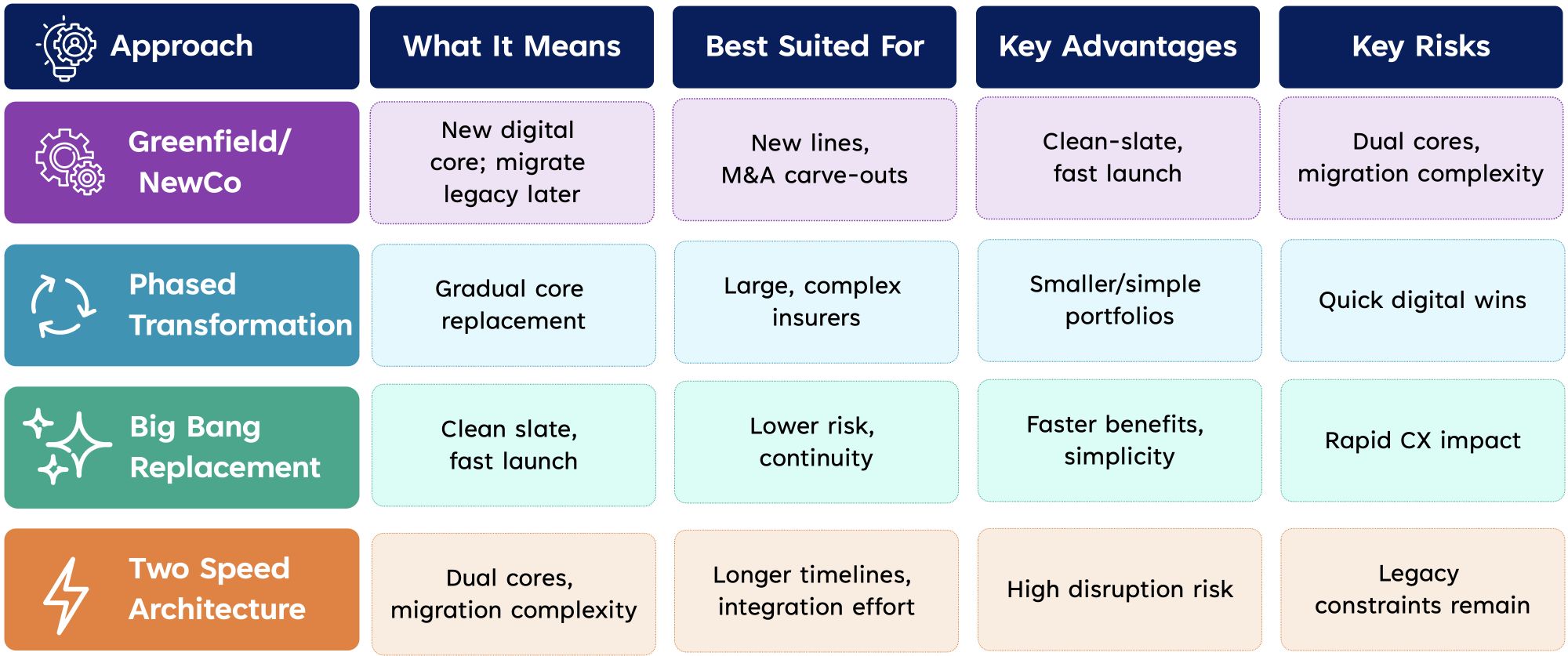
There is no single path. Insurers choose between full replacement, hybrid, or incremental modernization based on their scale, complexity, and risk appetite. What matters most is having a clear-eyed view of the current landscape, the target state, and the sequence of moves that will get you there.

Making Partnerships Work

Ecosystem participation creates value only when the fundamentals are in place. Insurers that move fast without this clarity risk accumulating partnerships that generate spend without measurable outcomes.

Four things must be clear before committing:

  • Business priorities: Where does improvement matter most — underwriting, claims, analytics? Start there.
  • Partner discipline: Vet providers on proven implementations, cost structure, scalability, and support — not just product demos.
  • A defined value model: Set measurable outcomes from the start. If you can't track it, you can't manage it.
  • Skill readiness: Ensure your operating model can sustain the ecosystem — don't create capabilities that remain permanently dependent on scarce external talent.

On the technology side, two foundations are non-negotiable: API-based architecture to integrate and modularize capabilities, and security by design to protect data as it flows across providers and platforms.

The Way Forward

Core platform transformation is a marathon of strategy, not a sprint of technology. The destination is increasingly clear: a modular, business-led, ecosystem-ready foundation that supports both operational efficiency and long-term agility.

When executed with the right architecture, governance, and culture, modern core platforms stop being systems of record — and become systems of innovation and growth.

Given the scale and complexity of this journey, many insurers choose to work with experienced transformation partners who bring structure, reusable assets, and implementation expertise to programs that must balance speed with safety.

About the Authors

Anurag Mishra
Partner, Wipro Consulting

Anurag Mishra brings over 30 years of strategic consulting and advisory leadership in the global insurance industry, with deep expertise across Life, Property & Casualty, and Healthcare segments. He has successfully led transformative initiatives encompassing digital strategy, core platform modernization, and operational excellence. Anurag’s experience spans solution architecture, vendor governance, and stakeholder engagement, driving high-impact consulting programs across the US, UK, Australia, and Asia-Pacific markets. As a trusted advisor, he has established Centers of Excellence (CoEs) and Communities of Practice (CoPs), fostering innovation and knowledge sharing. He spearheaded the creation of the Business Analysis CoE (BACOE) and directed end-to-end management of business functions across the insurance value chain. Leveraging his strong consulting acumen, Anurag has program-managed complex insurance practices, applying deep domain expertise to deliver scalable, future-ready solutions that enable clients to achieve strategic business outcomes.

Ashutosh Dixit
Senior Manager, Wipro Consulting

Ashutosh is a Senior Manager with Wipro Consulting, bringing over 12 years of experience working with insurance clients across specialist and cross functional roles. He has led and supported engagements spanning process automation, business analysis, and digital initiatives such as portal reimagination, helping insurers modernize operations and enhance customer experiences.