



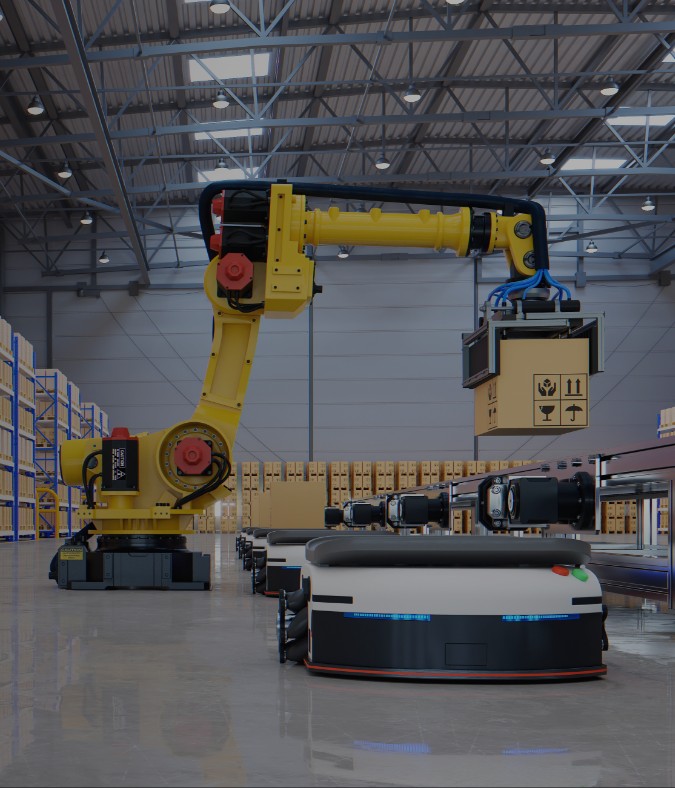

Most automated warehouses are not one system but several — AMRs from one vendor, a piece-picking arm from another, conveyors from a third, and a warehouse management system coordinating them through brittle point-to-point integrations. Each island is optimized on its own; the warehouse as a whole is not. The cost shows up at the seams: robots idling on hand-offs, peak volume the fleet can't flex to absorb, and a change to one vendor's stack that ripples into weeks of re-integration.
Why Physical AI Powered Warehouse & Intralogistics Automation Matters
Treating the floor as one heterogeneous fleet — Autonomous Mobile Robots (AMRs), manipulators, and human pickers under a single orchestration layer — lets work go to whichever resource is best placed to do it, moment to moment. Built around interoperability standards such as VDA 5050, a new robot type becomes an adapter, not a rip-and-replace.
Benefits of Multi-Robot Warehouse Orchestration
- Higher utilization: The orchestrator assigns work across the whole fleet, so robots keep moving instead of waiting on a hand-off.
- Flex for peaks: Add mixed units into the same pool to absorb seasonal volume — no re-platforming the floor.
- No vendor lock-in: Buy the best AMR, arm, or sensor as it appears; the orchestration layer, not the OEM, owns coordination.
How Wipro Delivers Intelligent Warehouse Automation Solutions
Wipro deploys the Heterogenous Multi-Robot (HMR) Orchestration layer over the existing and new estate, connecting each platform through vendor-neutral adapters and presenting the floor as one controllable fleet. Task allocation, traffic management, and human-in-the-loop exceptions run centrally, integrated with — not replacing — the WMS/WES. New workflows and layouts are rehearsed in the facility's Bidirectional Digital Twin before they touch live operations, and the estate is sustained under RoboOps so throughput holds up well past go-live.
Offerings drawn on: HMR Orchestration · Bidirectional Digital Twin · Sim2Real · RoboOps