



The Carbon Removal Challenge: Why Sorbent Discovery Matters
Climate targets cannot be met by cutting emissions alone — some carbon will need to be pulled back out of the atmosphere altogether, and permanently. Direct Air Capture (DAC) is one of the few technologies built to do exactly that, and a DAC sorbent is what makes it work: the special material inside a DAC machine that grabs carbon dioxide (CO₂) from the air, much like a sponge soaks up water — then releases it under gentle heat so it can be stored safely and the material reused. This matters more than ever: the world captures only about 0.01 million tonnes of CO₂ this way today, yet climate targets call for close to 1,000 million tonnes a year by 2050 — nearly a 100,000-fold jump in 25 years. Removal also costs roughly $600–$1,000 per tonne today, far above the $100 level seen as the tipping point for wider use.
Quantum computing is emerging as a way to close that gap: it can predict how a candidate material will behave with far greater accuracy before a single physical sample is made, giving discovery teams confidence sooner and giving buyers confidence that supply will scale on schedule and at a viable cost. Getting sorbent discovery right, and faster, will decide whether this technology becomes a mainstream climate solution for both groups, or stays costly and niche. For enterprises specifically, this is a competitive question as much as a climate one: the company that gets there first builds a durable cost advantage, meets its commitments on schedule, and becomes the partner governments and investors turn to as carbon-removal infrastructure scales — while slower rivals are left to catch up.
Understanding the Direct Air Capture Ecosystem
Two groups of companies sit on either side of DAC's central bottleneck: the sorbent itself. Materials innovators and DAC technology developers are racing to find the sorbent that captures CO₂ cheaply and reliably at scale — but today's classical solvers aren't always accurate, so they often test many materials by trial and error, wasting years and millions of dollars. Enterprises and corporates with net-zero and carbon-credit commitments sit on the other side: they depend on that first group succeeding, since slow or unreliable sorbent discovery means scarcer, pricier carbon removal just as regulatory deadlines and investor expectations arrive.
In practice, on one side of this market are the builders: companies racing to prove that direct air capture can run at scale and at a reasonable cost. Climeworks is scaling modular plants that depend on sorbents holding up over many capture-and-release cycles, while Carbon Engineering and 1PointFive run large liquid-based capture facilities such as STRATOS in Texas, where the energy needed to release CO₂ is the single biggest driver of cost. Government-backed programmes are reinforcing the same bet: U.S. Department of Energy-funded regional hubs, including Project Cypress and the South Texas Hub, are targeting costs below $100 per tonne, a goal that hinges almost entirely on better capture materials. For all of them, the sorbent — not equipment design or plant siting — is the real barrier to lower cost, and every improvement in how well it grabs CO₂, resists moisture, and releases it using less energy means fewer failed experiments and a lower cost per tonne removed.
On the buyer side, that dependency is already visible in the market. Frontier — backed by companies including Google, Stripe, Shopify, and Microsoft — pools corporate demand to prepurchase durable carbon removal, including DAC, precisely so its members can meet net-zero commitments on schedule rather than hope supply materialises in time. Their confidence depends entirely on the builders' progress: the same cost curve that determines whether a DAC plant is commercially viable also determines how affordably enterprises can meet their own net-zero and carbon-credit commitments.
The Quantum Advantage in Sorbent Discovery
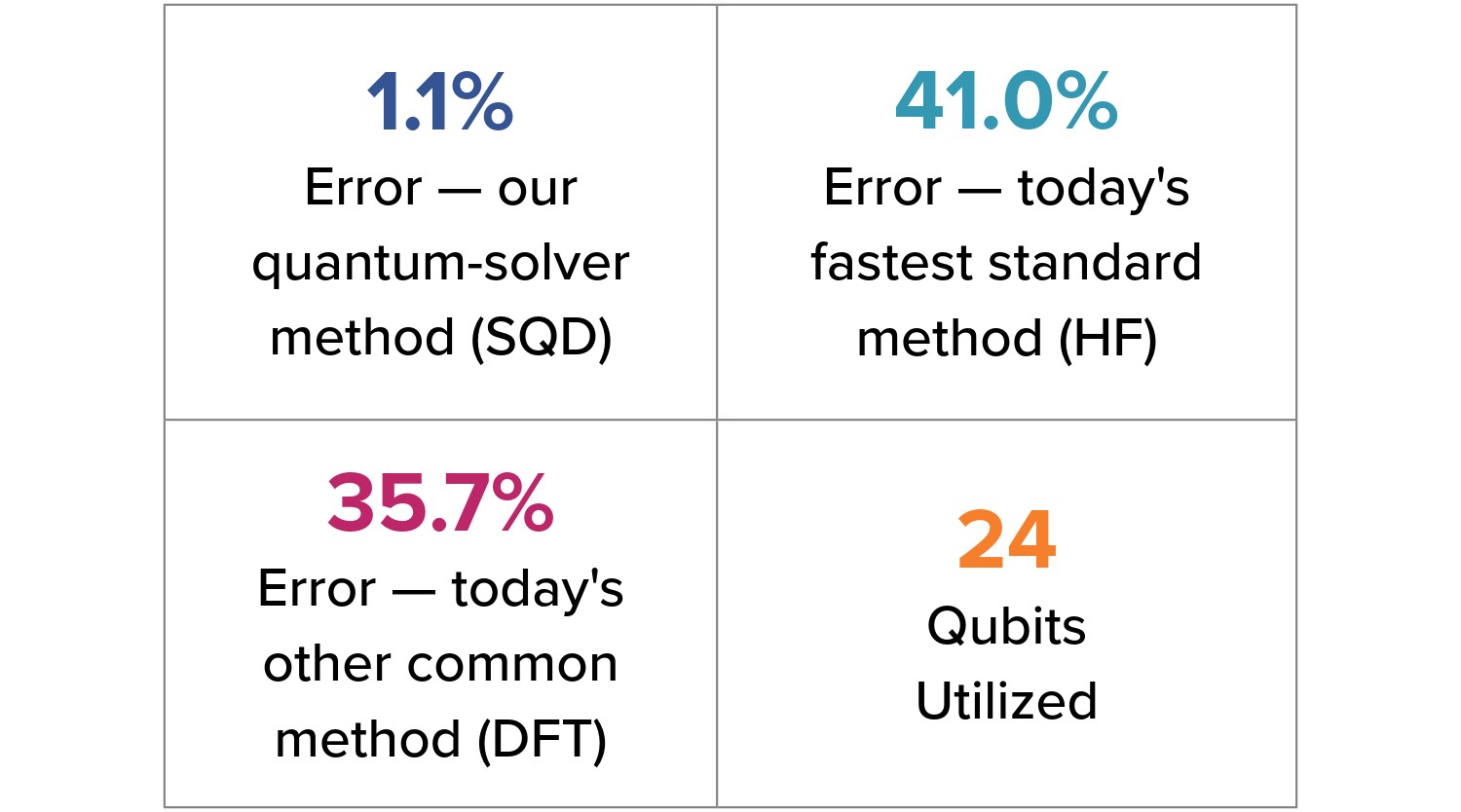
Quantum computing's core strength lies in modelling the behaviour of electrons — the tiny particles behind how atoms bond, and the very thing that determines how well a material captures and releases CO₂. This is genuinely hard to predict with today's classical solvers.
As introduced earlier, quantum computers are naturally suited to this specific problem — not a replacement for today's tools, but an extra, high-confidence layer applied exactly where prediction accuracy matters most.
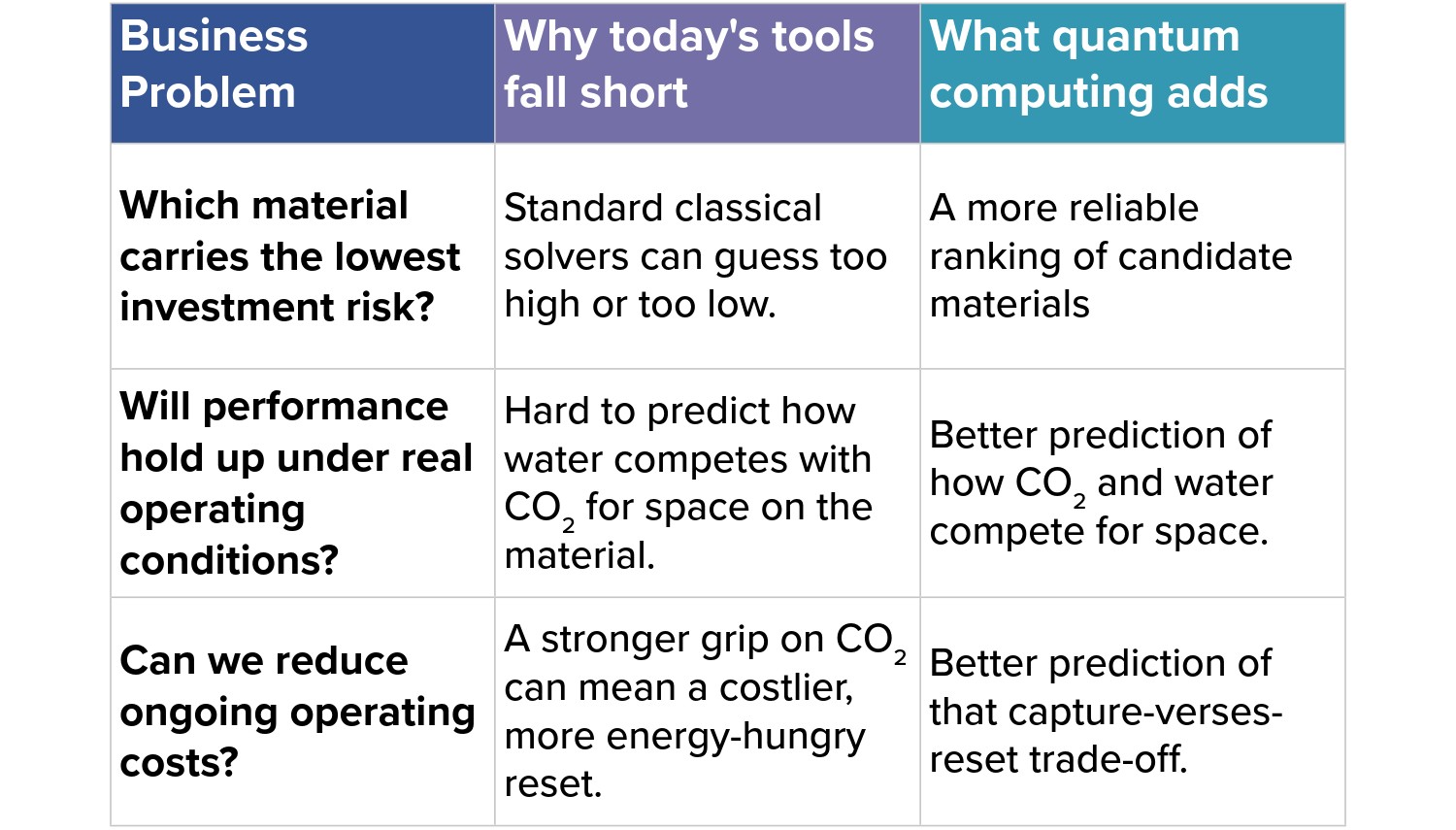
The table below shows where this extra layer of computing power adds the most value: