




Executive Summary
Fraud detection remains one of the most complex and business-critical challenges for enterprises operating at digital scale. Across industries such as financial services, insurance, retail, and digital platforms, organizations are managing increasing exposure to transactional and identity-related fraud risks. As fraud patterns increase in complexity and become harder to model using traditional statistical learning techniques, existing approaches are beginning to encounter structural limits. At the same time, customer tolerance for friction and false declines continues to fall, creating a growing need for new approaches to fraud risk management,
Emerging computational paradigms such as quantum-inspired machine learning (QML) offer a potential path forward—enabling the modelling of high-dimensional, weakly correlated fraud signals in ways that classical systems often struggle to capture. While still evolving, these approaches signal a broader shift in how enterprises may approach complex decisioning problems in the future.
As part of a strategic initiative, Wipro’s Technology Office, in collaboration with our Banking, Financial Services, and Insurance (BFSI) Risk & Compliance Consulting team, explored this frontier to identify the quantum worthy use case and assess the potential of QML techniques to extend fraud detection performance beyond the limits of classical machine learning. Drawing on insights from client engagements, the expertise of Wipro’s domain practitioners, and the quantum engineering capabilities of Wipro’s Quantum Centre of Excellence (CoE), we detailed out the approach for this experiment.
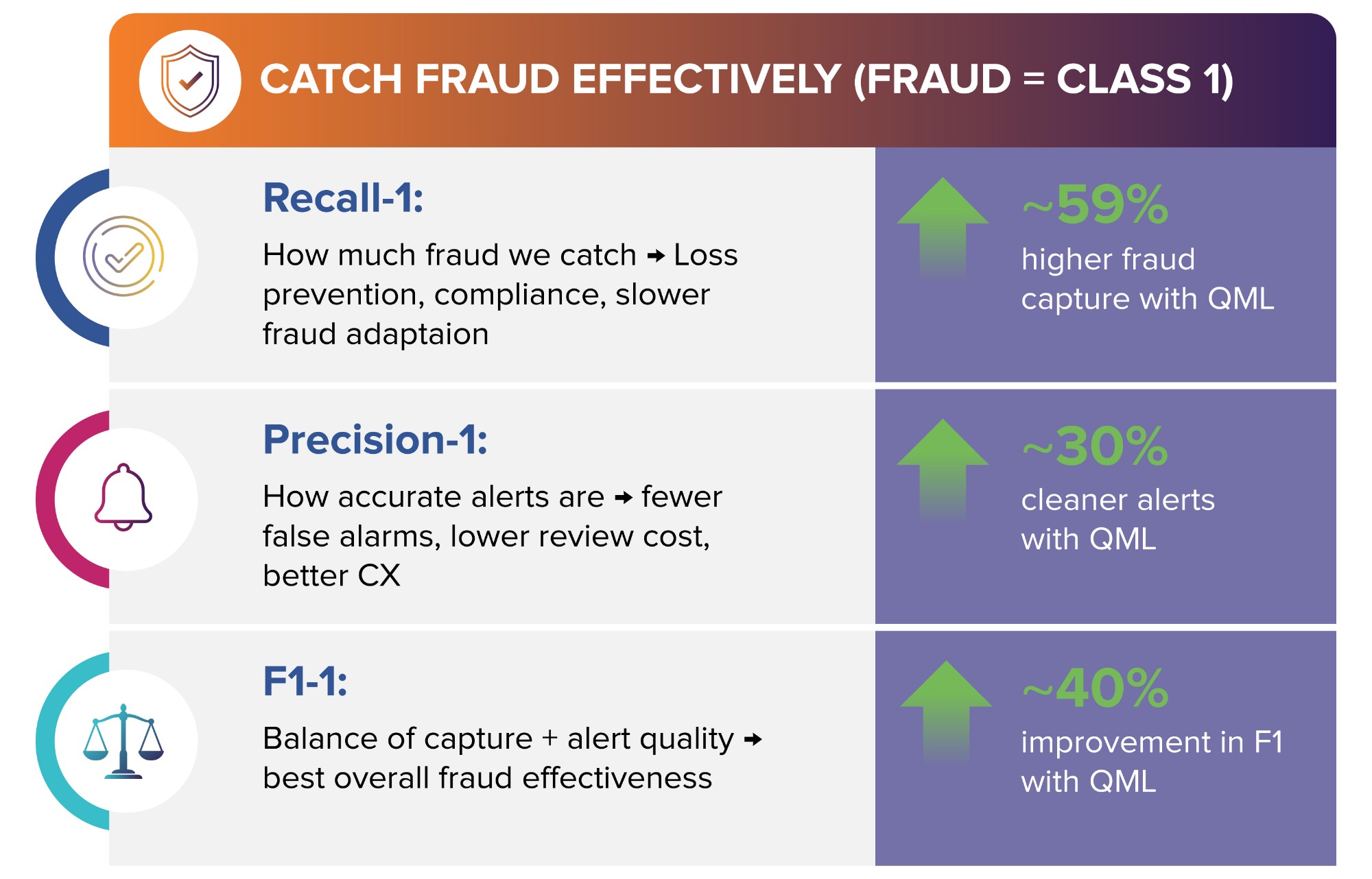
The evaluation demonstrated that a hybrid classical–quantum approach can improve multiple fraud detection metrics simultaneously. Results showed up to 20 percent relative uplift across key fraud metrics, with an overall accuracy improvement of 34 percent compared to a classical baseline. These outcomes provide a directional view of how hybrid classical–quantum models may be applied in fraud detection. They indicate potential to strengthen fraud risk management while reducing trade-offs between detection accuracy and customer experience.
1. Setting the Stage
Fraud has emerged as a key risk priority for organisations across industries, with increasing attention at the board level. Compliance and risk functions are therefore investing in more effective approaches to detect and mitigate fraudulent activity.
Fraudulent transactions are often designed to resemble legitimate behaviour, making them difficult to detect using historical patterns alone. Fraud signals are typically rare, weakly correlated, and embedded in high-dimensional transaction data.
From a business perspective, the impact is significant. Global fraud losses are estimated to exceed USD 50 billion annually and continue to grow at double digit rates, with some segments experiencing losses about 20 percent year over year.
Merchants lose approximately 3% of total revenue to fraud on average, highlighting the material business impact beyond isolated fraud incidents.
False positives remain a low single-digit share of transactions but are a major driver of customer friction, declined legitimate transactions, and lost revenue.
The total cost of fraud extends significantly beyond direct losses. When investigations, chargebacks, and operational overhead are included, the overall economic impact can be two to four times the direct fraud loss.
Enterprises therefore face a dual mandate: improving fraud detection to reduce financial loss and risk exposure, while maintaining a consistent and frictionless customer experience.
2. Limits of Classical Machine Learning
Classical machine learning approaches such as gradient boosting, logistic regression, and deep neural networks have delivered meaningful improvements in fraud detection over the past decade. However, several structural limitations are increasingly evident.
One recurring challenge is class imbalance. Fraud represents a small fraction of total transactions, which can bias models towards non-fraud outcomes and limits their ability to learn emerging fraud patterns. As a result, models may struggle to detect rare or evolving fraud patterns.
In addition, many fraud patterns depend on subtle interactions across multiple features. Capturing these relationships using classical models typically requires extensive feature engineering and tuning, increasing model complexity and the risk of overfitting.
There is also an operational constraint. Improving fraud recall often increases false positives, leading to higher investigation costs and potential customer disruption. Many classical models struggle to meaningfully shift this precision-recall balance.
Taken together, these factors suggest the presence of a performance ceiling in classical models, where further improvements become incremental, increasingly complex, and cost-intensive.
3. Quantum-Enhanced Machine Learning Approach
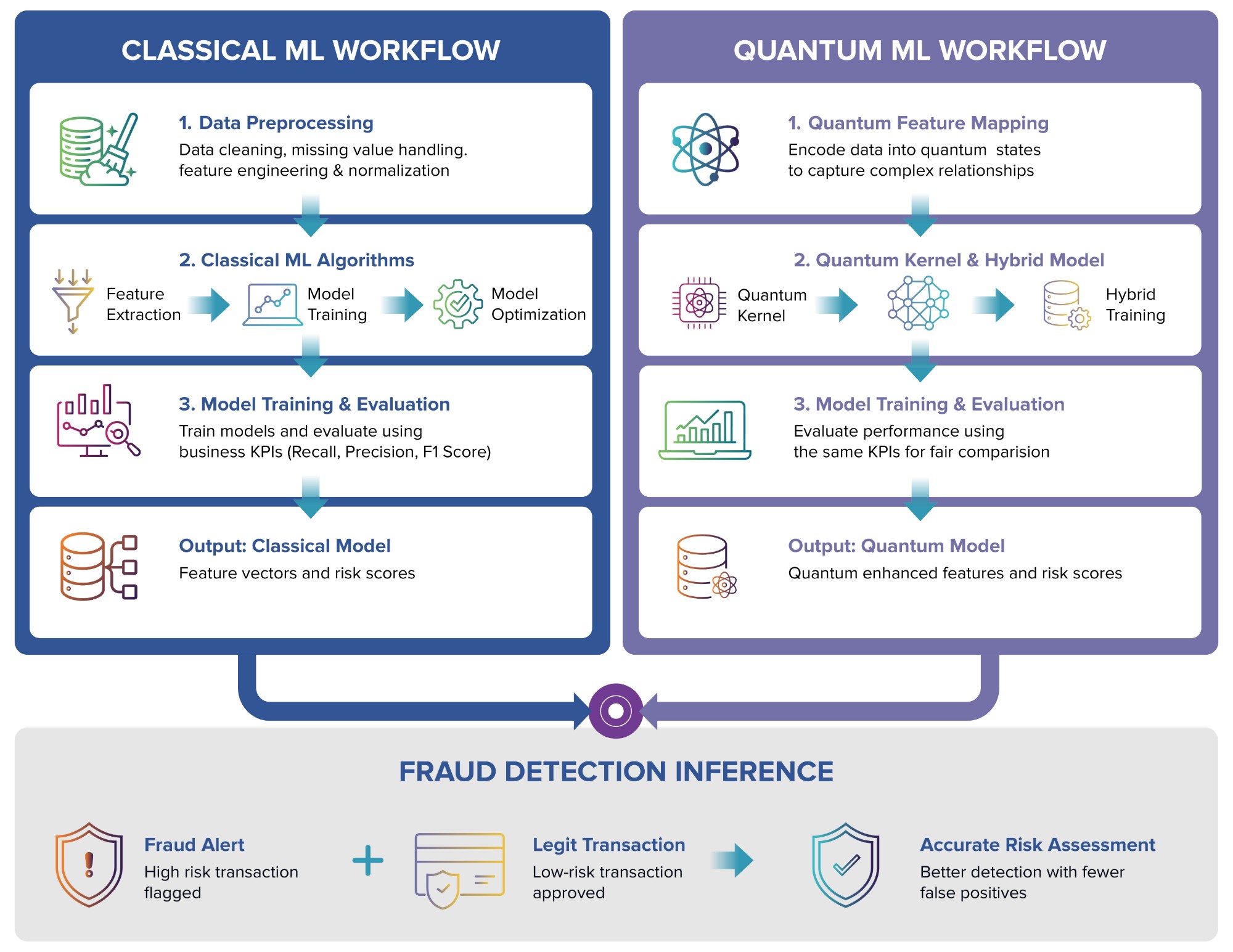
To address these representation limits, we examined a quantum-inspired machine learning approach. At a conceptual level, quantum feature mapping encodes transaction data into a richer, higher-dimensional space, enabling subtle multi-feature relationships to become more separable.