The shift from experimentation toward production has been enabled by several developments converging at once.
- Institutional custody and production tokenization platforms have matured
- Major financial institutions are progressing beyond pilots
- Regulatory frameworks are providing greater clarity around stablecoins, tokenized securities and digital-asset activities.
A recent survey of institutional decision makers confirms this trend where “73% of respondents intend to increase their digital asset allocations in 2026, driven by greater regulatory clarity, expanded availability of regulated products and improved infrastructure”
This does not mean that every use case is ready to scale or that regulatory uncertainty has disappeared. It does mean that the executive question has changed: from “Should we explore the technology?” to “Where does this change our economics, operating model and competitive position?”
Three Enterprise Transformation Plays for Digital Assets
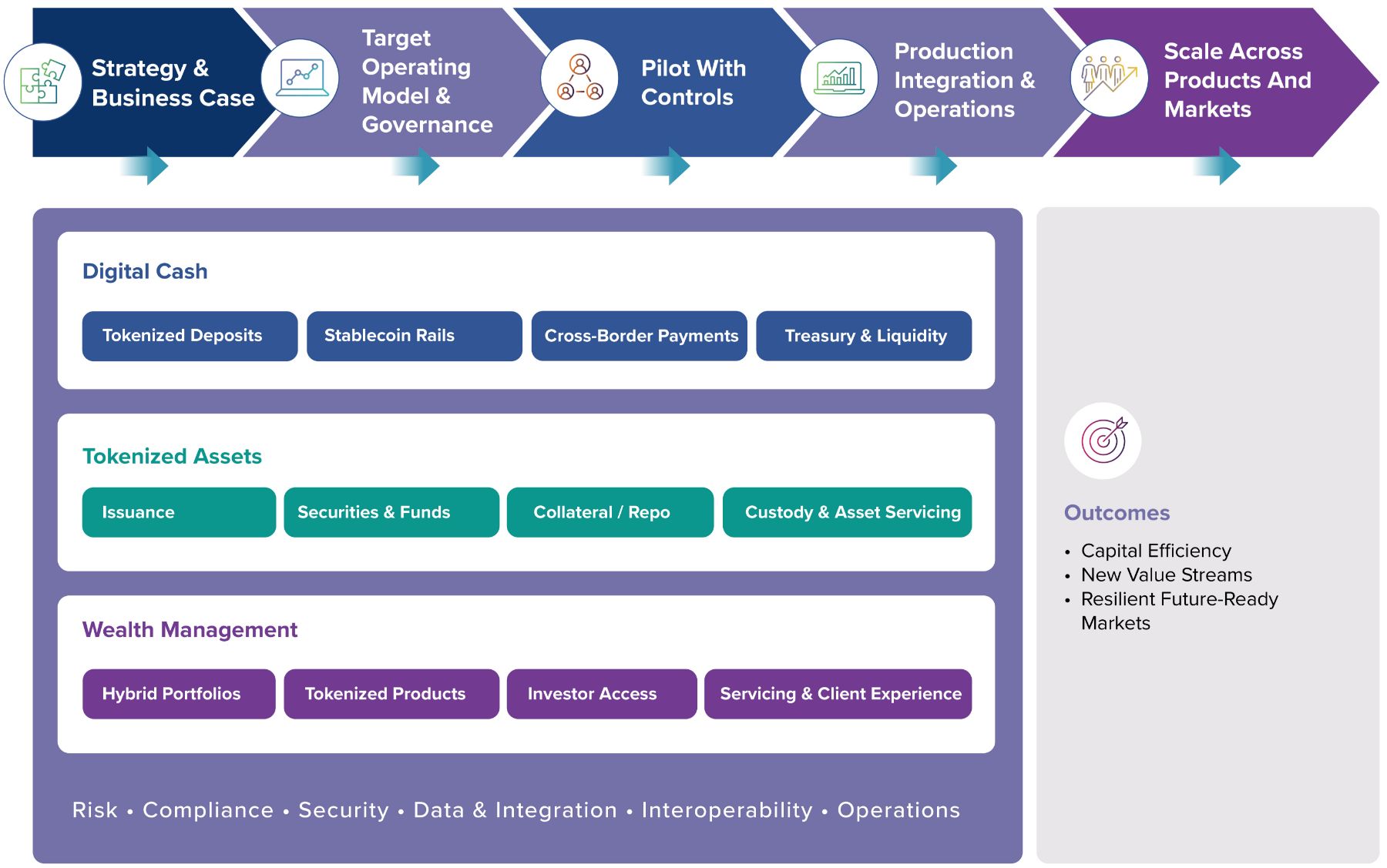
At Wipro, we view digital assets not as standalone technology initiatives, but as enterprise transformation opportunities with the potential to reshape how value moves, how financial products are issued and serviced, and how financial institutions engage with their clients. From that perspective, we see three transformation plays with distinct enterprise relevance. Through this lens, three transformation plays emerge with distinct enterprise relevance. Digital cash changes how value moves, tokenized assets change how financial products are issued and serviced, and wealth management converts these infrastructure shifts into differentiated client propositions.
Transformation Play #1: Digital Cash: Reimagining How Money Moves
Tokenized deposits, regulated stablecoin rails and other digital-money models can change how institutions execute cross-border payments, wholesale settlement, corporate liquidity and treasury operations.
Tokenized deposits, for example, combine a digital representation of commercial-bank money with programmable infrastructure, potentially supporting real-time payments, atomic delivery-versus-payment and 24x7 liquidity movement. Capturing those benefits, however, requires more than adding a new payment channel. Banks must connect tokenized money to core ledgers, deposit accounting, treasury, wallets, key management, AML, sanctions screening, reconciliation and regulatory reporting. Digital cash is consequently a transformation of payments, liquidity management and the bank operating model, not simply a new instrument.
Transformation Play #2: Tokenized Assets: Transforming Capital Markets Infrastructure
Representing securities, funds or collateral on programmable tokenization platforms can connect issuance, ownership transfer, settlement and servicing more directly. The opportunity spans tokenized securities and funds, collateral mobility, intraday repo, custody and asset servicing—areas where existing processes often involve separate systems, sequential messaging and substantial reconciliation.
DTCC’s digital collateral initiative, for example, is explicitly exploring how tokenization can increase collateral mobility, capital efficiency and liquidity while connecting traditional and digital assets. The strategic importance lies not in “putting an asset on-chain,” but in redesigning the lifecycle around faster settlement, reliable books and records, automated controls, and integration with custodians, venues, clearing infrastructure and payment rails.
Transformation Play #3: Digital Wealth: Rethinking Access, Ownership and Investor Engagement
Tokenized funds and other digital investment products can support new distribution models, digital subscription, fractional ownership and broader access to public and private-market opportunities. They can also alter investor onboarding, portfolio construction, suitability, custody, reporting and servicing.
The strongest wealth proposition will therefore not be an undifferentiated catalogue of digital assets. It will combine trusted advice, appropriate product governance and familiar investor protections with a more responsive digital experience. Traditional and tokenized holdings will coexist, requiring wealth firms to support hybrid portfolios rather than create a disconnected digital-asset channel.
Across all three plays, production adoption depends on a shared enterprise foundation.
- Institutions need clear accountability for wallets and keys, legal ownership, settlement finality, client-asset protection, transaction monitoring, cybersecurity, resilience, accounting, tax and regulatory evidence.
- They also need interoperability between new networks and existing payment hubs, core banking platforms, custody systems and books of record.
- Intelligent operations and compliance is the fabric that makes digital cash and tokenized assets production-safe.
Without that foundation, institutions risk creating faster transactions but slower exceptions, fragmented controls and additional reconciliation.
Digital Assets Transformation Roadmap
The transformation journey should therefore proceed through disciplined stages:
- Define the business ambition and use cases
- Design the target operating model and governance
- Prove the proposition through a controlled pilot
- Launch with production-grade integration and controls
- Scale through reusable platforms, processes and ecosystem connectivity.
The following view illustrates how the three transformation plays progress through common stages while depending on one shared enterprise foundation.