

Digital assets are changing more than the form in which value is held. They are reshaping when transactions occur, where business rules are applied, and how rapidly financial risk can spread. Tokenized deposits, stable coins and tokenized securities can settle conditionally, operate across platforms and continue outside traditional processing windows. The IMF describes tokenization as a structural change in financial architecture, one that can enable atomic settlement, continuous liquidity management and embedded compliance, but may also amplify instability through speed, concentration and fragmentation if governance does not keep pace.
For banks, this creates a fundamental control question: Can a compliance model designed around downstream screening, batch monitoring and retrospective investigation govern transactions that execute through software in near real time? Increasingly, the answer is no. Compliance must remain independent and accountable, but its controls need to move closer to the transaction such that it operates before, during and after execution.
Why traditional compliance checkpoints fall short
Conventional financial-crime controls typically operate across a sequence of systems: customer onboarding, sanctions screening, payment processing, transaction monitoring, case management and regulatory reporting. Programmable finance introduces additional surfaces such as wallets, smart contracts, distributed ledgers, custody providers and tokenization platforms, while linking on-chain activity to customer, account, treasury and risk data held off-chain.
The underlying regulatory obligations have not disappeared. The Financial Stability Board’s principle remains “same activity, same risk, same regulation.” Yet its 2025 review found significant gaps and inconsistencies in the implementation of crypto-asset and stablecoin frameworks, creating opportunities for regulatory arbitrage and complicating cross-border oversight. FATF’s July 2026 update similarly reported continuing challenges in translating virtual-asset risk assessments into effective controls, operationalizing licensing regimes and delivering effective risk-based supervision and enforcement.
The implication is not that every compliance process must become instantaneous. Banks need to distinguish between controls that must operate in the transaction path and activities that can occur asynchronously. More ambiguous questions such as linked-wallet behavior, unusual transaction patterns, source-of-funds concerns or cross-jurisdiction conflicts which may require investigation and human judgment.
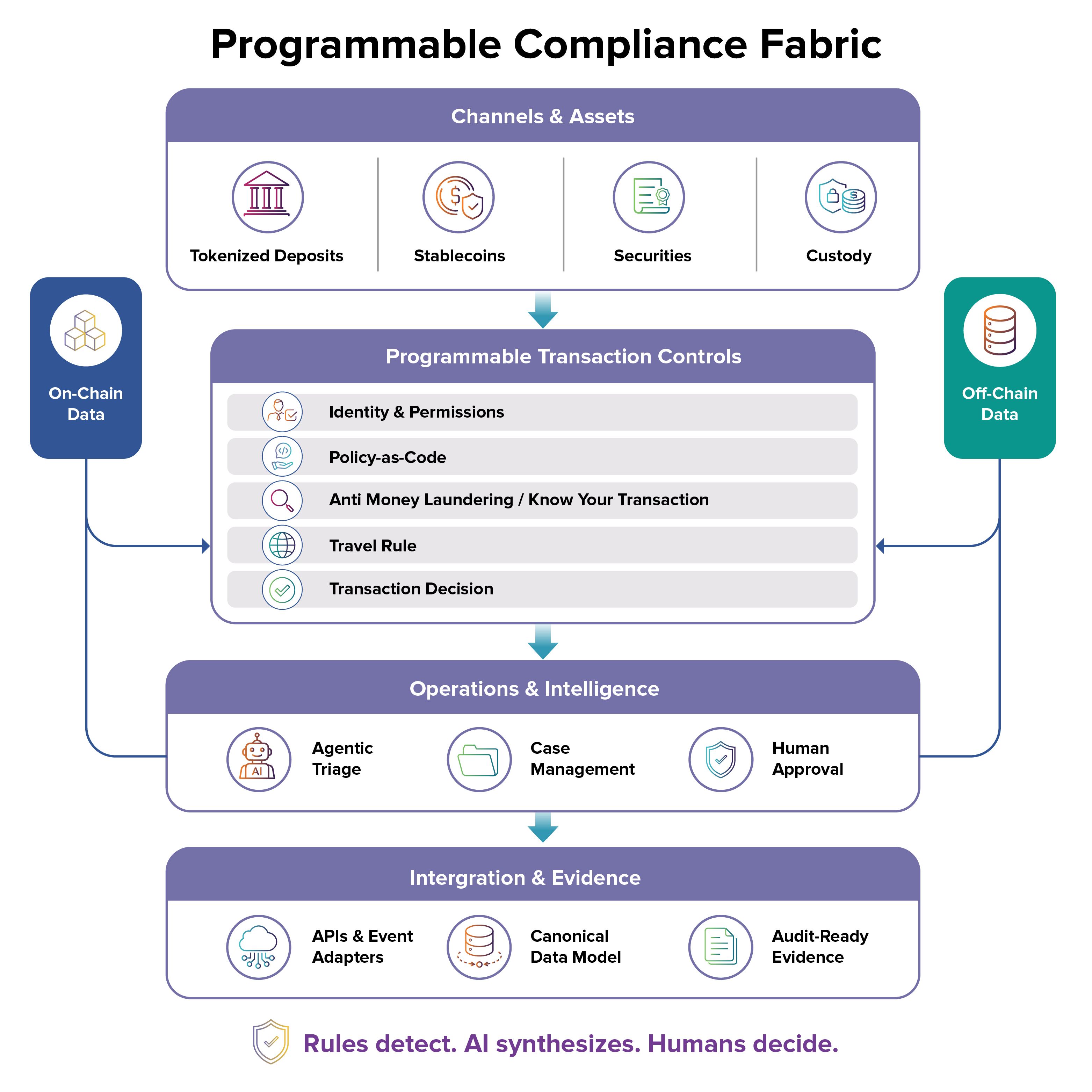
Building a Programmable Compliance Fabric
A more scalable model is a programmable compliance fabric with a policy, identity, monitoring, workflow and evidence services surrounding the transaction rather than a single control engine embedded inside one ledger.
- At its foundation is policy-as-code. Approved policies are translated into versioned, testable rules governing who may participate, what assets may move, which jurisdictions are permitted and when a transaction must be held or escalated.
- Compliance and legal functions must remain responsible for policy meaning, approvals and change governance. Code makes approved policy consistently executable; it does not determine what regulation should mean.
- Identity and permission controls then connect customers, counterparties, wallets, accounts and institutional roles.
- AML and know-your-transaction (KYT) monitoring combines conventional customer information with wallet risk, transaction history, asset type, counterparties and on-chain behavior.
- Travel Rule workflows validate originator and beneficiary information, identify missing data and retain the evidence exchanged with counterparties.
The control model described below combines these established obligations with emerging programmable capabilities.