



The New Reality: Compliance as a Strategic Lever

The U.S. healthcare payer market is undergoing a rapid transformation. Medicare Advantage and Medicaid Managed Care, once driven by growth and scale, now operate in an environment where compliance is the key to profitability. Success today hinges on operational precision, transparent data, and unwavering alignment with evolving regulations. As rules change faster than ever, compliance has shifted from a back-office obligation to a core growth strategy.

Medicare Advantage now covers more than half of all Medicare enrollees, but its growth is slowing. As expansion opportunities shrink, payers must safeguard margins and acknowledge a critical truth: compliance isn’t just a regulatory requirement; it’s a direct driver of financial performance.

Star ratings have dropped for three years in a row, reducing the number of plans eligible for bonuses. Even a half-star decrease can mean millions lost in bonus payments and member retention. At the same time, new Centers for Medicare & Medicaid Services (CMS) risk adjustment rules (V28) are lowering average risk scores by 3–7%, quietly reducing revenue for many plans.

Medicaid Managed Care is navigating a new wave of challenges. Emerging regulations around network adequacy, In Lieu of Services (ILOS) reporting, Medical Loss Ratio (MLR) transparency, and beneficiary experience are raising the compliance bar. Manual prior authorization processes have become costly and error-prone, adding operational strain. Meanwhile, CMS’s latest rules demand real-time transparency and public reporting, forcing payers to overhaul entrenched processes within an accelerated timeframe.

Navigating Market Saturation and Margin Pressure

Payer executives face a significant challenge: compliance is essential, but a reactive approach can erode margins. The shift to V28 means payers must be more precise in their documentation and coding to maintain revenue. Regulatory updates like network adequacy, ILOS effectiveness, Medical Loss Ratio (MLR) disclosure, and prior authorization Application Programming Interface (API) readiness are strategic priorities that demand smarter, more adaptive operations.

Traditional automation is no longer enough. Static, rules-based systems cannot keep up with the pace of regulatory change. Payers need intelligent solutions that can understand, reason, and adapt on their own.

This is where Agentic AI offers a transformative solution. Unlike traditional automation, these intelligent agents are built to deliver specific business outcomes such as compliance, faster turnaround, and fairness by continuously learning and adapting. This approach shifts payers from reacting to regulatory changes to proactively managing compliance as a strategic advantage.

Agentic AI moves beyond simple automation. It perceives, reasons, and makes decisions within regulatory boundaries, learning from every transaction and adapting in real time to keep operations efficient, compliant, and future-ready.

The 12-Month Playbook: Scaling Compliance with Agentic AI

To transition toward intelligent, self-governing operations, organizations should consider adopting an Agentic AI approach. This model focuses on embedding autonomy and compliance into core processes, thereby reducing reliance on manual oversight.

The path to implementation begins with Discovery and Risk Assessment, a structured review to identify regulatory risks and define transformation priorities, ensuring compliance objectives are clear from the outset. The next step is Agentic AI Integration, which involves incorporating AI/ML engineering into operational workflows to make compliance a built-in capability, enabling systems to act on regulatory triggers autonomously.

This must be supported by Platform Modernization—upgrading to cloud-native, interoperable platforms that enable scalability and real-time compliance monitoring. Foundational to this transformation is strong AI Governance, which includes human-in-the-loop oversight, explainable AI models, and auditable logs to ensure transparency and accountability for all stakeholders. Finally, deploying Continuous Monitoring and Adaptation through real-time regulatory intelligence dashboards allows organizations to stay ahead of updates and adjust operations proactively.

This phased approach accelerates transformation while maintaining robust compliance. The objective is not a theoretical framework but a practical implementation of self-governing systems that operate within clear regulatory boundaries. Agentic AI delivers value far beyond cost savings; it empowers payers to compete by defending margins through automated compliance, improving quality by monitoring Star Ratings, boosting agility with rapid responses to regulatory changes, and building trust through transparent and auditable AI.

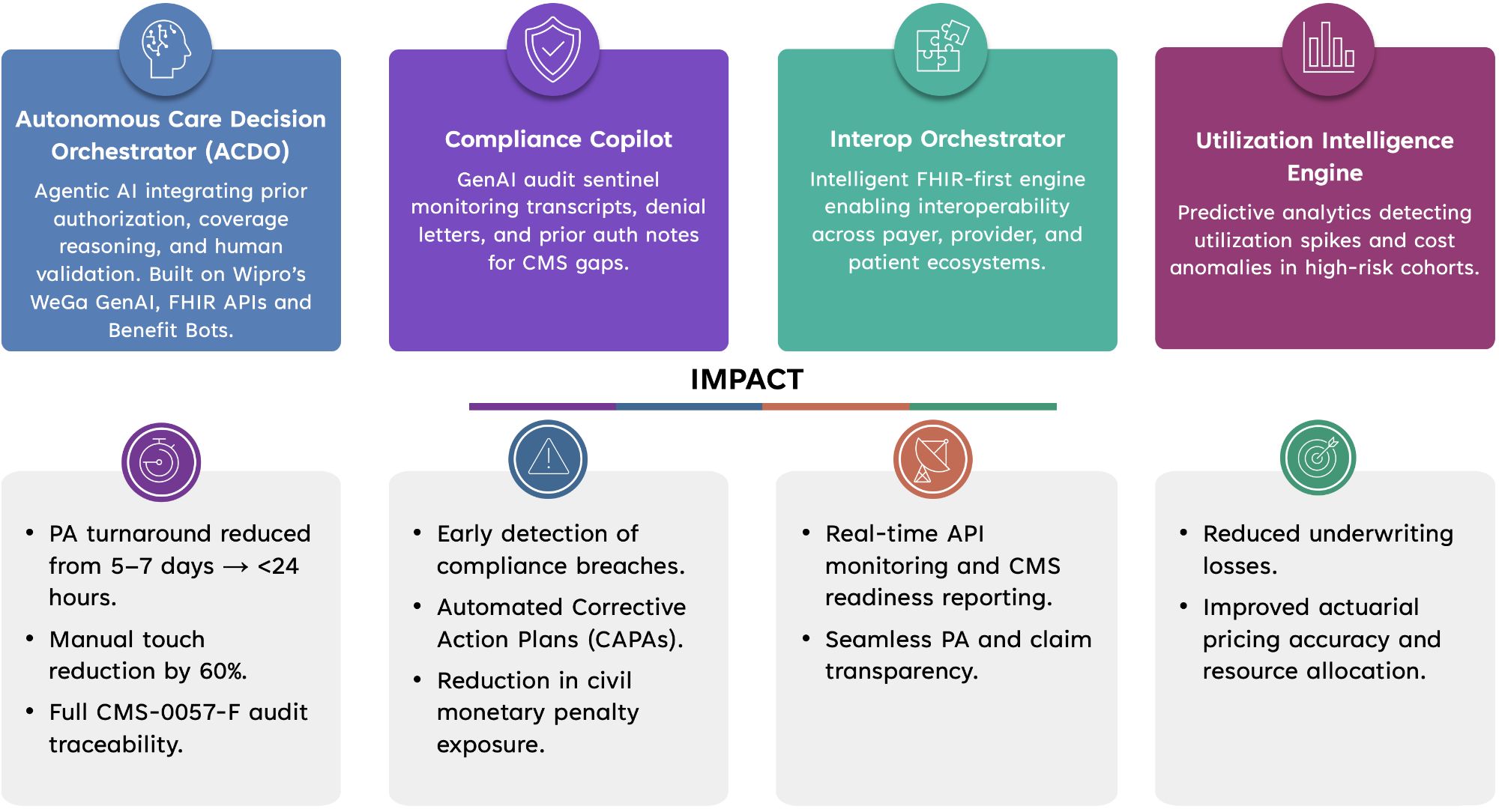
Agentic AI Framework: Orchestrate, Monitor, Predict

Compliance, Intelligence, and Margin: The Agentic AI Framework

This consult-to-code approach accelerates transformation while maintaining strong compliance. The goal is practical implementation, creating systems that govern themselves within regulatory boundaries, not just theoretical frameworks. Agentic AI delivers value beyond cost savings. It helps payers compete by:

  • Defending margins: Automating compliance reduces overhead and protects revenue.
  • Improving quality: Intelligent agents monitor star ratings, spot gaps, and drive improvements.
  • Boosting agility: Adaptive AI responds to regulatory changes quickly, minimizing disruption.
  • Building trust: Transparent, explainable AI and human oversight ensure confidence and auditability.

The Future Belongs to the Self-Governing Payer

The future of healthcare payers will be shaped by those who are not just compliant, but consciously intelligent. Agentic AI empowers organizations to turn compliance into a business advantage. As regulations continue to evolve, payers who invest in agentic AI will unlock new levels of resilience, margin protection, and competitive strength.

About the Authors

Surendar Vijayakumar
Principal Consultant, Healthcare Consulting, Wipro

Surendar Vijayakumar is a seasoned Principal Consultant in Wipro’s Healthcare Consulting Practice. He has a strong focus on solution consulting and market research analysis, primarily within the dynamic landscape of U.S. healthcare. His dedication to this domain has enabled him to develop comprehensive insights and expertise that drive impactful solutions and strategies. Surendar holds a Certified Fellowship in Healthcare Management and is based in Chennai, India.

Anisha Patel
Consultant, Healthcare Consulting, Wipro Limited

Anisha Patel brings deep healthcare domain expertise and is passionate about exploring emerging trends. Her enthusiasm for advancing innovative solutions within the healthcare ecosystem reflects her commitment to driving meaningful change.

Philip Handal
Senior Partner, Healthcare Consulting Leader

Phil has over 20 years of experience in healthcare technology consulting and care delivery. He is a leader in Wipro’s Payor Strategic Consulting services, focusing on transforming technology to deliver value for the future of healthcare delivery. He has worked extensively with payors, providers, and life sciences organizations to develop strategic initiatives, implement technology, and execute data-driven digital solutions.