


A practical approach for health plans responding to new OPM requirements without unnecessarily redesigning the entire enterprise delivery model.

The U.S. Office of Personnel Management’s Carrier Letter 2026-04 introduces new requirements for Federal Employees Health Benefits (FEHB) and Postal Service Health Benefits (PSHB) business. It restricts new contracts, extensions and amendments with vendors based outside the United States, requires relevant restrictions to flow through subcontracting tiers and establishes U.S. residency requirements for protected federal health and personal information, subject to limited exceptions. Existing contracts with vendors based outside the United States must be terminated as soon as possible and no later than December 31, 2026, unless OPM grants an exception.

For health plans operating shared claims, enrollment, contact center, data and technology environments, this creates an important leadership question -

How can the organization establish a defensible U.S. boundary for federal business while avoiding unnecessary disruption to commercial operations, modernization programs, talent capacity, and delivery economics?

Protect the boundary first and then make it more precise:

Wipro’s approach separates the response into two horizons—protecting federal data and sensitive operations in the U.S. first, then progressively improving the precision of that boundary.
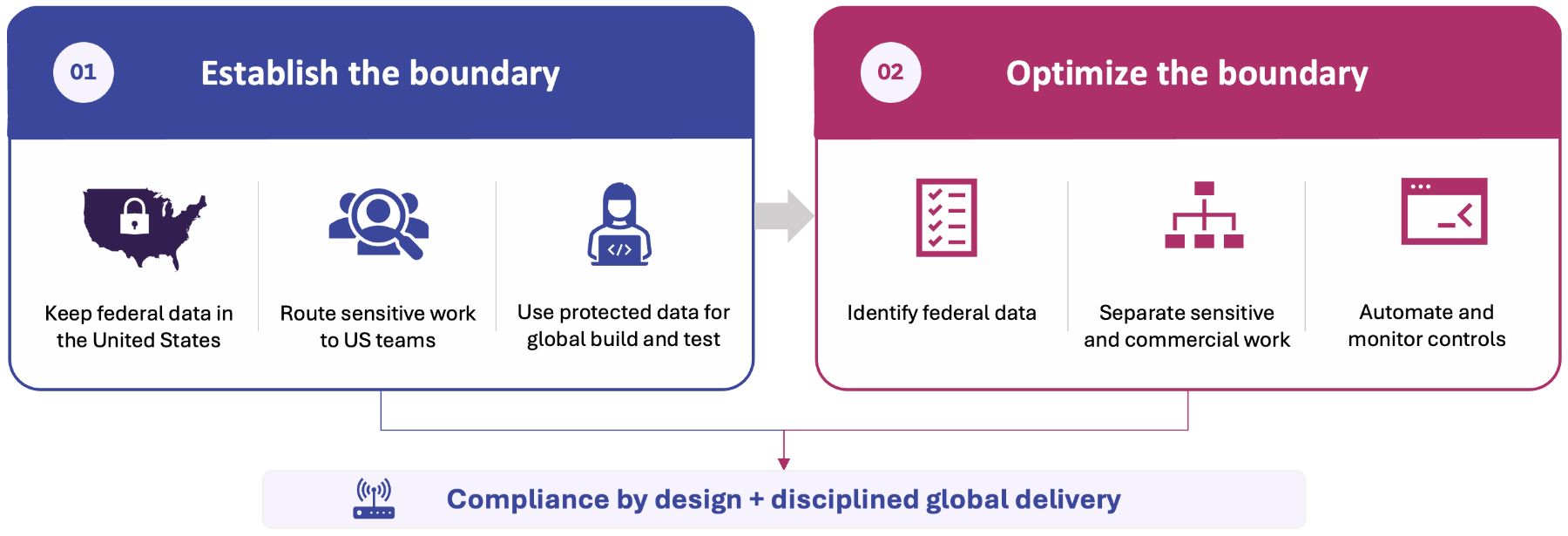
Horizon 1 — Establish the boundary: Put immediate controls around federal data, production access, privileged activities, and sensitive operations.

Horizon 2 — Optimize the boundary: Identify and segregate federal data so that only the activities that genuinely require the protected U.S. boundary remain within it.

This creates a path to address compliance requirements without automatically redesigning the entire technology and delivery estate around the most restrictive scenario.

Know what is federal, then use only as much separation as needed

The model becomes manageable when federal status is determined from an authoritative source and follows the data through the enterprise.

This allows access, work routing, security controls and data protection to follow the information itself—rather than treating an entire application or technology tower as federal.

Shared platforms can then move progressively from identifying and masking federal information to tokenization, partitioning, or, where justified, a dedicated U.S. instance.

The key question becomes:

Which data, transactions and activities require the protected U.S. boundary and which can be demonstrably separated from it?

What stays within the protected U.S. boundary?

Activities likely to require the protected U.S. boundary include:

  • Federal production operations
  • Privileged administration of environments containing federal information
  • Sensitive incident response and investigation
  • Live-data fixes, testing and diagnosis
  • Federal access approvals and production release decisions
  • Regulatory accountability, attestations and exception management

What can remain global after validation?

Activities that may be considered for global delivery include:

  • Commercial-only applications and operations
  • Generic engineering, reusable tooling and automation
  • Development and testing using synthetic or otherwise approved information
  • Triage using identifier-free tickets and alerts
  • Validated non-federal activities that do not require access to protected environments

The objective is not simply to determine how much work can remain global, but to identify what work genuinely requires federal data, privileged access or a U.S.-controlled environment.

Five actions to move from requirement to operating model

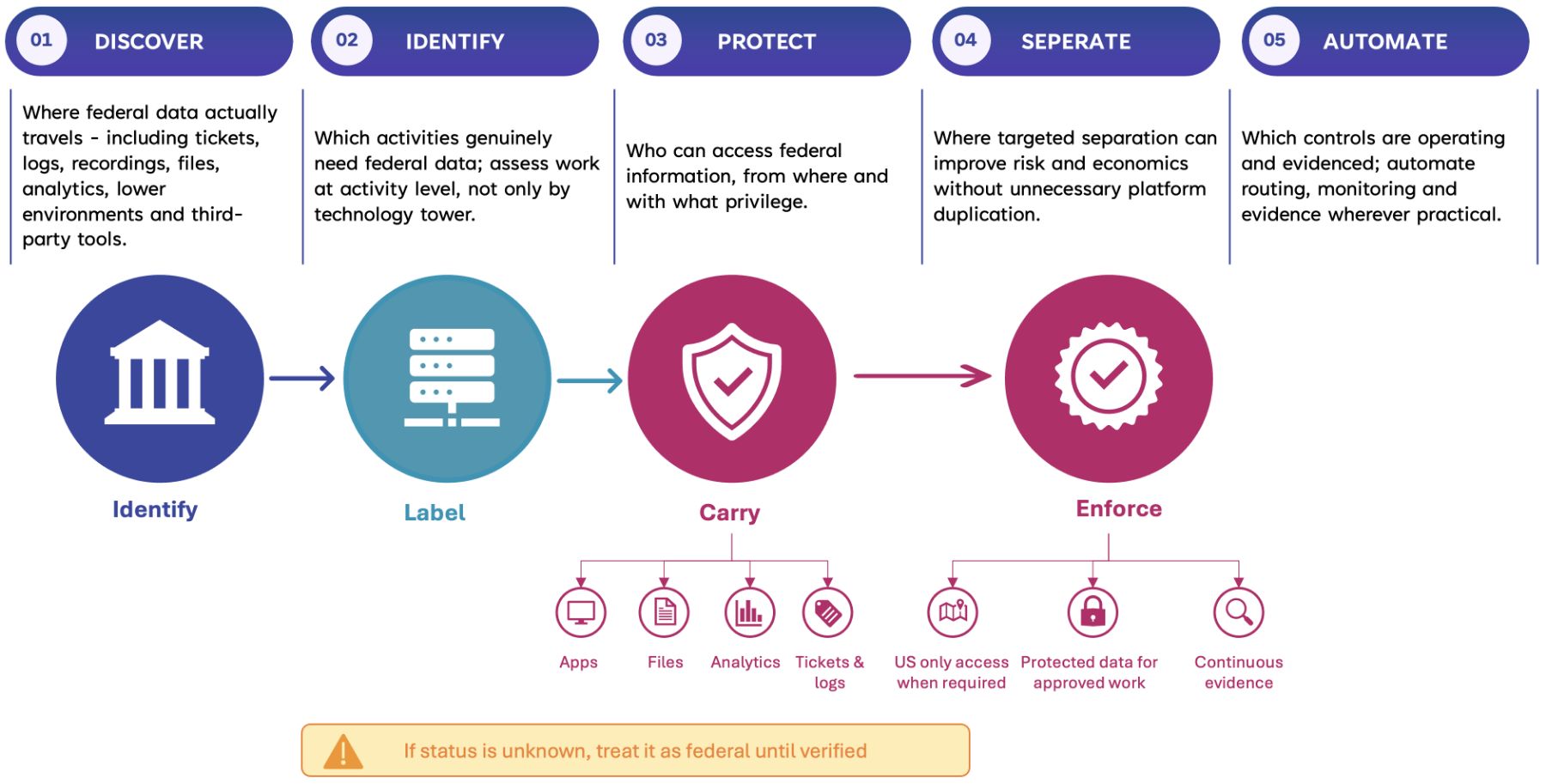
Turning regulatory and contracting requirements into a workable operating model requires an integrated view of contracts, data, applications, access, service management, security, vendors, and evidence.

DECIDE → DISCOVER → PROTECT → SEPARATE → AUTOMATE

  • DECIDE the protected U.S. boundary and accountability for it.
  • DISCOVER where federal information flows across the enterprise.
  • PROTECT federal data, privileged access and sensitive operations immediately.
  • SEPARATE federal and non-federal activity progressively, where needed.
  • AUTOMATE controls, monitoring and evidence to support ongoing compliance.

Together, these actions can create a more precise, data-aware boundary that addresses regulatory requirements, operational resilience and delivery economics.

Decide the boundary. Discover where federal information flows. Protect it immediately. Separate it progressively. Automate the evidence.

Connect with Wipro to assess your FEHB/PSHB technology and service landscape, define a protected U.S. operating boundary and build a practical roadmap from immediate readiness to sustainable delivery efficiency.

About the Author

Anuj Kumar, Senior Vice President and Sector Head , Wipro Health

Anuj is the Senior Vice President and Sector Head for the Americas Healthcare and Life Sciences business at Wipro. He leads strategy, growth, and operations for one of the Wipro's fastest-evolving sectors, with a sharp focus on consulting, AI-led transformation, digital innovation, and delivering differentiated value to clients.

Under Anuj's leadership, Wipro is helping Payer, Provider, Health-tech, Life Sciences, and Medical Devices organizations reimagine their business models - leveraging AI, automation, and next-gen platforms to drive intelligent operations and better health outcomes.

He has been featured in The Consulting Report’s The Top 25 Healthcare Consultants and Leaders of 2025. He has also featured on the cover of The Enterprise World, sharing his leadership vision as one of The Visionary Healthcare Pioneers to Watch in 2026.