




Manufacturing organizations today are managing increasingly complex production environments while trying to scale efficiently across regions. Many struggle with inconsistent MES implementations, long rollout cycles, and site‑specific customizations that make change slow and costly. As manufacturing networks grow, the challenge is no longer just implementing MES, but doing it in a way that is consistent, repeatable, and adaptable across plants.
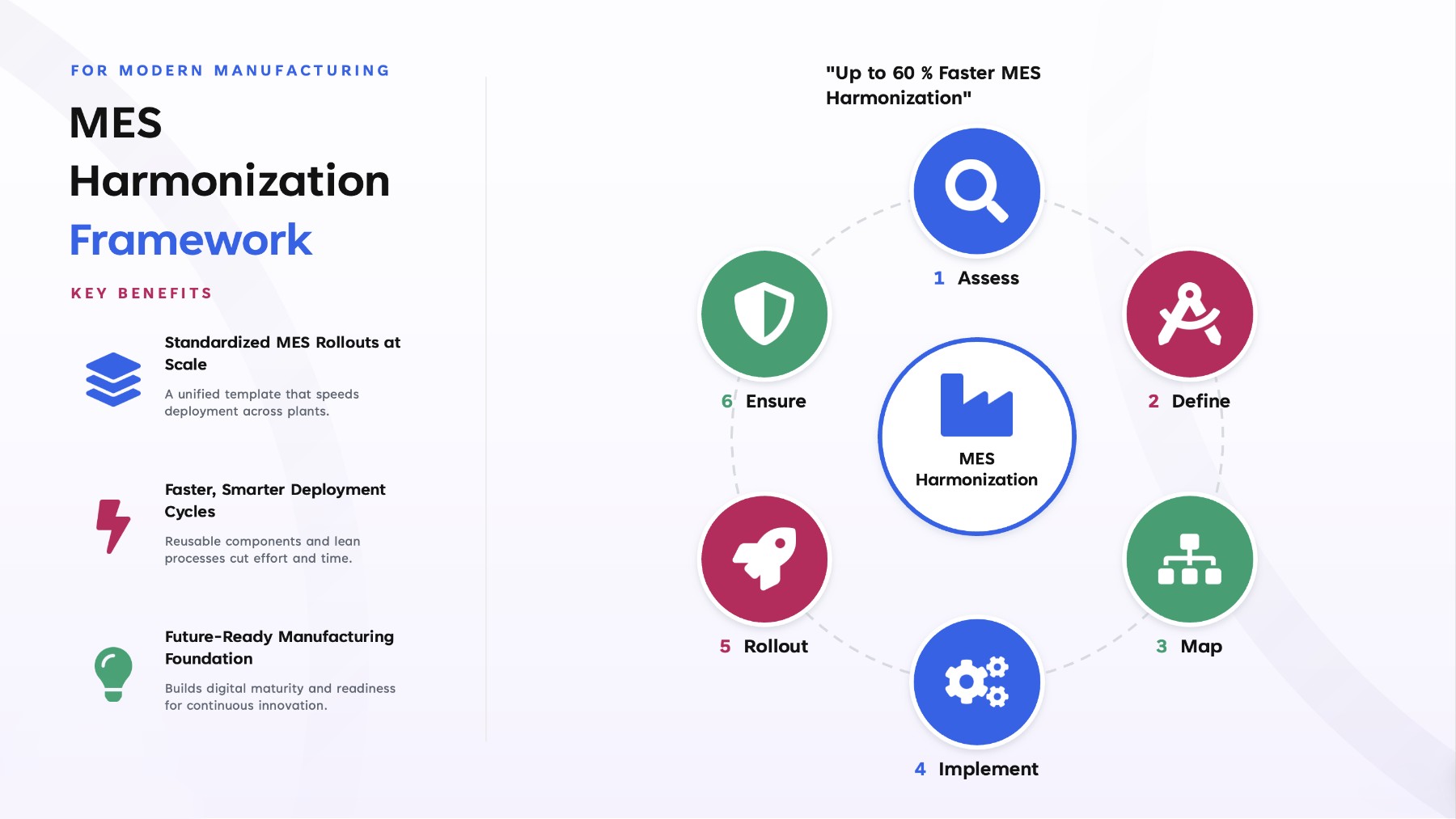
The MES Harmonization Framework provides a structured way to address this challenge. Built around six clear stages - Assess, Define, Map, Implement, Rollout, and Ensure. The framework helps manufacturers move away from isolated, plant‑by‑plant MES deployments toward a more unified and coordinated approach. It establishes a common blueprint for MES while allowing room for local operational needs, bringing balance between global standards and plant‑level realities.
By focusing on standard templates, clear processes, and reusable components, the framework helps reduce implementation effort, shorten rollout timelines, and improve adoption across sites. It brings clarity to decision‑making, simplifies future upgrades, and creates a stronger foundation for digital manufacturing growth. More importantly, it enables organizations to think beyond individual implementations and treat MES as a scalable capability — one that supports continuous improvement, operational consistency, and long‑term manufacturing maturity.