Is This You?
Pre-compliance is filed under "engineering problems," but the people it really protects are scattered across the org chart.
- Product Managers - every failed cycle can slip on a launch date and put committed quarterly revenue at risk.
- Hardware Engineers - decisions made quietly at the schematic level to decide whether the product passes months later.
- Startups - one unexpected re-test can devour the runway you need to reach the next milestone.
- OEMs - you are not certifying for one market but ten, each with its own path to failure.
The Cost of Pre-Certification Delays
Certification of economics is more predictable than most teams assume. Depending on product complexity, accredited EMC labs place CE/FCC certification between $1,000 and $20,000, with chamber time running $1,500 to $2,500 a day. In high-reliability markets - automotive, medical, defense - that rises to between $13,600 and $34,000 per cycle, and most teams carry a further 10% to 30% buffer for design changes after a failure (EMC cost guide). Safety testing to IEC 62368 and IEC 60601 sits in a similar range, as does environmental testing to MIL-STD-810 and IEC 60068 (IEC 60601 safety).
Then comes the second layer of cost, which no quote carries. A failed cycle means waiting four to six weeks for a chamber slot. It means paying for a design review, spinning up a new board, and building fresh samples. By the time the team is back in front of the chamber, 90 days have gone by. This is why early compliance testing services matter: they turn certification risk into a managed engineering queue rather than a launch-threatening surprise.
Why First-Class Certification Matters
The old workflow was simple: design the product, build the product, hand it to a lab. That worked when products were simpler, and standards moved slowly. It does not work anymore.
Today, a connected device may carry Wi-Fi 7, Bluetooth LE Audio, a switch-mode power supply, a high-speed processor, and an OTA update path - all within a 30 mm form factor. Each subsystem can breach CISPR 32 emissions levels. Each cable can generate an ESD failure. Each power input can create surge immunity problems. By the time the device reaches the lab, dozens of design decisions that determine its certification have already been made.
The first-pass question reframes from the entire workflow: what would it take for this product to pass its formal EMC, safety, and environmental tests on the first attempt?
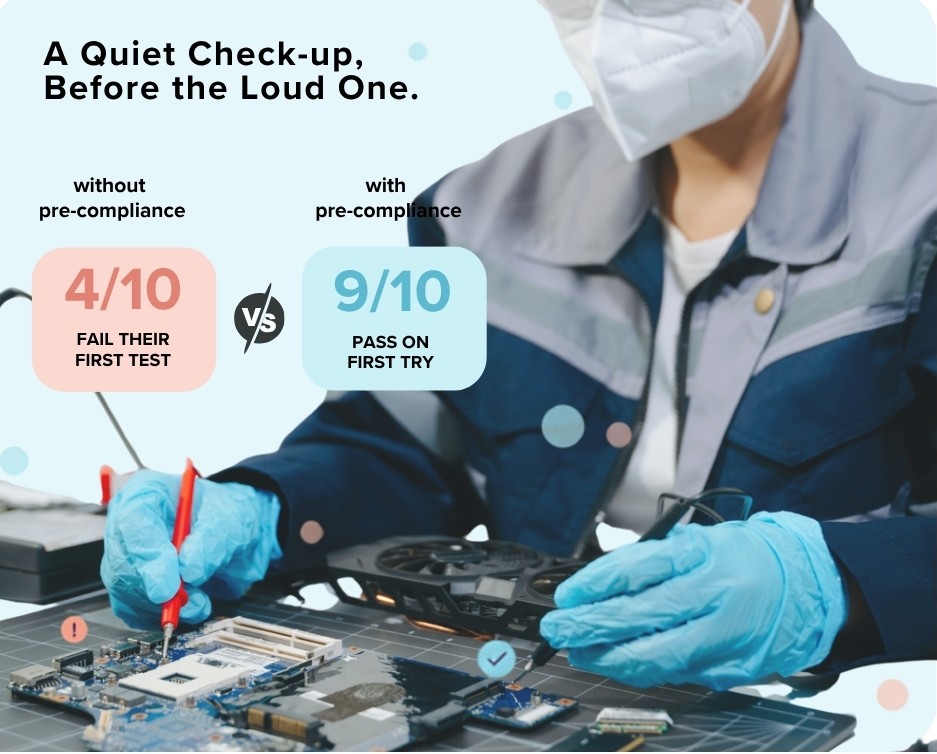
The answer is not more rigor at the end. It is diagnostic testing - earlier, cheaper, repeated - at every stage of the product lifecycle. That is a pre-compliance. Done well, it prepares a team for every formal evaluation that follows - emissions, safety, environmental - long before the final chamber booking is made.
The Compliance Lifecycle, Re-engineered
Compliance testing is binary - pass or fail; report goes to a certification body. Pre-compliance is a diagnostic. It shows how close to the boundary a product is, where it is leaking, and what design change will bring it under threshold. A well-architected pre-compliance engagement has 6 distinct stages, each targeting a different failure surface and reducing the risk of failure during final product compliance testing:
Stage 1 - Design Review
Most of the EMC and safety failures have seen downstream trace back to decisions visible at this stage - component placement, ground-plane partitioning, connector position, enclosure material. Reviewing the schematic and layout before the first board is fabricated catches them while a fix still costs a design revision rather than a re-test.
Stage 2 - Emissions Sweep
Characterize radiated and conducted emissions on the first physical prototype, sweeping 9 kHz to 6 GHz against CISPR 32, FCC Part 15, or equivalent regional standard. This EMC testing step is not a verdict, but a spectrum trace with each peak within 10 dB of the limit annotated with probable root cause.
Stage 3 - Immunity Stress Profile
Expose the product to the electromagnetic environment it will operate in - ESD, electrical fast transients, surge, and conducted RF. The output is a ranked list of failure points and the protective components needed to close each one.
Stage 4 - Safety and Thermal Audit
Thermal mapping under worst-case operating conditions, verification of insulation barriers, measurement of creepage and clearance, and evaluation of touch currents at every accessible connection point.
Stage 5 - Environmental & Reliability Snapshot
Assess how the product behaves in its intended surroundings: thermal cycling across the full operating range, vibration, and humidity exposure. For products headed into aerospace, defense or harsh industrial use, add HALT (Highly Accelerated Life Test), which drives temperature and vibration beyond operating limits to expose latent defects before shipping.
Stage 6 - Modular Certification (The Step Most Teams Miss)
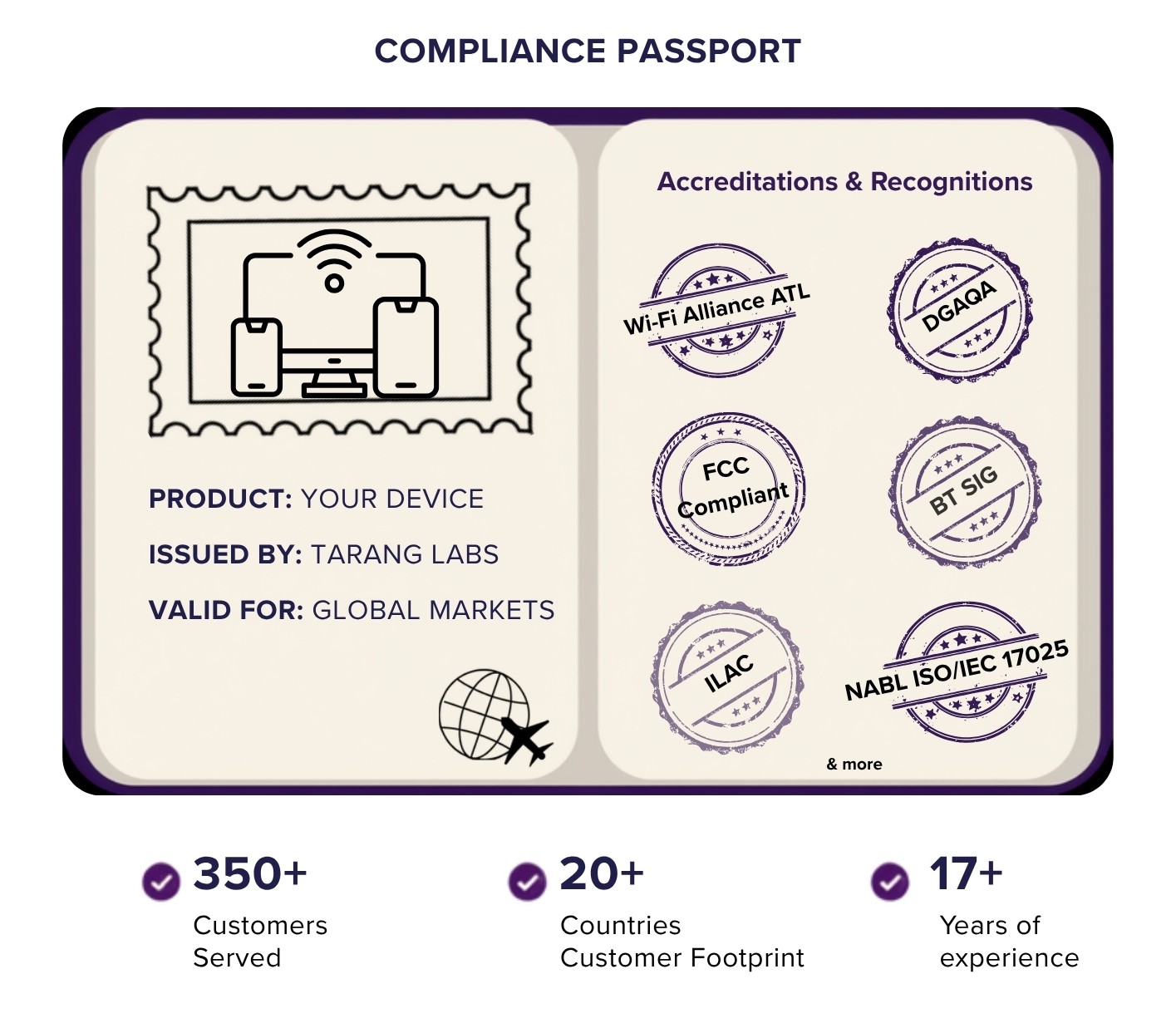
If your product uses a previously certified Wi-Fi or Bluetooth module, you may be able to avoid repeating the full radio test campaign. A module may already carry approvals such as an FCC modular grant, Wi-Fi Alliance certification, or Bluetooth SIG Qualification, allowing the host product to inherit or reference that approval where the module is integrated within the grant conditions and regional requirements.
One Lab, One Plan, Faster Certification