


Telecommunications providers have spent more than a decade virtualizing networks in pursuit of agility and efficiency. Yet the vision of a truly self driving network—one that can understand business intent and act autonomously—has remained frustratingly out of reach. The paradox is striking: the industry has most of the necessary components, but not the connective tissue required to make them work as a coherent, self governing system.

What is missing is not analytics, automation, or orchestration in isolation. It is an architectural model that can translate high level business intent into coordinated, real time action across customer, service, and network domains. That translation requires a fundamental re architecture of the digital stack—one built natively for Agentic AI. This is where an Agentic AI Native Open Digital Architecture (ODA) becomes essential, anchored by a tightly integrated Triad of Fabrics: Cloud, Data, and Agentic.

Together, these fabrics move operations beyond static automation toward dynamic, intent driven autonomy, turning aspiration into operational impact.

Why the Time is Now

The industry has reached a point where multiple standardization efforts have matured simultaneously, creating a viable foundation for autonomous operations. Some of them include:

  • ODA as the blueprint
    The industry has embraced the ODA canvas to replace monolithic legacy stacks with composable components exposing Open APIs. This accelerates build, integration, and zero-touch operations.
  • Autonomous networks (AN) reality
    Operations are moving toward Level-4 autonomy: closed-loop, intent-driven operations with predictive capabilities that promise material gains in O&M costs, customer satisfaction, and energy efficiency.
  • Matured intent standards
    Formal frameworks now govern autonomy. ETSI ZSM 016 operationalizes intent-driven closed loops, while IETF RFC 9315 provides the semantic clarity to distinguish intent from simple policy. This precision is critical for multi-vendor environments.
  • Real network APIs
    The GSMA Open Gateway and CAMARA initiatives have standardized the exposure of network capabilities like Quality on Demand (QoD) and device location, creating a cross-operator platform for enterprise monetization.
  • Native analytics
    With 3GPP NWDAF, analytics are now a standardized function of the 5G core. This enables predictive decisions directly within the network control plane.

The Triad of Fabrics

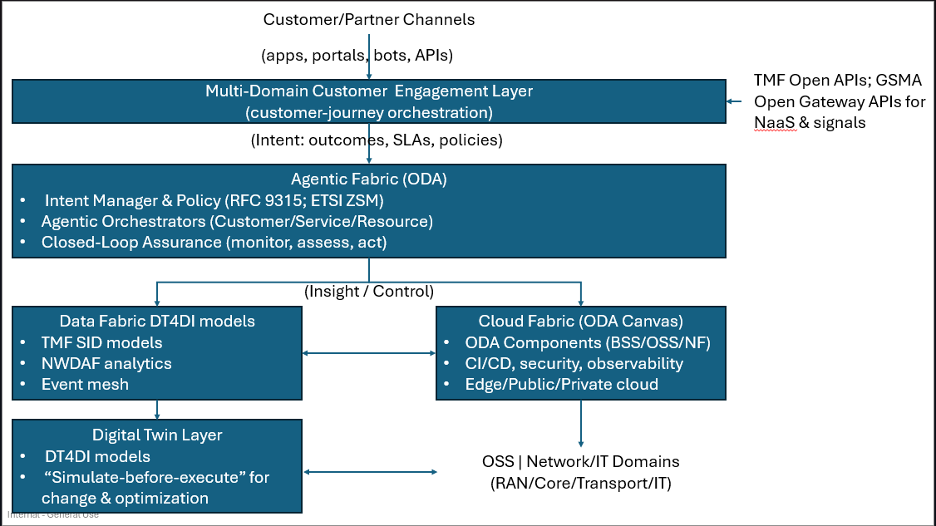
While these industry forces provide the necessary building blocks, they remain fragmented without a unifying structure to bind them together. The architecture rests on three distinct but deeply integrated layers, each addressing a specific dimension of autonomy.

  1. Cloud Fabric provides the runtime foundation. This cloud-native ODA Canvas hosts modular components exposing TM Forum Open APIs. Deployable across public cloud, edge, and data centers, it delivers the elasticity, security, and GitOps automation primitives modern network functions demand.
  2. Data Fabric solves data fragmentation. This shared, governed layer harmonizes TMF SID information models with operational telemetry, feeds NWDAF analytics, and publishes insights to agents. By decoupling producers from consumers, it enables near real-time AI/ML inference grounded in a single source of truth.
  3. Agentic Fabric is where intent becomes action. This layer consists of goal-directed AI agents that interpret business intents, coordinate across BSS/OSS/Network domains, and verify outcomes. It implements the full intent lifecycle, from ingestion and translation to orchestration and assurance, as defined in RFC 9315 and ZSM specifications.

Operating Model: Intent-Based and Closed-Loop by Design

The power of this architecture lies in how it operationalizes intent across the entire network.

  • Intent lifecycle management: Every intent follows a rigorous path: capture, translate, orchestrate, assure, and explain. Wipro has designed an end-to-end architecture for a major Australian telco to enable precisely this agentic AI native ODA, proving the viability of intent-driven operations at scale.
  • Closed-loop automation (CLA): CLA creates self-correcting systems where telemetry feeds analytics to trigger actions. These loops operate at customer, service, and resource levels. Wipro is currently developing a virtual NOC (dark NOC) platform with GCP and building AI agents for end-to-end service management for a major US mobile provider.
  • Predict-Then-Apply: A Digital Twin for Decision Intelligence (DT4DI) simulates impact to SLAs, costs, and energy before applying any intent. This ‘simulate-before-execute’ approach dramatically reduces risk. Wipro has implemented DT4DI for a major global network element provider and collaborates with NVIDIA to advance this capability.

What Becomes Possible

This layered architecture unlocks three immediate value plays that demonstrate the shift from reactive to proactive operations.

Proactive CX with agentic care
An intent like "Keep VIPs above MOS 4.3 on 5G video calls" translates into coordinated actions. NWDAF predicts congestion; an agent requests Quality-on-Demand via CAMARA APIs; another informs the customer. The result is a protected experience without human intervention.

Zero-touch offer and fulfillment
Catalog-driven bundles can expose Open Gateway capabilities directly in B2B marketplaces. ODA components automate the quote-order-fulfill cycle, while MEF LSO extends automation across partner ecosystems. Revenue operations shift from weeks to hours.

Change simulation at scale
Before rolling a RAN parameter change, the Digital Twin replays traffic patterns to predict NPS and energy impact. Only safe intents execute. The TM Forum DT4DI showcases this approach, with adoption accelerating across major operators.

Risk and Trust by Design

Autonomy without governance is chaos. This architecture, therefore, embeds trust mechanisms at every layer.

  • Guardrails: Policy constraints define where agents may act autonomously and where human-on-the-loop approval is required (per RFC 9315).
  • Observability: LSO operational observability instruments the pipeline end-to-end, ensuring full visibility into agent decisions.
  • Simulate-first: The DT4DI-style twin validates intent feasibility and impact transparency before any change touches production.

Metrics That Matter

While measuring success, we must move beyond standard technical KPIs to quantify the actual value delivered by autonomy, correlating agentic actions directly to reduced churn, lower carbon footprints, and faster revenue realization.

  • Intent latency: Time from intent capture to action decision.
  • Closed-loop MTTR: Speed of detection and correction.
  • AN maturity: Progress toward Level-4 autonomous scenarios.
  • CX outcomes: NPS uplift and SLA adherence.
  • Operational gains: Fault auto-resolution and energy savings.

A Practical Path Forward

The complexity of this transformation demands a platform capable of orchestrating intelligence across these fabrics. Wipro Intelligence provides this foundation: an AI-powered framework designed to embed adaptive intelligence directly into workflows. It ensures the transition to an Agentic-AI Native architecture is grounded in proof, not promise.

Our engagement model delivers value in 90-day increments:

  1. Days 0–30: Map the estate to ODA components, ingest priority telemetry, and stand up an Intent Manager MVP.
  2. Days 31–60: Implement a service-level closed loop (NWDAF analytics to agentic decision) and wire in Open Gateway QoD.
  3. Days 61–90: Expand to customer and resource-level loops and expose monetizable capabilities via Open Gateway APIs.

The path to Level-4 autonomy begins with a single closed loop. Start with one high-impact use case and build the muscle memory for intent-driven operations. Master the coordination between Cloud, Data, and Agentic fabrics in a controlled environment before scaling horizontally. This disciplined approach transforms autonomy from a distant vision into an operational reality that delivers measurable business value within quarters, not years.