


Airports Ecommerce: A Necessity for securing Duty-free Retail Growth in the New Normal



November | 2020
Introduction
The objective of this paper is to explore and evaluate the merits and feasibility of E-commerce marketplace for Airports to boost non-aviation revenues.
Airports today are facing a huge challenge to run their business in the post-COVID era with air traffic reducing by approx. 60% as compared to 2019 (per a recent ICAO report). With reduced passenger volumes and growing pressures from airlines to decrease aeronautical fees, the margins on the aeronautical revenues are reducing by the day. Non-aviation revenues, on the other hand, have much higher margins and contribute to approx. 80% of the airport profitability per an Arthur D Little report (2). However, since non-aviation revenues are also seeing a huge decline due to reduced passenger footfall, it is imperative for airports to look at alternative means to boost this revenue.
With changing norms and increasing adoption of digital modes, an Online E-commerce channel for Airport duty-free and retail products is now becoming a necessity to compensate for the lost sales and secure long-term growth.
A Case for Airport Retail Digitization
The Aviation Industry has been heavily impacted due to COVID-19 and the path to recovery appears rather slow. As travel restrictions ease gradually, it is estimated that tourism will progress through four stages: a crisis period, a pandemic recovery, an economic recovery, and finally, a new normal. We are at the end of the crisis period and hence seeing signs of latent demand for travel. Customers are now interested in and willing to travel again, even before a vaccine is available at scale. The rise of remote work seems to have accelerated the growth of digital nomads. This will likely blur the lines further between business and leisure travel as well. (3)
A recent report published by McKinsey suggests that Indians are increasingly adopting and using digital methods and devices. Online streaming saw a 10% growth in new customers and over 40% existing customers started streaming more. As far as online shopping goes, there has been a 16% growth in food takeout and delivery, 21% growth in footwear, 15% growth in jewelry, and 11% growth in accessories (4).
Planned buying is around 80% these days and up to 89% in some Asian countries (5). With the added stress and risks of catching COVID-19, passengers are even less likely to use their dwell time browsing physical stores and buying on impulse. These data points indicate that there is a lot of potential for online buying at the airport and there is an immediate need for building digital experience at airports.
With e-retail sales expected to claim 22% of the market share by 2037, the COVID-19 pandemic could be a catalyst for airports to tap the potential of online sales.
Few airports like Brisbane have already taken the lead here and capitalized on the opportunity. With foot traffic having fallen by 96 per cent since 29 March 2020, Lotte Duty Free, its major tenant, had $70 million worth of product lying unused, which it was no longer able to sell. Brisbane Airport then decided to build an online marketplace and launched the BNE Marketplace in just 16 days. With the given initiative, Brisbane managed to sell in excess of six figures across hundreds of transactions (6). Few other leading airports like Delhi airport’s duty-free have also started the online click-and-collect service to tap the online market.
Airport E-commerce: Diversifying distribution channel and customer groups
Retail concessions today contribute to around 30% of the non-aviation revenue according to a study done by ACI (7). By leveraging the online channel, Airport vendors and Partners can not only spur this growth during COVID but can effectively also create a long-lasting omni-channel experience for passengers.
Airport e-commerce can not only boost the retail and F&B revenues for passengers but also tap the non-passengers or local community market using e-commerce delivery (per the local regulations). It can also be extended to F&B stores using a Grab & Go model so that customers can place an online order and pick-up at the terminal or visiting area. Additionally, the e-commerce marketplace can also support B2B partners by providing them with a platform to push their offers, promotions, coupons etc. The airports can in turn capture the customer data and run campaigns for select promoted products/ brands, adding it as an additional source of revenue.
The diagram below depicts a sample marketplace ecosystem with key functionalities that such a platform can offer different customers.
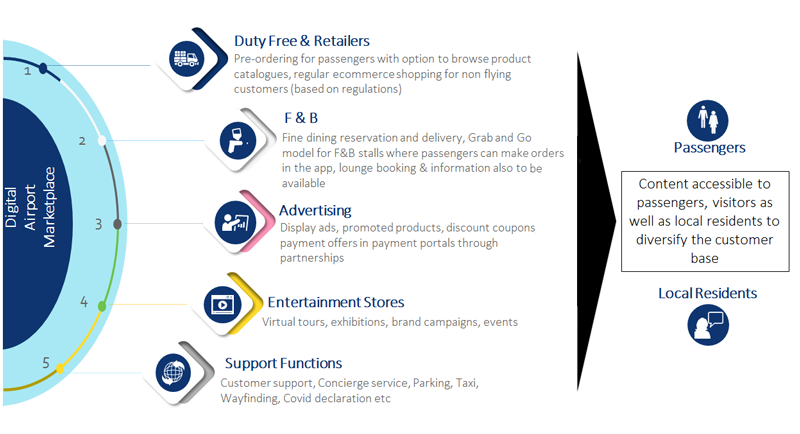
Fig 1: Airport E-commerce Service Ecosystem
The platform can offer multifold benefits and can go a long way in securing duty-free retail growth for this industry. In order to outperform this growing market in the coming years, airports have to look at this as a holistic digital platform that can support the needs of both B2C as well as B2B partners so that duty-free shops, kiosks, retail shops, and F&B stores can all be sellers on the platform.
Few key functionalities the platform can offer are:
Revenue Estimates
Let us evaluate the revenue projections and growth that can be expected by launching such a platform for airports. The question “Why will people download an airport app?” is bound to pop up in our minds knowing that an airport app or website is always visited for information & updates on flights. We are therefore considering estimates in the lower range with few assumptions listed below
Assumptions:
The table below depicts a high-level estimate of sales numbers with the advent of the online channel:
Year/ Quarter |
Flights/ day |
Passengers/ flight |
Passengers/ day |
App Users/ day |
No of users making purchases/ day |
Gross Merchandise value/ day (in rupees) |
Gross Merchandise Value/ quarter (in rupees) |
|---|---|---|---|---|---|---|---|
2020-21 Q4 |
60 |
100 |
6,000 |
300 |
6 |
9,000 |
810,000 |
2021-22 Q1 |
80 |
120 |
9,600 |
480 |
10 |
14,400 |
1,296,000 |
2021-22 Q2 |
100 |
140 |
14,000 |
700 |
14 |
21,000 |
1,890,000 |
2021-22 Q3 |
120 |
160 |
19,200 |
960 |
19 |
28,800 |
2,592,000 |
2021-22 Q4 |
150 |
180 |
27,000 |
1,350 |
27 |
40,500 |
3,645,000 |
Estimated first year GMV from passengers alone: Rs. 9,423,000
Further adding revenues from advertisements (assuming 5% contribution per industry standard (9)): Rs. 471,150
Assuming there’s a 50:50 split between passengers and non-passengers, the total expected GMV in the first year for an airport in a Tier 2 city in India can be around Rs. 20 million.
While the growth may be slow to begin with, it is expected to grow non-linearly as more and more people will accept the online channel and further sales will grow with revenues from campaigns and other third-party services.
Scaling up to the Digital Airport Ecosystem Platform: Roadmap for Product Growth
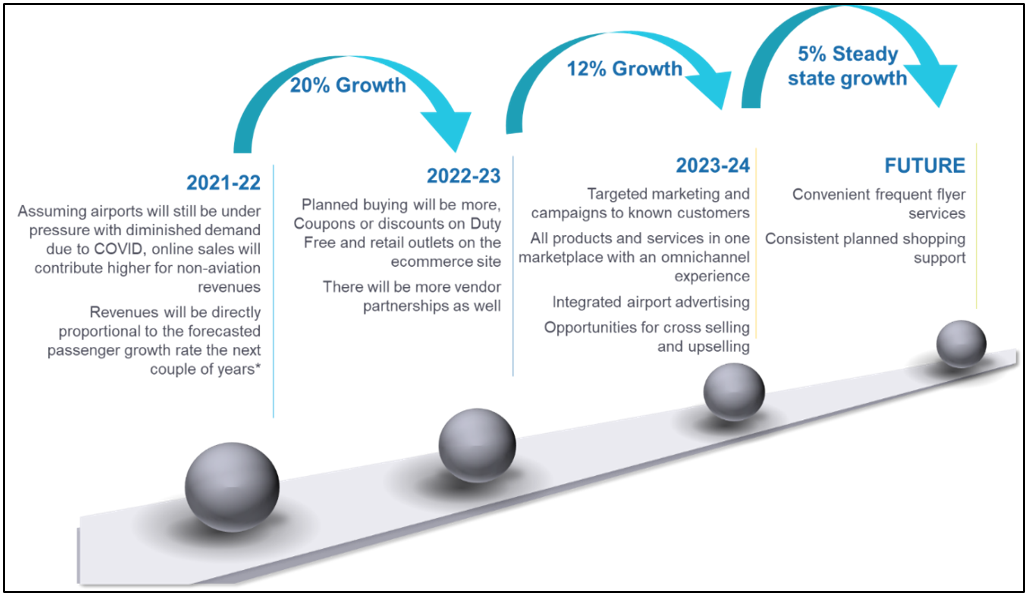
Depicted below is an illustrative roadmap for this initiative. The Airport Digital Platform can further become the entry point for all partner-related products and services, thereby generating significant revenue impact through partner integration and targeted customer offerings. The platform will also enable more partnerships for driving relevant traffic by improving ‘ease of doing business’ for the airport ecosystem partners.
Journey to a Mature Digital Airport Ecosystem
Conclusion
The fundamental necessity for passengers and customers to move to online shopping coupled with the expected gradual growth in flight travel in the coming years will result in quick growth in airport e-commerce adoption. The investments for setting up an e-commerce platform and onboarding partners are relatively low. Loyalty programs and personalization can further improve stickiness of the product.
Airports should take this opportunity to diversify their distribution channels and launch e-commerce for enabling airports and their B2B partners to boost sales. Airports can also target non-travelers and local residents with new services like ‘Pick up or home delivery’, thereby introducing new avenues for revenue. It is also important for airports to drive this with a clear vision for Airport Service Digitization and build a common digital marketplace to integrate other airport services like Cabs, Porter etc. The platform can further drive traffic to advertisers and retailers with personalized offers targeting special brands and premium products.
This initiative will not just help to improve revenues but also make the airport buying digital experience way smoother and further enhance customer experience.
Wipro Ltd and Airport Practice
At Wipro, we have a dedicated airports practice with SMEs who are building innovative solutions to address the challenges faced by the industry, based on our experience of working with leading airports across the globe in different facets of technology, strategy, and commercials.
We have developed industry reference solutions using a combination of digital airport vision, smart airport model, and solutions/accelerators for improved efficiencies that drive velocity, flexibility, and cost benefits for our customers.
We deliver end-to-end services for 15+ airports across geographies including leading airports in North America, India, and the Middle East. We also work with several leading global airlines in the areas of customer loyalty, customer and sales analytics, cargo, MRO and group booking, thereby possessing holistic experience in the aviation sector. Wipro’s Digital Commerce Service provides consulting and product selection to help customers with the best-suited e-commerce products and platforms. Wipro's ready-to-deploy accelerators, monitoring tools, managed services, implementation, operations through cloud-based models, and support ensure agility and stability.
References
Siddarth Prabakaran
Consultant, Airports
Siddarth has 5+ years of experience in the Technology and Aviation industry and is currently working as a consultant with a leading global airport.
Pranjali Bhatia
Managing Consultant, Airports
Pranjali has 15+ years of experience in Products, E-commerce, and Business Analytics in the Aviation and Travel Industry sector. Currently, she is the Lead Consultant for the Airports cluster in India.
Jasvinder Singh
India Head of Wipro’s Airport, Engineering, and Construction business
Jasvinder Singh is the India Head of Wipro’s Airport, Engineering, and Construction business. With over 20 years of experience in helping customers unlock value from their IT investments and drive business transformation strategies, Jasvinder is a respected adviser to Wipro’s Airport industry customers and partners, and a proven P&L leader within the industry. Jasvinder’s experience spans a range of industry sectors including Telecom, Retail, BPO, and Insurance.