



Colleges and universities with remote, online students face unique challenges in communicating one-on-one with students and constituents. Based on where the school is recruiting, students might be across time zones or living abroad. Adult learners might have full-time jobs and limited availability to connect with school staff during the day. Beyond time and location logistics, today’s students have preferred methods of communication and expect any business or organization they engage with - including their school - to abide by those preferences.
Considering all these factors, schools need multiple, flexible communication channels. This approach can help students make their way through the enrollment process and beyond, with one-on-one lines of communication between individual students and staff members. An effective communication plan that can be used across all departments will help ensure successful engagements between students and staff.
Knowing where to start creating your communication plan can be a challenge in itself. How do you know you’re using the right technology, at the right time, and -- perhaps most importantly -- delivering the right messages? Here we provide insight on how to get started, the tools involved, and various factors to consider.
Building a foundation
Before you create and implement an effective communication plan, we recommend taking time to build an initial foundation. These key steps will help you:
- Establish a CRM platform with campus-wide access. In a CRM, you can manage all tools, and staff will have the necessary data to give them a 360-degree view of the student. Having key student data readily available helps staff provide a more personalized experience and prevents students from having to repeat information.
For example, if a student visits the Financial Aid department and needs to proceed to the Bursar’s office, the Financial Aid Advisor can make a note on the student’s record regarding the conversation and what the student’s next steps are. Upon arrival, the Bursar’s office can clearly see that information and be able to help the student in a seamless transition. The student won’t have to rehash what just occurred with Financial Aid. - Encourage departmental collaboration to coordinate groups and avoid conflicting or overlapping messages. Broadly speaking, Admissions, Financial Aid, Academic Advising, Career Services, and Alumni Engagement should all work together. Incorporating other applicable groups, such as Residential Life or Athletics, will help ensure a truly comprehensive plan.
The goal is to unify departments and share communications, so students are not hit with multiple emails, phone calls, or texts, especially on the same day. By working together, campus departments and groups can share their communications, especially when the content has enough similarities, such as getting the student through the enrollment process. - Create a Center of Excellence (CoE), which monitors, updates and governs the student communication plan to ensure consistency. This is not intended to micro-manage or approve content, but rather to look at the communications as a whole, and periodically determine what works, what doesn’t work, and what can be improved.
Having a dedicated group to evaluate the overall student communications gives great insight into what is sent, when, how frequently, and via specified channels. The CoE should function across these main pillars: Strategy & Planning, Building & Delivery, Maintaining & Operating, Adopting & Sustaining.
Comparing tools
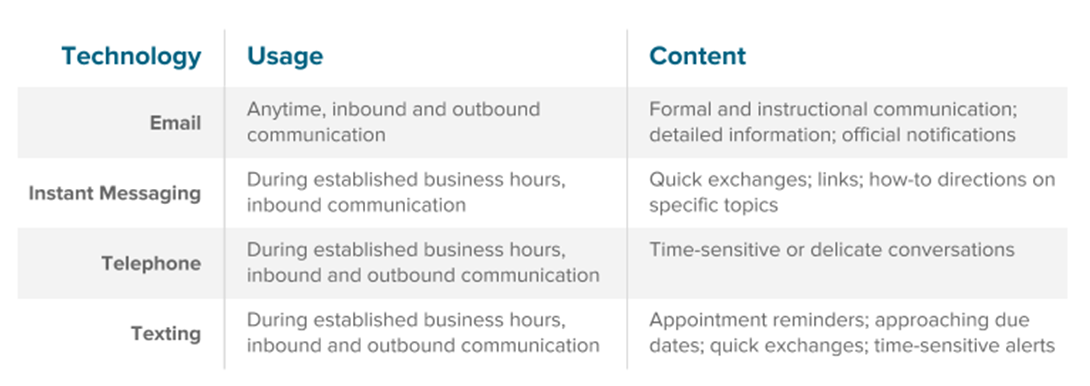
After you’ve established this foundation as the starting point, you can make decisions regarding which tools (email or telephone, for example) to use, when to use them, and what to use them for.
This table outlines the four primary communication tools that schools may want to consider using in a communication plan for one-to-one student engagement.