


The advantages of IT outsourcing IT are well known. You can transform fixed costs to variable costs, reduce dependence on commoditized and non-core components, and readily access industry best practices. All of which reduce costs and allow you to focus on adding value to core areas of the business.
But with so many advantages to be gained by outsourcing your IT, why do companies so often end up being disappointed? In our experience, it’s because many executives treat outsourcing as a pure cost-reduction initiative and underestimate the changes that IT teams and business users face.
Substantial time and money are spent selecting the right outsourcing partner, including hiring advisory consultants, identifying potential suppliers, creating, evaluating and responding to RFIs and RFPs, conducting due diligence, visiting supplier premises, and, eventually, negotiating the contracts.
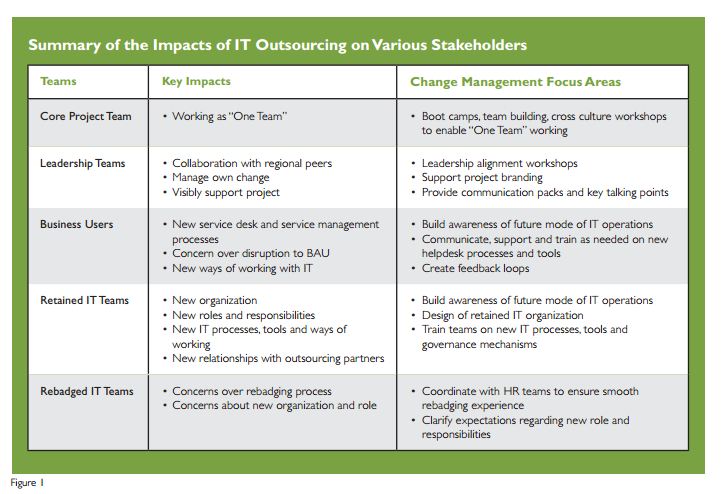
Yet the amount of time spent on considering the impact on IT teams and end users is comparatively minimal. Once the transition is complete, business users must, among other things, adapt to new service management processes, get used to concepts like self-help and self-heal, and do without long-established onsite IT support. For global companies, cultural differences may also be a crucial factor.
You can hardly blame business leaders of specialized functions like R&D, trading, production or customer service for fearing that an outsourcing partner (service provider) may not deliver what they need. If you do not reassure such user groups by bringing them into your project from the start, then you could face internal resistance, operational disruptions, and even heightened regulatory and compliance risks.
What Outsourcing Brings to the Table
For IT teams, outsourcing brings new roles and responsibilities based on the specific details of the future mode of operations. There will also be new processes and tools to understand, and new relationships to develop with counterparts from the outsourcing partner organization. For instance, the retained IT team will have to focus on areas such as supplier relationship, governance, and service management, some of which can be completely different from their pre-outsourcing responsibilities.
In short, without fully understanding the people and organizational ramifications of outsourcing, you run the risk of creating an experience that could negate your intended IT cost savings and deter your business leaders on further outsourcing.
This happened to a global telecommunications company. After a long procurement cycle, the transition to the outsourced model resulted in resistance from business leaders who were unprepared to change the ways in which they used IT services.
Previously, end users could approach the IT department directly to resolve technical issues. In the outsourced model, they were expected to call a helpdesk to log tickets. This seemingly small change created frustration, especially because users were expected to use self-help tools without appropriate training.
In the end, the company’s IT executives were forced to delay the outsourcing program, resulting in significant losses and contractual issues with their outsourcing partner.
Turning IT Outsourcing into a Change Management Initiative
In our experience, the most successful IT outsourcing projects are designed and executed as Change Management initiatives. That means in addition to the IT specialists required to design an effective technology solution and processes, you need to include Change Management experts to create a partnership with business leaders and users—one that has a clearly defined IT service vision and agreed-upon success criteria.
In an effective outsourcing plan, your Change Management experts should work alongside technical team members and company stakeholders to:
Making IT Outsourcing Work for You
We recently partnered with a global telecom organization that was planning to outsource the IT infrastructure services of its R&D function. Business leaders and end users alike were not too convinced about this as previous attempts at outsourcing had not worked as per plan. Now, the company’s IT executives were under intense pressure to deliver the right results.
The project team decided to approach the project from a business user’s perspective. The company’s Change Lead worked closely with the outsourcing partner’s Change Management experts from the start. Together, they aligned priorities among the regional leaders of the seven countries in the company’s footprint, analyzed the impact of the planned changes on different stakeholders, enabled the retained IT teams, and educated the business users on the new IT processes and tools.
The result was the kind of success that had eluded the company in its first outsourcing attempt. Business users readily adopted the new IT service delivery model and started a new culture of collaboration between IT and business users.
For decades, organizations have been turning to outsourcing to reduce costs and gain access to the most up-to-date technologies and practices. However, leadership teams in companies have underestimated the impact of outsourcing on their people.
For IT outsourcing to succeed, the transition must be treated as both an IT project and a Change Management project. Yes, the technology solution is critically important. But it’s by driving ownership and adoption of the new IT service model between your business users and IT communities that you will ensure your project’s long-term viability and gain the competitive edge in the marketplace.