

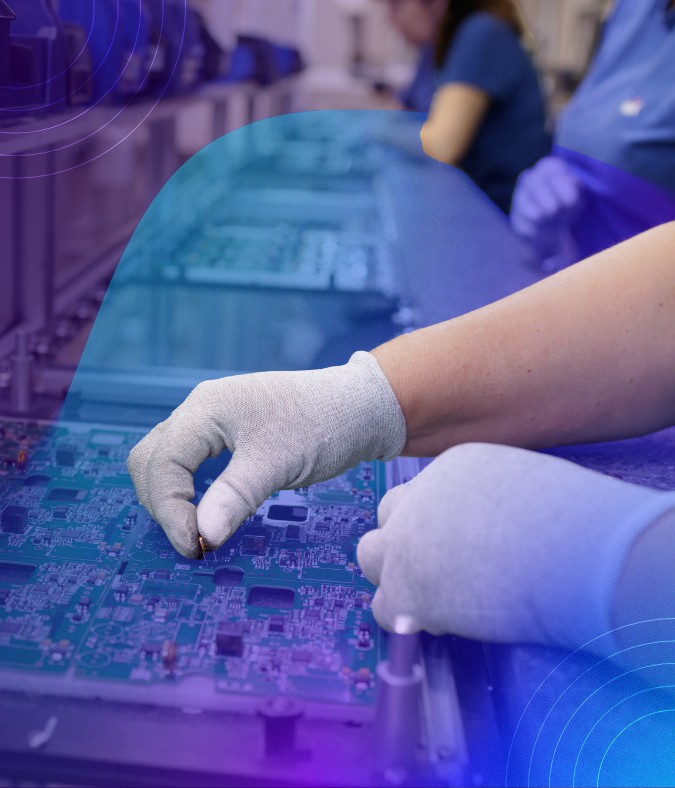

Manufacturing is entering a decisive new chapter—one defined not by incremental improvement, but by a fundamental rewiring of how plants plan, operate, and compete.

Why it matters:

  • Global supply chains are more volatile.
  • Labor is harder to source and upskill.
  • Sustainability expectations are shifting from reporting to real operational commitments.
  • The tech stack—AI, automation, connectivity is finally mature enough to deliver speed, precision, and resilience simultaneously.

The takeaway: Manufacturers that treat intelligence, adaptability, and data as core operating principles, not bolt-on capabilities will win.

1. AI-Native Operations Are Here

For years, AI in manufacturing was confined to isolated pilots and proof-of-concept projects. That era is over. AI is moving from the lab to the factory floor, becoming the backbone of industrial decision-making.

Manufacturers are no longer asking if AI can deliver value, they’re asking how fast they can scale it. From predictive quality to dynamic scheduling, AI is now embedded in core workflows, enabling real-time optimization and resilience.

  • Agentic AI is now used in diagnostics, quality, scheduling, sourcing, and tariff simulations.
  • “Physical AI” robots, cobots, vision systems is accelerating. Adoption expected to double by 2027 (OEM Magazine, 2025).

Bottom line: AI is no longer an experiment. It’s becoming the operating system for industrial decision-making.

2. Supply Chains Go Local and Smarter

Re-regionalization is gaining momentum.  Globalization’s one-size-fits-all model is giving way to regionalized, resilient networks. Manufacturers are rethinking sourcing strategies to mitigate geopolitical risk and tariff volatility.

  • Geopolitical risk, tariff volatility, and incentives (CHIPS ActEU Chips Act) are driving change.
  • Dual-sourcing, supplier diversification, and hyperlocal networks are rising.
  • AI-driven network modeling is helping manufacturers simulate risk and optimize sourcing.
  • Semiconductors led the reshoring wave, with EV batteries and power electronics following (Reshoring Initiative, 2023).

Takeaway: The supply chain of the future is local, digital, and intelligent.

3. Sustainability Becomes the Operating System

Sustainability is now a core business priority. Manufacturers are embedding green practices into every layer of operations, from material sourcing to energy optimization. In 2026, sustainability won’t just be about reporting, it’s about operational excellence.

  • 88% of manufacturers say sustainable manufacturing is “important or essential” (CommBank, 2023).
  • Green materials like SSAB Zero™ steel are scaling across automotive, construction, and heavy industry (Volvo Cars & SSAB, 2025).
  • AI-based energy optimization, carbon modeling, and lifecycle analysis are embedded in planning.

Why it matters: Sustainability is now tied to efficiency, brand, and resilience. It’s not optional.

4. The Workforce Is Changing Fast 

The talent gap remains one of manufacturing’s biggest challenges. Technology is stepping in, not to replace workers, but to augment their capabilities and accelerate onboarding.

  • 65% of manufacturers struggle to find qualified workers (NPR, 2025).
  • Connected worker platforms are scaling, integrating private 5G, AR/VR, digital SOPs, and real-time coaching (Market.us, 2025).
  • AI is capturing tribal knowledge and generating SOPs to accelerate onboarding.
  • Flexible labor models (“build, buy, borrow”) are becoming standard (SHRM, 2025). 

Bottom line: Technology is augmenting, not replacing human capability. But the talent gap is real.

5. The Tech Stack Is Ready

After years of experimentation, the industrial tech stack has matured. Technologies that were once exploratory are now embedded in daily workflows--AI, digital twins, edge computing, and robotics--are no longer futuristic, they’re foundational. 

Industrial AI & Multi-Agent Systems

  1. Generative AI powers design, predictive quality, scheduling, and documentation.
  2. Closed-loop optimization systems show 10–20% OEE gains and 20–40% fewer unplanned downtimes (LLumin, 2025Siemens, 2023).

Digital Twins & Simulation

  1. Over 50% of large industrial firms will use digital twins by 2026 (Gartner, 2025).
  2. Platforms like Siemens Xcelerator and NVIDIA Omniverse enable immersive planning and MES-connected optimization. (Siemens, 2023).

Edge Computing + Private 5G

  1. Enables ultra-low-latency apps: machine vision, AMR orchestration, AR-guided assembly.
  2. Key use cases: Solutions like Wipro’s InspectAI allow for predictive maintenance, real-time analytics, and remote expert assistance. 

Next-Gen Robotics

  1. Annual industrial robotic installations have doubled over the last decade and will surpass 700,000 by 2028 (International Federation of Robotics).
  2. Cobots and AMRs dominate growth; humanoids remain in pilot stage.
  3. AI-enabled robotics drive mass customization and adaptive material flow.

Additive Manufacturing & Advanced Materials

  1. Metal AM is moving into production-scale use in aerospace, energy, and automotive (Strategic Revenue Insights, 2025).
  2. High-entropy alloys, composites, and hybrid printing are gaining traction (EPSRC HEAT-AM, 2024).

OT Cybersecurity & Zero-Trust Architectures

  1. 96% of manufacturers plan to invest in OT cybersecurity (Rockwell Automation, 2025).
  2. Zero Trust models, secure-by-design PLCs, and AI-enhanced threat detection are becoming mandatory.

Manufacturers now have the tools to unify intelligence, automation, and connectivity into a single adaptive system. From predictive maintenance to immersive planning, these technologies are driving measurable gains in efficiency and resilience.

What’s Next: The Competitive Gap Widens

2026 marks an inflection point.

  • Digital twins are expanding from single-line pilots to enterprise platforms.
  • Sustainability is evolving into an operating system.
  • OT cybersecurity is transitioning from IT hygiene to real-time production resilience.

The next phase of manufacturing will reward organizations that unify intelligence, automation, and human capability into a single, adaptive operating model.

Those that don’t? They’ll be stuck running pilots while competitors compound performance gains.

About the Authors

Naveen Gupta
Senior Partner, Chemicals Consulting 

Jignesh Patel
Partner, Industrial Consulting

Contact Us