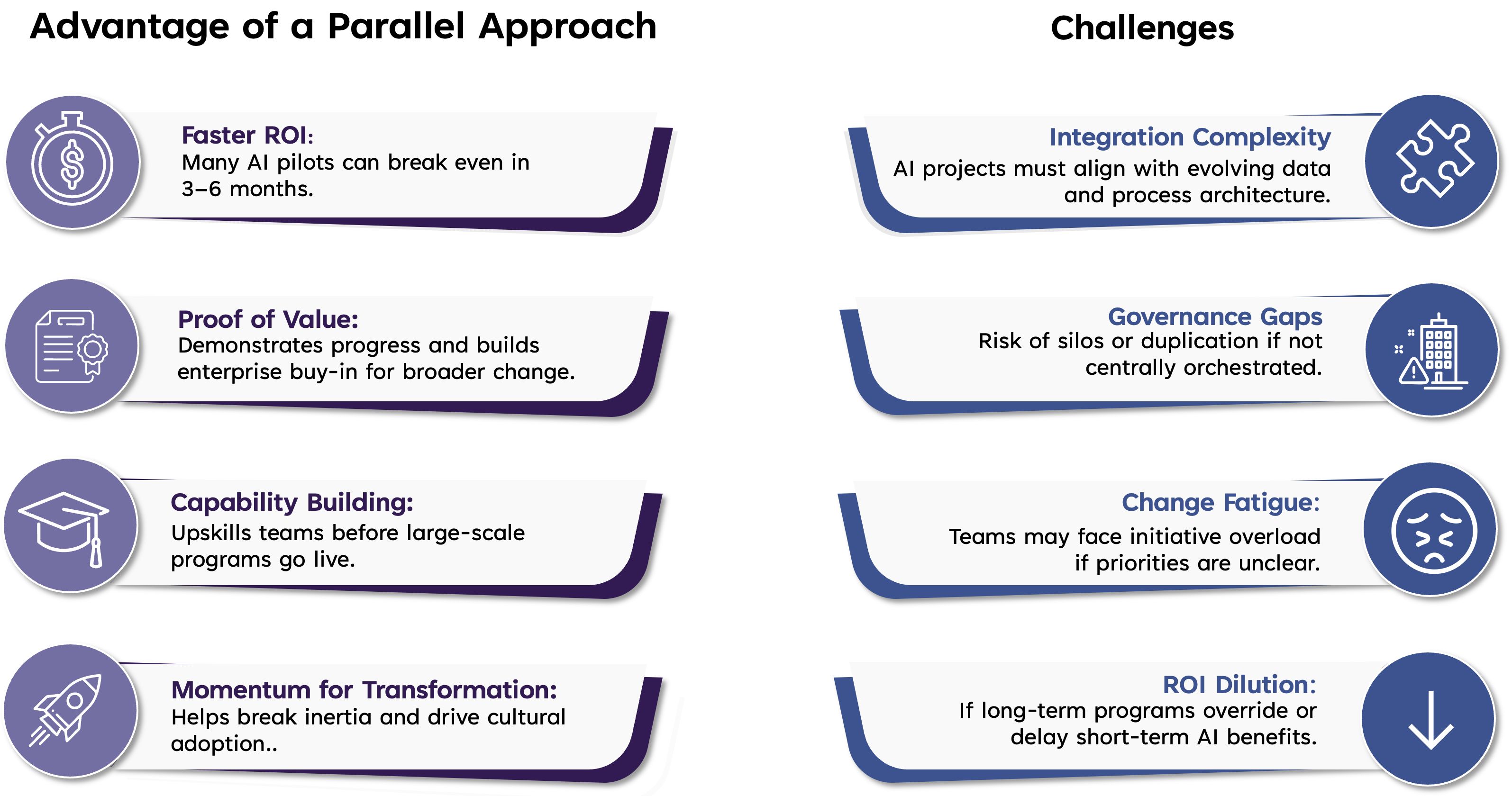
Real-World examples:
- A leading health insurance company based in the U.S. modernized its specialty pharmacy operations through a phased AI-led transformation. For near-term quick wins, they prioritized automation in prior authorizations, prescription processing, and contact center operations improving turnaround time and reducing call deflection. This approach combined with a long-term roadmap, delivered $30M in projected savings and a 30% increase in payer-agnostic prescriptions.
- A global fashion retailer leveraged AI to modernize its manual, bottom-up revenue forecasting process, initially facing skepticism around AI’s adaptability to fast-changing consumer trends. As a short-term win, the AI model quickly demonstrated 98% accuracy in forecasting past revenue building trust in the system and enabling faster adoption. This laid the foundation for uncovering $226M in unrealized revenue and enhancing strategic decision-making with greater transparency.
How to implement AI along ongoing transformation projects
1. Unified roadmap with dual-speed architecture: Enable both agile sprints and marathon programs
2. Executive alignment on prioritization and ROI: Tie short-term value to long-term business outcomes
3. Flexible funding models: Create ringfenced budgets for AI innovation alongside core investments
4. Modern change and governance frameworks: Orchestrate initiatives under a single vision
5. Data readiness playbooks: Enable AI without waiting for full data lake modernization
The Future belongs to the ‘fast and the focused’
To stay competitive and future-ready, enterprises must learn to run sprints while laying the track. By executing fast-cycle AI initiatives in tandem with foundational transformations, organizations can de-risk their innovation journey, create early momentum, and build a culture of experimentation and measurable value.
To learn more about how you can better leverage existing data to supercharge your AI readiness, download Wipro’s Data 4 AI Report.