Implications for Leaders
The hardest shift in the X model is economic, not technological. Leaders must let go of familiar proxies—hours, utilization, headcount—and confront more demanding questions:
- Where is value actually created?
- Who owns outcomes end-to-end?
- How do we reward collaboration without eroding accountability?
Firms that avoid these questions will drift into a dangerous middle ground: AI enabled in delivery, but legacy bound in economics. Those that address them directly will find that the X model does not lower ambition—it forces clarity.
In an AI driven consulting economy, value is no longer hidden in the pyramid. It is explicit, owned, and priced accordingly.
What Leadership Looks Like in the X Model
Leadership changes just as fundamentally.
As AI absorbs analytical and executional work, leaders create value less through expertise and oversight and more through context, judgment, and system design. Their role shifts in three ways:
- From command to context
Leaders define direction, guardrails, and success criteria; then empower teams and AI agents to execute within those boundaries. - From answers to judgment
When AI can generate options instantly, leadership value lies in deciding which questions matter, when to intervene, and how to weigh trade-offs. - From managing talent to building capability
Leaders become accountable for skills, trust, and resilience at scale; not just utilization and progression.
The premium moves to leaders who can integrate strategy, technology, and people—rather than optimizing one in isolation.
Learning Becomes the Operating System
The X model only works if learning is no longer a separate function.
In an AI enabled firm:
- Development is embedded in daily work
- Skills are validated continuously, not self reported
- AI provides coaching, reflection, and challenge in real time
- Career progression is based on skills and impact, not tenure
This solves the apprenticeship problem the diamond creates. People learn by doing, supported by intelligent systems that surface feedback, stretch assignments, and future skill gaps.
The consulting firm becomes a living learning system, not a static hierarchy.
Conclusion: What This Means for Consulting Leaders
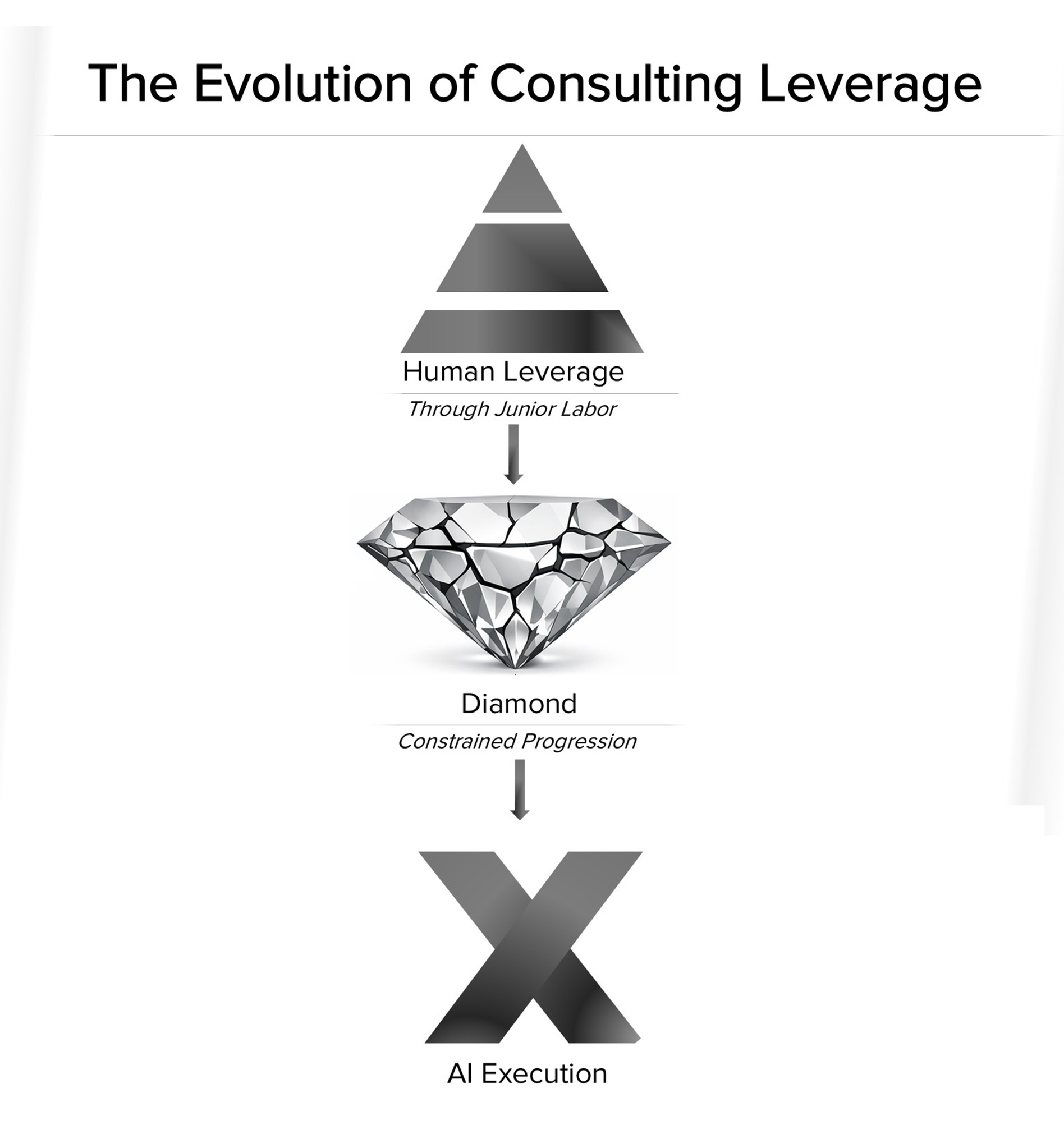
The shift from diamond to X is not a workforce tweak. It is a strategic redesign.
Leaders must confront four hard questions:
- Where does judgment matter most, and how do we protect it from erosion?
- How do we train future leaders when repetition disappears?
- How do we price value when AI collapses effort?
- How do we build trust in AI, in people, and with clients… at scale?
Firms that treat AI as a productivity tool will shrink their way into relevance. Firms that redesign talent, learning, and economics together will redefine the industry.
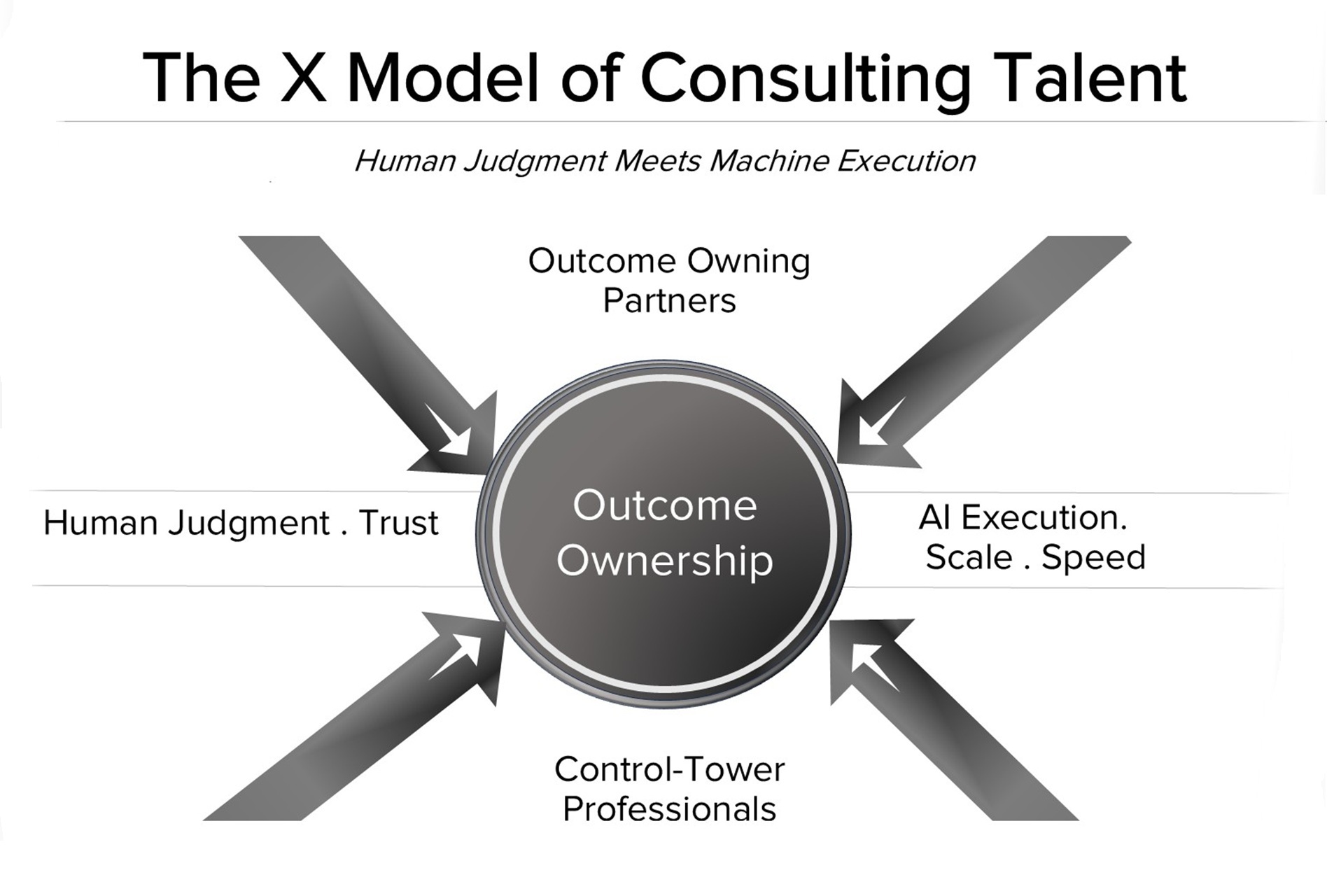
If the X model explains how consulting talent is reorganized in an AI driven world, high performance determines whether the model actually delivers value.
AI does not automatically create high performing organizations. In many cases, it does the opposite: It often amplifies speed without direction, output without insight, and activity without outcomes. The difference lies not in technology, but in culture and leadership.
The future of consulting will not belong to those with the biggest pyramids, or even the most elegant diamonds, but to those who master the X: where human judgment and machine intelligence intersect to deliver outcomes clients actually care about.
Redefining High Performance in an AI Enabled Consulting Firm
In traditional consulting cultures, high performance was often synonymous with intensity: long hours, heroic effort, and individual brilliance. In an X model, that definition no longer holds.
High performance shifts from effort to orchestration, and rests on four conditions:
- Clarity of outcomes: Teams are measured on results delivered, not volume of work produced. AI accelerates execution, but leadership clarity and governance ensures it accelerates the right work.
- Trust paired with accountability: Consultants must trust AI outputs enough to act on them and be accountable for when human judgment should override them.
- Learning embedded in work: Skills are built continuously through real assignments, supported by AI feedback and coaching, rather than through episodic training.
- New skills ecosystems: AI removes friction, but humans still provide judgment, creativity, and ethical reasoning. High performing cultures design for growth, with change at the heart.
In this model, performance is no longer about pushing harder; it is about designing evolving systems that allow people and machines to perform at their best together.
Why Integrated Consulting Models Are Structurally Better Positioned
These cultural and leadership demands expose a structural fault line in the consulting industry.
Pure play consulting firms were built around selling effort. As AI compresses that effort, they must simultaneously reinvent pricing, delivery, talent models, and culture; often while defending legacy economics.
By contrast, consulting embedded within a global technology and services organization starts from a different place.
In integrated models - where consulting sits alongside execution, platforms, and long-term operations - three advantages emerge:
- Proximity to outcomes
Consulting teams are closer to delivery and operations, enabling clearer accountability for results rather than recommendations alone. - AI as an operating reality, not an abstraction
AI is embedded in delivery, monitored in real time, and refined through continuous use; making human AI collaboration tangible and credible. - A performance culture shaped by execution
High performance norms are grounded in what works over time, not just what persuades in a boardroom.
In this context, consulting becomes a multiplier: Amplifying the organization’s ability to deliver complex change, rather than a standalone advisory product.
As consulting moves from diamond to X, competitive advantage will not come from org charts or AI investments alone. It will come from cultures that enable judgment, leaders who design and lead systems rather than manage activity, and operating models that tie insight directly to outcomes in a business environment that will increasingly experience levels of disruption not seen since the creation of the electricity or internet.
The future of high-performance consulting belongs to organizations that can integrate human judgment, intelligent machines, and execution at scale; and make that integration their defining strength.