



Executive Summary

Finance teams are being asked to deliver accurate and faster forecasts, tighter control, and better strategic guidance, at the exact moment when volatility and data complexity are making traditional FP&A cycles less reliable.

Agentic AI can help to improve the operating model. Instead of automating isolated tasks, agentic systems deploy “digital analysts” that can reconcile data, run scenarios, explain variance drivers, and recommend actions, continuously and within defined guardrails.

For CFOs, the opportunity isn’t just efficiency. It’s strategic: FP&A becomes a continuously running decision system that improves decision velocity across margin, cash, and capital allocation.

The winners won’t be the organizations that use AI. They will be the ones that govern it like finance with transparency, auditability, and clear accountability.

The FP&A Reality: Data-Rich, Insight-poor, and Too Slow

Most finance organizations are not short on data. They are short on time, trust, and decision velocity.

Common FP&A pain points are well known:

  • Analysts spend excessive time gathering, reconciling, and validating data.
  • Financial data is fragmented across ERP, CRM, operational systems, and spreadsheets.
  • Forecasts refresh on fixed calendars—even when the business changes daily.
  • Variance analysis explains what happened, not what should happen next.
  • Scenario modeling is too slow to keep up with executive decision-making.

The result: FP&A teams describe the past instead of shaping the future.

When businesses can reprice, reroute, and reallocate resources in days, a forecast that updates monthly is no longer a strategic tool, it’s a lagging indicator.

What Makes Agentic AI Different in FP&A

Many CFOs have already invested in automation, analytics platforms, and predictive models. Agentic AI goes further.

Rather than automating isolated tasks, agentic AI deploys intelligent agents that can operate across the FP&A lifecycle. These agents can:

  • Integrate and reconcile data continuously
  • Detect anomalies and explain likely drivers
  • Generate and compare scenarios on demand
  • Produce executive-ready narratives
  • Trigger updates when conditions change
  • Recommend actions within defined guardrails

This enables a shift from periodic planning to event driven, continuous planning.

In practice, FP&A becomes less about producing forecasts and more about orchestrating decisions.

Agentic AI vs. GenAI in FP&A 

  • GenAI is strongest at generating content: commentary, narratives, executive Q&A, and summarizing insights.
  • Agentic AI orchestrates work: it coordinates tasks, runs processes end-to-end, and escalates exceptions, within governance.

In FP&A, GenAI makes insights easier to consume. Agentic AI makes insights faster to produce and more consistent.

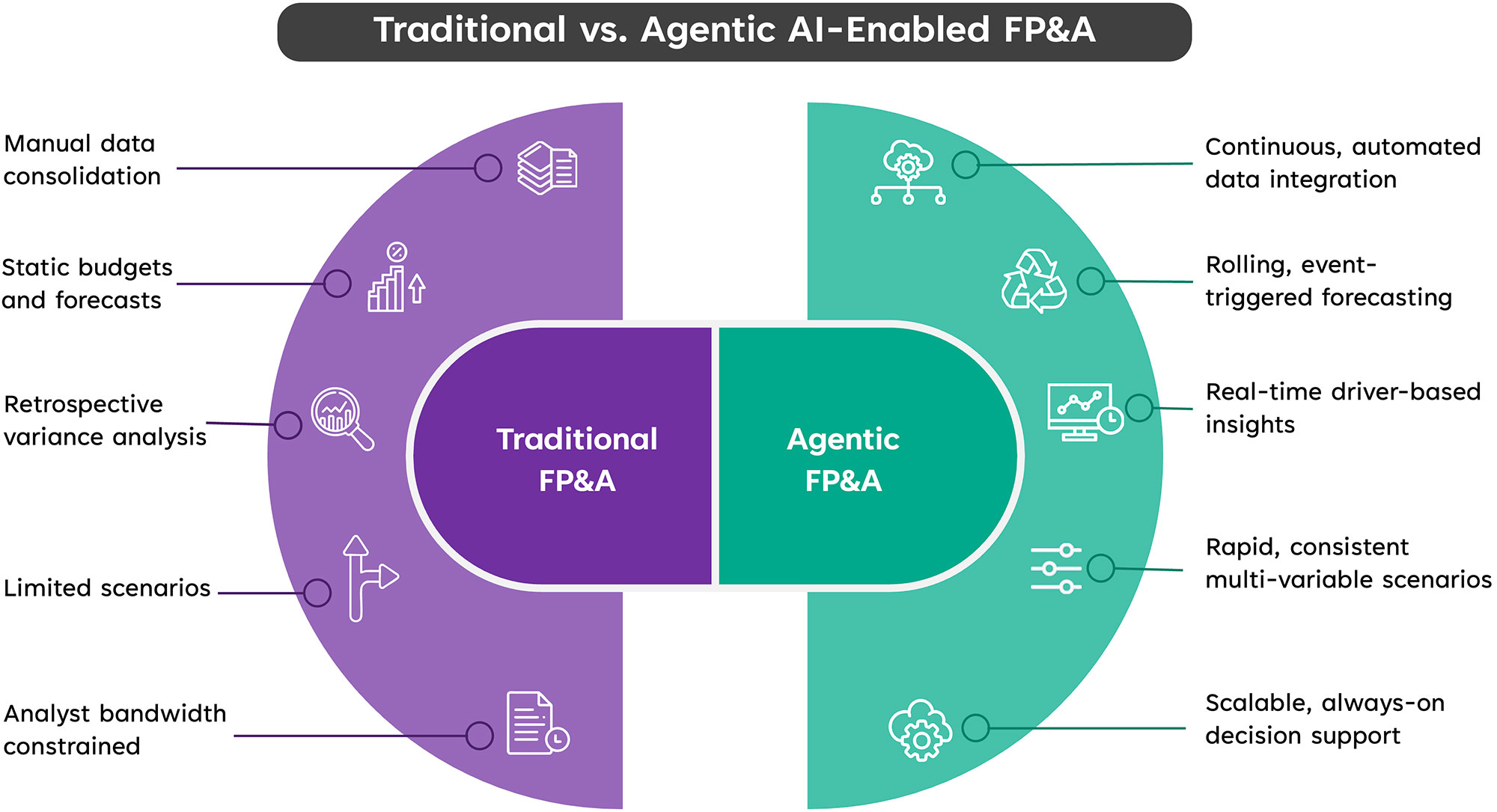
From Traditional FP&A to Agentic FP&A

The difference is not incremental. Instead of relying on individual heroics and spreadsheets, FP&A becomes a scalable, continuously improving capability.

Where CFOs See Value First

In our experience with clients, CFOs increasingly prioritize agentic capabilities in a few high-impact areas:

1. Continuous forecasting

Agents monitor leading indicators such as orders, pipeline, utilization, pricing, and cost signals, and refresh forecasts when thresholds are crossed, not when the calendar dictates.

Impact: faster response to volatility and fewer forecast surprises.

2. Driver-based variance analysis

Rather than days spent tracing discrepancies, agents identify anomalies, surface likely drivers (volume, mix, price, cost), and highlight operational contributors.

Impact: reclaimed analyst time and better alignment with business leaders.

3. Executive-speed scenario modeling

Agentic systems enable finance teams to generate, compare, and refine scenarios quickly, using consistent assumptions.

Impact: better decisions under uncertainty.

4. Narrative and conversational insights

GenAI layers on top of agentic workflows to analyze data and translate outputs into clear executive language, answering “what changed, why it matters, and what to do next.”

Impact: faster executive alignment and fewer ad-hoc fire drills.

From Black Box to Glass Box: the CFO Control Imperative

Here is where many AI initiatives stall. Finance cannot scale AI without trust, transparency, and control. If a forecast cannot be explained, it cannot be operationalized.

CFOs must insist on glass box FP&A:

  • Explainable drivers behind every forecast and recommendation
  • Clear data lineage and refresh timing
  • Full audit trails of agent actions and approvals
  • Defined segregation of duties between humans and agents
  • Ongoing monitoring for model drift and bias

Agentic FP&A succeeds not because it removes humans, but because it elevates judgment within strong financial governance.

A Pragmatic Adoption Path

Successful CFOs take a phased approach:

  • Phase 1: Foundational automation
    Target repetitive work such as data extraction, reconciliation, and recurring reporting to free capacity and stabilize inputs.
  • Phase 2: Specialized intelligence
    Deploy focused agents in ERP (Enterprise Resource Planning) and EPM (Enterprise Performance Management) for forecasting, variance analysis, and scenario modeling to accelerate insight.
  • Phase 3: Human-led, AI-powered strategy
    Embed governance, review controls, and override mechanisms so FP&A becomes a proactive strategic partner.

The goal is not autonomous finance. The goal is better, faster, more defensible decisions.

The Strategic Takeaway

Agentic AI is redefining FP&A from an administrative process into a continuously running decision system.

Routine work becomes autonomous. Insight becomes faster. Finance leaders gain the bandwidth to focus on what matters most: judgment, trade-offs, and enterprise value creation.

In an era of constant uncertainty, decision velocity, governed by financial discipline, becomes a competitive advantage.

For CFOs exploring agentic FP&A, the smartest place to start is a focused pilot: 

identify a high-friction FP&A process, define success metrics, and prove value within a governed framework.

About the Authors

Anil Bhange
Managing Consultant, Finance Transformation, Western Europe

Anna Bida
Senior Partner, Head of Consulting Western Europe and Head of Finance Transformation Europe