



The Economic Imperative for Autonomous Networks

The telecommunications industry has reached the point where the cost of inaction at companies can become visible in mere months. Telecoms deferring the transition to autonomous, AI-native networks are not simply falling behind on technology. They are accumulating what we call Autonomy Debt: a compounding structural liability that manifests as higher operating costs, slower time-to-market, and an inability to compete for the enterprise contracts that will define the next decade of revenue growth.

The numbers clarify the urgency. 5G deployments require materially higher capital expenditure per subscriber than 4G, while average revenue per user stagnates or declines in mature markets. Simultaneously, network complexity is growing at a pace manual operations cannot absorb. Industry studies indicate that only around 20% of NOC alarms result in actionable intervention, meaning most operational effort is consumed by noise. Operators implementing intelligent automation report reductions of up to 70% in daily alarm handling time. At scale, the difference between those two operational realities can translate into substantial annual savings.

Autonomous networks are not a long-term aspiration. They are the operational and commercial foundation required to compete in 5G Advanced and pre-6G environments. Operators that move decisively now will establish competitive advantages in cost structure, service quality, and revenue models that compound over time and become increasingly difficult for delayed competitors to match.

Three Forces Redefining the Operator's Competitive Landscape

  1. Complexity has become unmanageable at human scale. Modern operators balance heterogeneous infrastructures spanning legacy systems, cloud-native applications, distributed edge computing, and an IoT footprint projected to reach 40 billion devices by 2030. 5G Standalone introduces configuration complexity far beyond 4G, driven by network slicing, programmable user plane functions, and continuous microservice operations. Operational teams have grown at only 3 to 5% annually. The gap between infrastructure complexity and human operational capacity is not a staffing problem but a structural one, and intelligence-driven automation is the most viable way to close it at scale.
  2. The economics of traditional operations are unsustainable. Traditional network operations scale linearly with infrastructure complexity, creating cost trajectories that compress margins over time. Operators achieving 30 to 50% reductions in operational expenditure through intelligent automation are not cutting corners; they are fundamentally restructuring how their networks run.
  3. Enterprise customers are raising the bar beyond what manual operations can meet. Mission-critical applications across autonomous vehicles, industrial automation, and extended reality demand guaranteed service levels: single-digit millisecond latency, availability exceeding 99.9999%, real-time adaptive performance. These requirements cannot be met through reactive, human-mediated operations. They require networks that can sense, decide, and act autonomously.

The Hidden Barrier to Autonomy: From Limited Steps to Transformational Change

What the industry often underestimates is that the primary barrier to autonomous networks is not technological maturity but institutional inertia. Many operators continue to operate within long-established models designed for human-mediated control. NOC processes emphasize escalation over prevention, vendor contracts remain tied to ticket volumes and SLA penalties rather than outcomes, and regulatory frameworks continue to assume human accountability at critical decision points. Together, these factors create structural resistance that makes it difficult for enterprises to fully embrace the autonomy they aim to achieve.

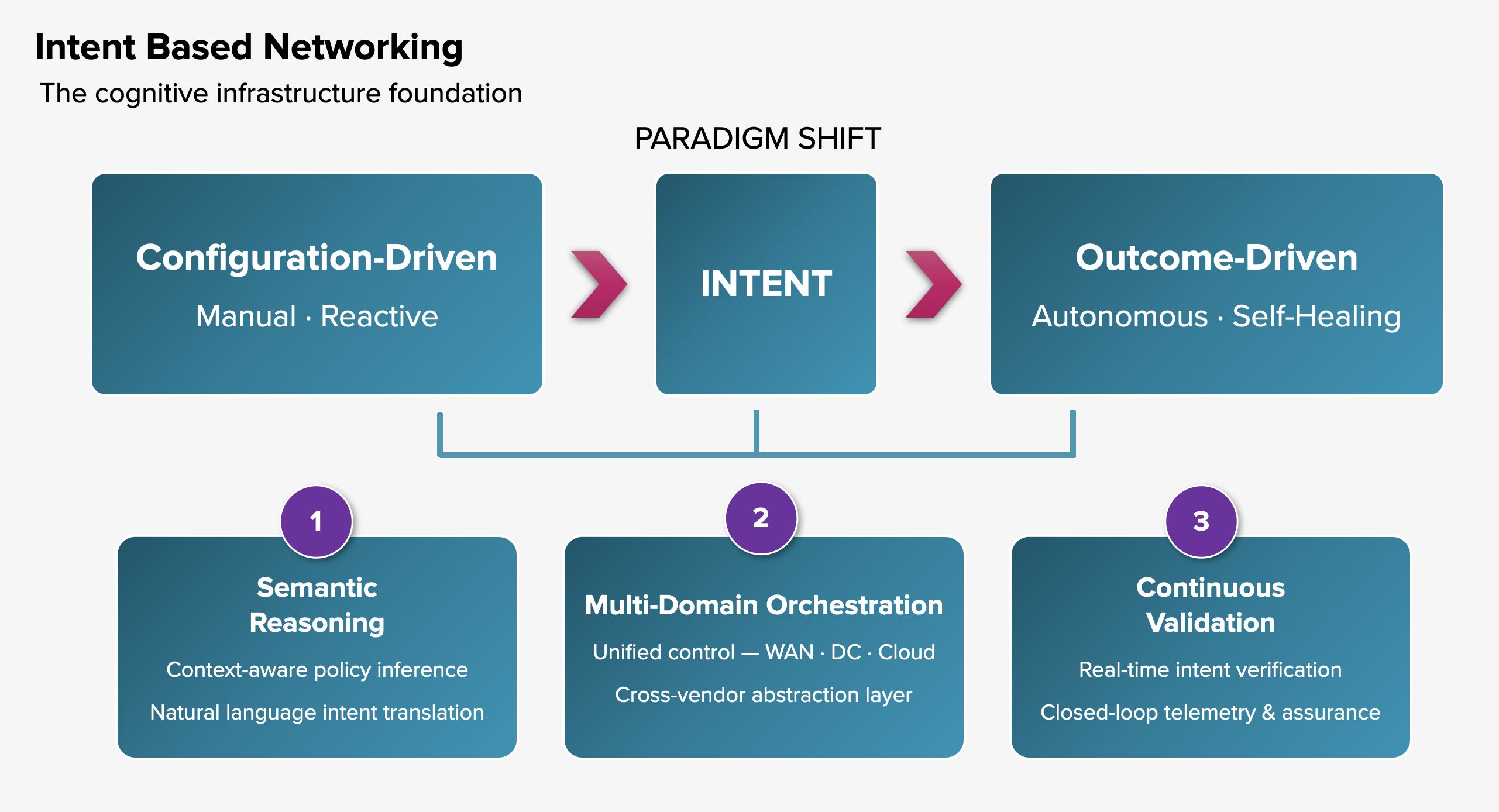
True autonomous networks represent a shift beyond automation toward intent-driven, intelligent operations. Instead of instructing the network how to behave, operators define the outcomes they require, such as service levels or latency thresholds, and the network translates this intent into coordinated action across domains in real time. The emerging frontier is the agentic network, where distributed AI agents continuously learn, collaborate, and act in alignment with evolving business objectives. In practical terms, this enables the network to anticipate and resolve conditions such as congestion during large-scale events by dynamically reallocating resources across domains and validating outcomes before human intervention is required. Some of these capabilities are beginning to move into production, with leading operators demonstrating high levels of predictive accuracy and building operational intelligence that compounds over time.

Operators that make meaningful progress toward autonomy recognize that this is not a purely capability-led journey. They evolve their operating model in parallel with technology adoption, progressively reducing dependence on legacy constructs. This includes transitioning NOCs toward exception-based oversight, shifting commercial models toward outcome-driven agreements, and engaging regulators to support new approaches to assurance and accountability.

In this context, a consulting partner helps orchestrate coordinated transformation across operations, commercial frameworks, risk, and governance. The operators that will lead in this new era are those that treat autonomy not simply as a network upgrade, but as a broader business transformation that reshapes how decisions are made, how accountability is defined, and how value is created across the telecom enterprise.

The Architectural Foundation

Five interconnected capabilities define an autonomous network.

Intent-Based Networking translates business objectives directly into network policy, eliminating the manual translation layer between commercial intent and technical implementation. When conditions deviate from intended states, the system automatically initiates corrective action. Production implementations achieve policy compliance rates exceeding 99.5%
AI/ML-Driven Observability extends far beyond traditional monitoring. Supervised learning systems achieve 95%+ accuracy in categorizing network issues. Unsupervised learning identifies novel anomalies without labeled training data. Reinforcement learning optimizes radio access networks in real time, achieving 15 to 25% capacity improvements. This creates a continuously improving operational picture of the network.

Closed-Loop Automation converts network intelligence into autonomous action through hierarchical control loops operating at different time scales: fault response in milliseconds, capacity optimization over hours, and strategic planning over days. Leading deployments achieve 80 to 90% automation rates for Level 1 and Level 2 support activities, with up to 80% reduction in unplanned outages.

Digital Twin Technology creates a continuously synchronized virtual replica of the network, enabling comprehensive change testing before production implementation and probabilistic capacity planning through simulation. Production digital twins now achieve over 90% accuracy on tasks such as beam prediction and propagation modeling, reducing the operational risk that has historically constrained configuration velocity.

Cross-Domain Orchestration unifies service lifecycle management across the full infrastructure stack like RAN, transport, optical, core, and cloud through standardized APIs and resilient service mesh architecture. When services span multiple domains and vendors, orchestration ensures consistent experience and automated conflict resolution.

These five capabilities are not independent workstreams. They are an integrated system whose value compounds when implemented together.

A Phased Path to Autonomy

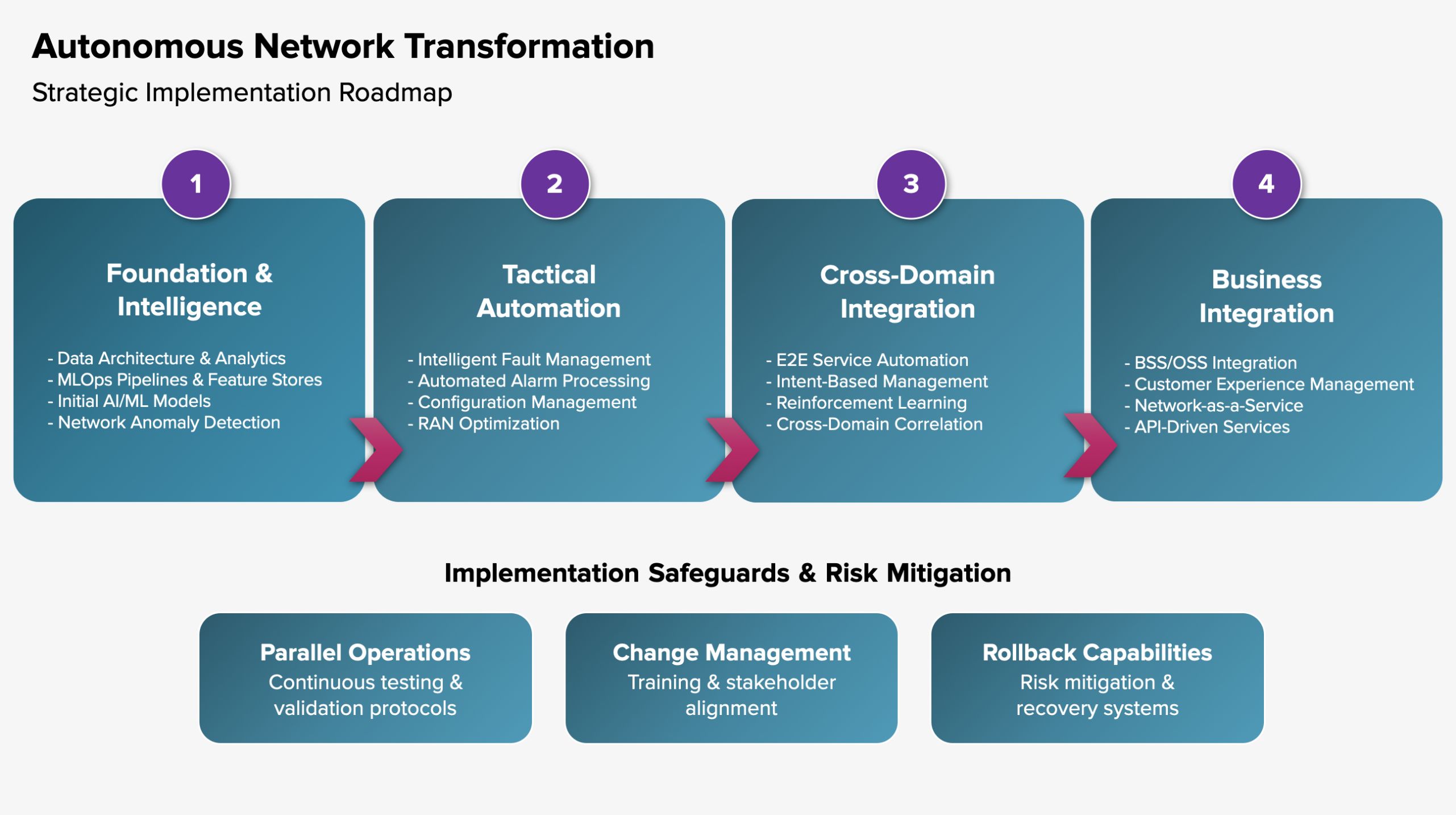
Autonomous network transformation is a phased reorganization of architecture, operations, and organizational capability, designed to deliver measurable value at each stage.

Phase 1: Intelligence Foundation. Establish the data infrastructure and observability platforms on which all subsequent automation depends. Modernize telemetry infrastructure, deploy scalable analytics platforms, and prioritize high-impact initial AI/ML use cases: anomaly detection, performance prediction, alarm correlation. Validate all model decisions in sandboxed digital twins before any production deployment.

Phase 2: Tactical Automation. Target specific operational pain points. ML-driven alarm correlation reduces false positives by 70 to 80% and enables predictive maintenance that identifies at-risk equipment in advance of failure. Configuration management automation drives up to 86% cost avoidance in service fulfilment and 71% reductions in assurance labor time, while accelerating deployment velocity. Domain-specific RAN and transport optimization delivers 15 to 25% capacity improvements and 20 to 30% reductions in transport operational expenditure.

Phase 3: Cross-Domain Integration. Integrate domain capabilities into comprehensive cross-domain automation and introduce the agentic AI layer: distributed agents that coordinate action, negotiate resources, and align execution to business intent without human orchestration. End-to-end service automation achieves 80 to 90% automation rates for routine service management. Cross-domain AI correlation enables causality inference and coordinated remediation that siloed operations cannot achieve.

Phase 4: Business Integration and Revenue Transformation. Connect autonomous network capabilities to business systems and new commercial models. BSS/OSS integration enables automated service fulfilment from order to activation. More significantly, this phase unlocks revenue streams that remain structurally inaccessible to traditional architectures: network slicing is already commercially deployed across 65 services worldwide, with 55% generating revenue through subscription and B2B models; API-driven platform services transform operators from connectivity providers into ecosystem businesses; and Network-as-a-Service models align revenue directly with customer consumption and outcomes. Several telcos in Europe have reported operational cost reductions of 25 to 40% from broader autonomy transformation efforts in 2025.

The Compounding Advantage and the Cost of Delay

Operators that achieve early autonomy gain advantages that multiply. A 30 to 50% reduction in operational costs can create structural reinvestment capacity that competitors on legacy models cannot replicate. AI model maturity, trained on real network data across millions of events, becomes a proprietary asset that takes competitors years to replicate. Operational learning embedded in closed-loop systems compounds continuously.

The reverse is equally true. Every quarter of deferred transformation increases the Autonomy Debt operators must eventually repay at greater cost, against a more advanced competitive field, with less time before 6G timelines accelerate. Operators building autonomous capabilities today are not simply preparing for 6G, they are ensuring they have the architectural foundation, operational maturity, and AI model depth to compete when it arrives. Those that delay will face compounding disadvantage: architectural debt, model immaturity, and operational cultures that have had years less time to adapt.

What Executive Leadership Must Own

Autonomous network transformation cannot succeed as a technology program. The cost of delay is rising, and four dimensions of executive commitment determine success.

  • Strategic clarity: a specific, measurable vision for autonomy maturity that is tied to business outcomes, not technology milestones and communicated consistently across the organization.
  • Funding discipline: multi-year investment structured around operational and commercial outcomes, not technology delivery.
  • Cross-functional governance: transformation ownership that spans network operations, IT, finance, and commercial functions because autonomous networks built for technical achievement rather than business impact consistently underdeliver.
  • Talent and culture: active investment in data science, AI/ML, and software engineering capability, alongside the change management that brings operational teams through a transition that fundamentally changes their roles. Operators that fail at autonomy transformation often fail less on technology than on culture and change management.

The question facing telecommunications leaders is not whether autonomous networks will define the next era of the industry. It is whether your organization will be positioned to lead that transition or be forced to respond to competitors that moved first.

About the Author

Balagurunathan Palaparthi Radhakrishnan
Industry Consulting Partner and Head of TMT Consulting for ANZ, Wipro Consulting

Balagurunathan Palaparthi Radhakrishnan has over 25 years of experience in telecom network transformation and large-scale delivery across Tier-1 telcos in the ANZ region. He has led complex transformation programs across network and OSS domains and has previously held senior leadership roles in a global technology services firm and within a Tier-1 telco, leading integration labs, modernization programs, and multi-vendor ecosystems. His focus areas include autonomous networks, AI-driven operations, and intent-based transformation, helping operators evolve toward resilient, scalable, and self-operating network environments. Passionate about bridging strategy with execution, Balagurunathan brings a strong consultative mindset to enabling next-generation networks that support 5G Advanced and future-ready network architectures.