The Agentic AI Operating Model: From Prototype to Production
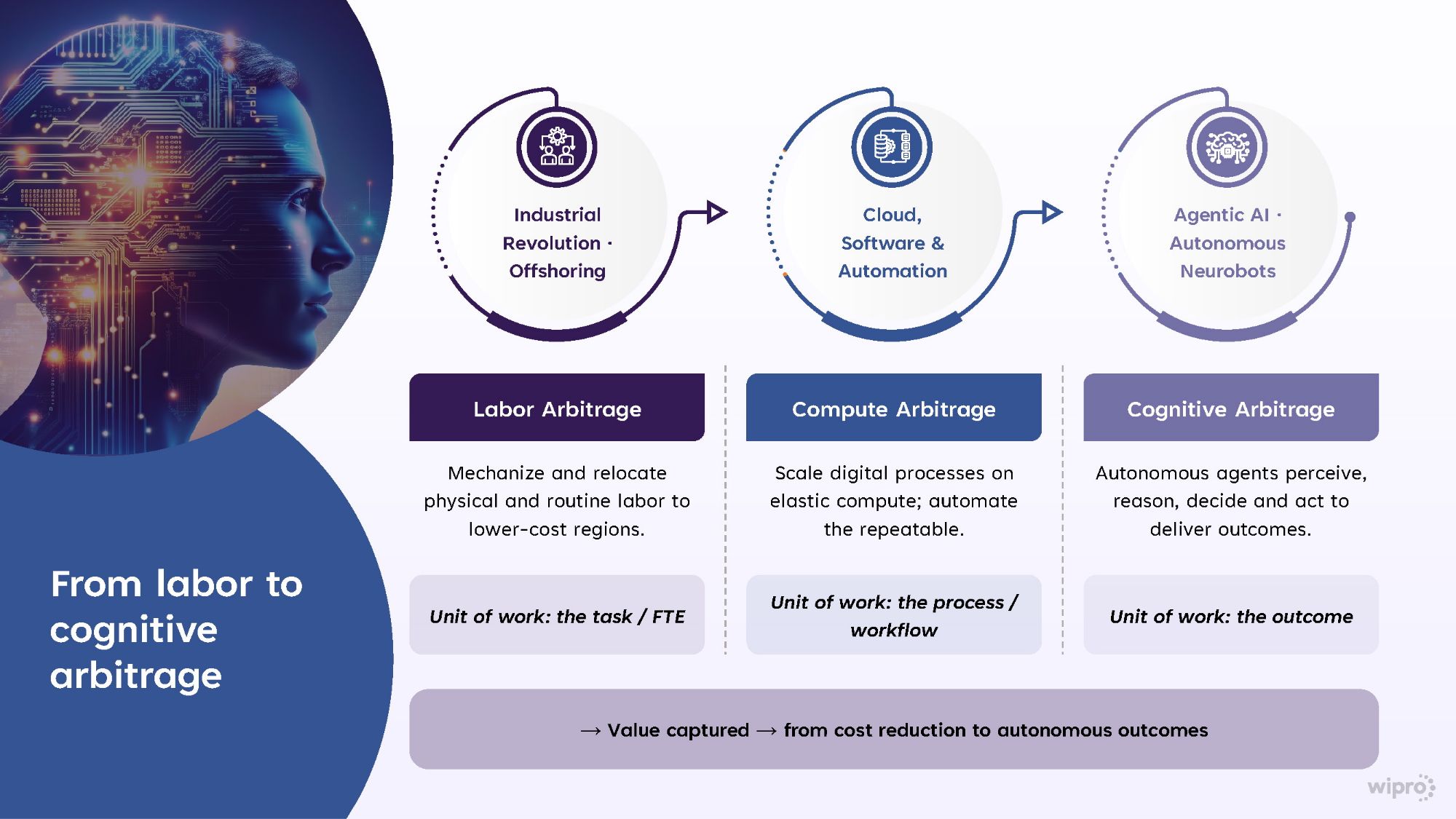
Agentic AI is more than a technology upgrade; it represents a structural shift in how enterprises operate. Agentic AI enables organizations to rethink operating models, moving from experimentation to production-grade deployment. In this model, autonomous execution is no longer just another layer of automation. Autonomous agents can perceive, reason, act, adapt and deliver outcome-oriented results, helping enterprises move away from legacy execution dependencies toward self-orchestrating, always-on operating models that run across global time zones.
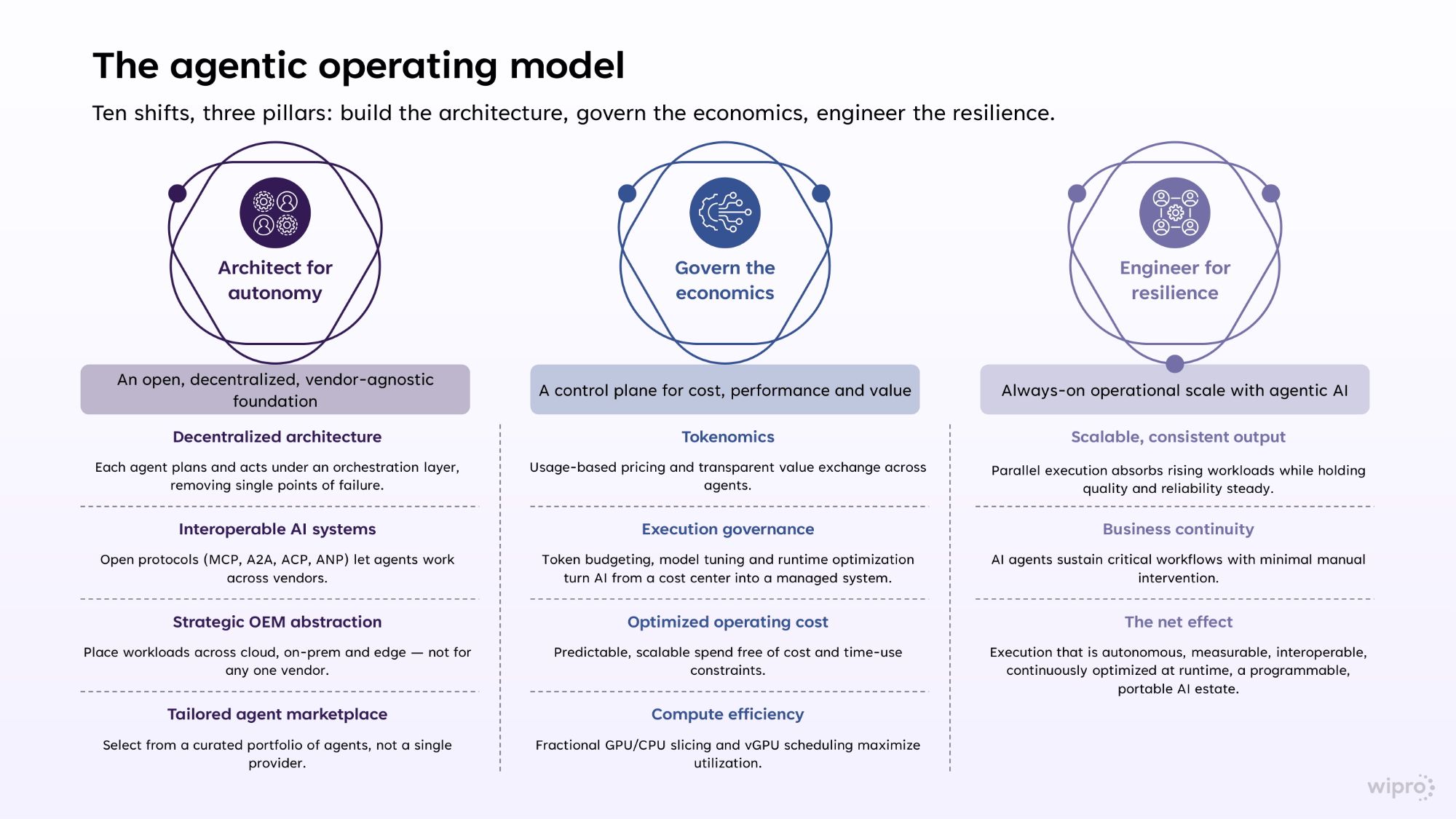
Realizing that promise depends less on the sophistication of any single agent than on the operating model built around it. Three pillars matter: an open architecture that avoids lock-in, an economic control plane that governs cost and value, and an operational design engineered for resilience and scale.
Pillar 1: Architect for autonomy
- Decentralized architecture. Under an orchestration layer, each agent plans, learns and acts toward a defined outcome. This improves resilience by removing single points of failure, enhances scalability as new agents are deployed on demand, and strengthens security through more localized data processing improving time-to-market while increasing resilience and availability.
- Interoperable AI systems. Standardized and open protocols, Model Context Protocol (MCP), Agent-to-Agent (A2A), Agent Communication Protocol (ACP) and Agent Network Protocol (ANP) — unlock the full value of decentralized AI ecosystems. As enterprises scale, system integrators become central to abstracting OEM dependencies and enabling vendor-agnostic architectures, shifting the focus from managing products to orchestrating business value.
- Strategic OEM abstraction. OEM-agnostic strategies keep enterprises flexible across hybrid environments. Agentic systems are designed to operate seamlessly across cloud, on-premises and edge infrastructure, with OEM choices driven by workload, cost, performance and regulatory considerations rather than vendor lock-in.
- Tailored agent marketplace. Enterprises move beyond dependence on any single agent, selecting from a curated portfolio aligned to strategic and operational needs. An agent marketplace model lets organizations compare capabilities, commercial terms and integration fit, creating a transparent, competitive and value-driven ecosystem for rapid adoption.
Pillar 2: Govern AI economics
- Tokenomics. As agent ecosystems mature, the economic abstraction of AI execution, tokenization has the potential to quantify and transact AI-driven work. Token-based frameworks enable granular pricing, usage-based consumption and transparent value exchange across agent marketplaces.
- Execution governance. AI execution must be governed end to end. By embedding token budgeting, model tiering and agent optimization into runtime orchestration, enterprises continuously balance cost, performance and utilization, thus, transforming AI from a static cost centre into a dynamically optimized economic system.
- Optimized operating costs. Shifting from non-autonomous execution to a self-orchestrating agentic workforce makes financial planning more predictable and scalable. Enterprises improve profitability and ROI by reducing time-zone dependency, shift-based constraints, inconsistent quality, recurring training and administrative overhead.
- Compute efficiency. Fractional resourcing, slicing CPUs, GPUs and TPUs across specialized and accelerated hardware, redefines utilization through dynamic, runtime allocation. Constructs such as time-slicing and Kubernetes-driven vGPU scheduling allocate GPU resources across concurrent workloads, maximizing throughput while controlling cost.
Pillar 3: Engineering for Resilience
- Scalable, consistent output. The enterprise architecture should absorb rising workloads while holding quality and reliability steady. This decentralized design distributes tasks for parallel execution, reducing bottlenecks and supporting enterprise-scale growth without compromising consistency.
- Business continuity. During disruptions, agents reroute processes automatically and sustain critical workflows with minimal manual intervention, reducing downtime and helping business and IT teams respond more effectively to unforeseen events.
Together, these shifts signal a move toward programmable, portable and economically optimized AI ecosystems where execution is not only autonomous, but also measurable, interoperable and continuously optimized at runtime.