




Why Now: The Escalating Complexity and Velocity of Enterprise Risk
Enterprise risk is no longer defined by isolated failures or predictable outages. It is shaped by speed, scale, and interdependence. Rapid advancements in technology, automation, and AI-enabled adversaries have created an environment where disruption travels faster than traditional controls can respond. Multi‑cloud platforms, SaaS ecosystems, APIs, and distributed architectures have introduced tightly coupled dependencies, where a single failure can trigger disproportionate disruption.
As digital environments grow more interconnected, the operational blast radius expands. Third‑party and supply-chain dependencies compound this fragility, turning external weaknesses into enterprise-level risks. A single disruption in a critical vendor or platform provider can cascade across business units and geographies, affecting revenue continuity, regulatory posture, and customer trust.
Regulatory expectations are evolving in parallel. Frameworks such as DORA in financial services signal a clear shift – from periodic assessments to requiring continuous proof of resilience and verifiable recovery. AI intensifies this dynamic on both sides – attackers use automation to accelerate reconnaissance and exploitation, while defenders must rely on AI-driven detection, triage, and recovery insights to keep pace. In this environment, resilience can no longer be treated as a technical safeguard; it must be engineered as a business capability – designed for enterprise‑grade reliability, and governed at scale, that keeps pace with both technological complexity and compliance demands.
What is ERaaS: A Unified, Outcome-Based Resilience Model
Enterprise Resiliency as-a-Service (ERaaS) reframes resilience as an integrated, outcome-oriented operating model rather than an assortment of tools or siloed processes. At its core, ERaaS unifies cyber resilience, operational resilience, data protection, recovery orchestration, and business continuity into a single managed capability which is powered by Wipro Intelligence™, a unified suite of AI-driven platforms, solutions, and transformative offerings to accelerate AI infusion and business resiliency across customer’s core business operations.
This model emphasizes:
- Clear business outcomes rather than infrastructure-centric measures
- Continuous testing, validation, and improvement
- Cross-functional coordination between technology, operations, and business teams
- An architectural posture built for disruption—not merely availability
Traditional approaches like separate backup teams, a disaster recovery (DR) plan, and periodic security audits were designed for predictable failures in isolated systems. However, today’s enterprises operate across complex ecosystems spanning multi‑cloud platforms, SaaS ecosystems, partner networks, connected operations, and data pipelines powering analytics and AI. In that context, the question is not whether disruption will occur, but whether the organization can absorb shock, contain impact, and restore critical business capabilities at speed and with integrity.
Foundational Principles of an Effective ERaaS Model
An effective ERaaS strategy is anchored in a set of principles that elevate resilience from operational readiness to executive discipline:
- Executive-led resilience culture: Leadership must define risk appetite, fund resilience initiatives, and embed accountability across teams—creating the mandate required for adaptive, intelligence‑driven resilience.
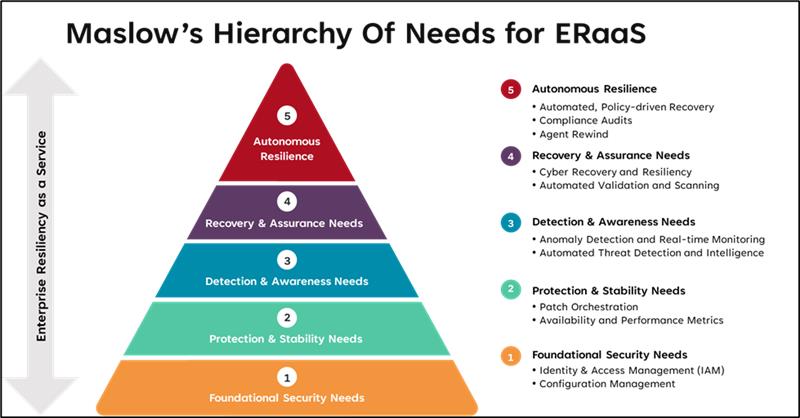
- Layered architecture (Protect à Detect à Recover): Resilience is engineered through defense‑in‑depth, early detection, and assured recovery pathways. AI and agentic automation strengthen each layer by identifying deviations earlier, isolating threats faster, and guiding recovery decisions.
- Third-party oversight: Supply‑chain resilience must be treated as a first‑tier business responsibility. AI‑enabled dependency mapping and failure simulations expose hidden relationships and systemic vulnerabilities across vendors and platforms.
- AI-enabled resilience and governance: AI enhances situational awareness, detection fidelity, and cross-domain correlation. Agent Rewind‑style capabilities retrace system events, reconstruct causal chains, and autonomously revert harmful changes, elevating resilience from manual recovery to intelligent self-correction.
- Compliance-by-design: Resilience controls and evidence must align naturally with regulatory and audit requirements. Automated telemetry, reporting, and verification enable compliance to be continuous, real‑time, and embedded into operational workflows.