


Artificial intelligence no longer lives on the fringes of experimentation – it drives every aspect of today’s enterprise. It shapes customer experience, underpins operational resilience, informs risk management, and fuels product innovation. Yet too many organizations push their AI ambitions into data centres built for transactional IT, hobbling transformation, inflating costs, and exposing themselves to compliance and security risks. For senior leaders, the message is clear: if you want to compete in the next era, you must reimagine your infrastructure around AI.

Why AI Data Centres are Becoming a Priority

The scale and complexity of AI workloads demand infrastructure far beyond traditional capabilities. Training large models requires high-density compute and scalable storage, while inference depends on low-latency networking and energy efficiency. Legacy data centres, lacking GPU density and high-throughput interconnects, often stall AI pilots – delaying product cycles and eroding margins through rising costs. Purpose-built AI data centres (DCs) address these challenges, enabling production-grade reliability and unlocking new revenue streams.

Regulatory compliance adds another layer of urgency. Data privacy and sovereignty rules increasingly dictate where and how data is stored and processed. Non-compliance risks fines and market exclusion, making jurisdiction-aware infrastructure essential for market access and trust.

Sustainability pressures further complicate the equation. AI compute drives significant power and cooling demands, creating tension between operational costs and ESG commitments. Enterprises must adopt energy-efficient designs—such as liquid cooling, renewable integration, and advanced metering—to reduce total cost of ownership while strengthening environmental credibility.

AI data centres are becoming essential instruments for CIOs and CTOs, helping them strengthen regulatory compliance, speed up delivery of AI solutions, optimize operating costs, and reinforce organisational credibility, thus, turning infrastructure into a powerful source of stability and competitive advantage.

The AI DC Framework: BOE

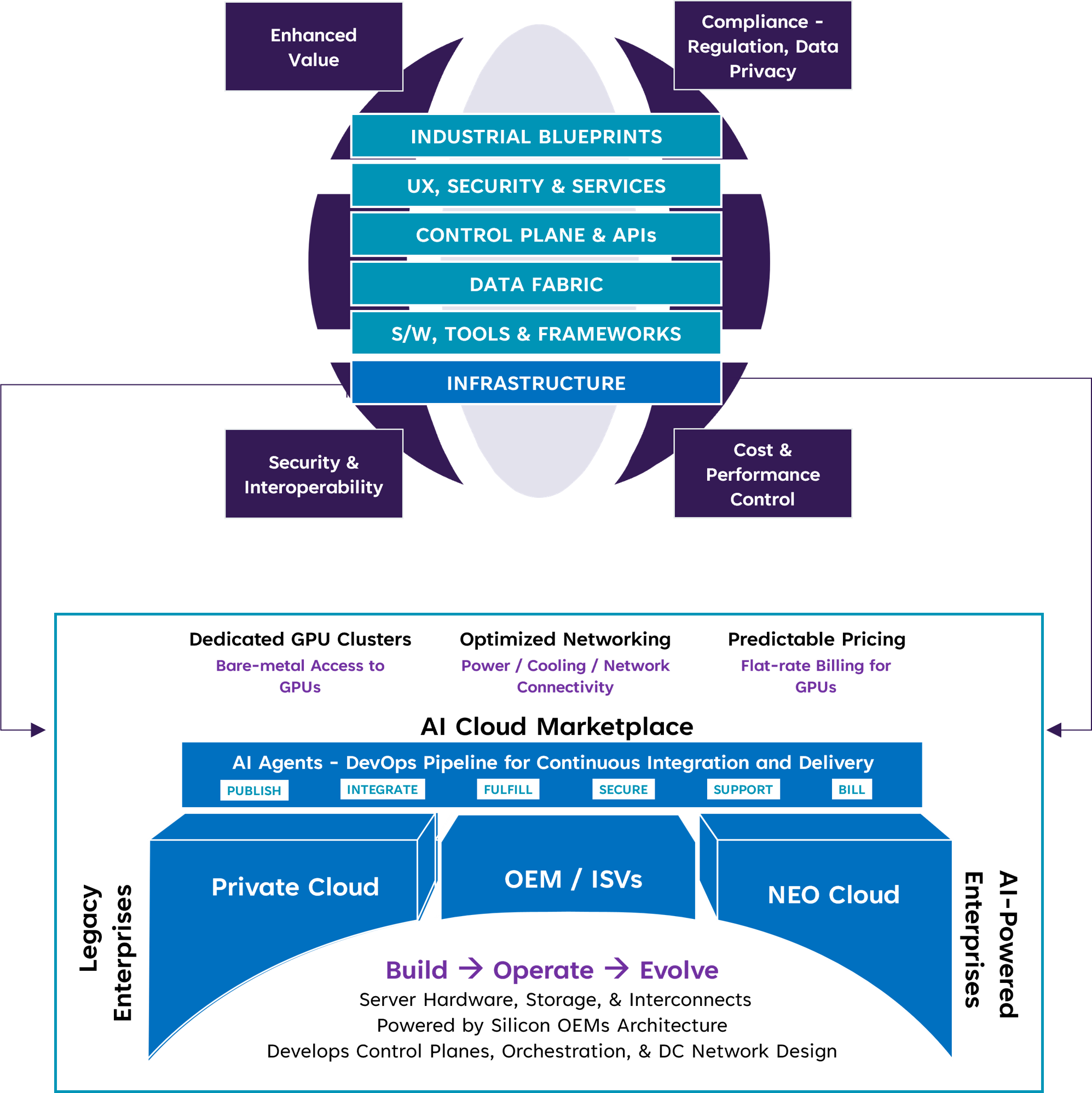
Building an AI DC is not a one-time project; it is a strategic lifecycle. The Build-Operate-Evolve (BOE) model embeds sustained value, compliance, and resilience into the infrastructure.

  • Build: Architect for agility and governance
    Enterprises should segment environments for training, fine-tuning, and inference to optimize cost and performance. Architectures must combine heterogeneous compute – GPUs, specialized accelerators, and CPUs – and adopt modular designs for scalable rollouts. Every design choice should align with governance objectives, risk appetite, and investment guardrails, giving CFOs and CIOs clear oversight.

  • Operate: Industrialize AI infrastructure as a business platform
    Treating infrastructure, configurations, and policies as code standardizes deployments and minimizes human error. Converged orchestration across compute, storage, networking, and AI frameworks ensures consistent performance, while automated lifecycle management reduces downtime and improves SLA adherence. Embedded audit trails and policy enforcement strengthen compliance and operational integrity.

  • Evolve: Future-proof for performance, trust, and cost
    Real-time telemetry optimizes energy use, zero-trust security safeguards model integrity, and AI governance frameworks monitor bias, lineage, and performance. Evolution plans must include disaster recovery and failover strategies to ensure uninterrupted operations and trust.

The Role of GSIs: Partners in Reinvention

Transformation doesn’t happen alone. Global system integrators (GSIs) are more than implementers; they are co-architects of transformation. They bridge silicon innovation (GPUs, accelerators) with enterprise constraints (power, space, cooling, finance), negotiating vendor ecosystems to deliver fit-for-purpose stacks that meet business SLAs. Their expertise spans end-to-end stack integration, from chipsets to AI frameworks and machine learning operations (MLOps) tooling, ensuring interoperability, performance tuning, and security alignment, while reducing integration risk. GSIs increasingly offer managed AI infrastructure operational models, reducing complexity, speeding up time-to-value, and freeing internal teams to focus on AI use cases rather than plumbing. 

Fig 1: AI DC Conceptual Architecture and Value Proposition

Adoption Roadmap: From Vision to Value

Moving to an AI Data Centre begins with clarity on workloads and compliance needs. Enterprises should start by assessing priority AI use cases, data sources, and latency requirements, then translate these insights into an architecture blueprint and a business case that balances performance, cost, and regulatory obligations. This foundation ensures that investments align with strategic objectives and measurable outcomes.

The next phase focuses on execution and scale. A pilot environment validates security, throughput, and resilience before modular expansion across geographies. As operations mature, automation and governance become critical – enabling predictable costs, continuous compliance, and operational resilience. This structured approach transforms AI infrastructure from a vision into a scalable, sustainable engine for innovation and growth.

Conclusion: Build for the Decade, Deliver Value Now

AI Data Centres will continue to evolve alongside workloads, policies, and markets, integrating new silicon, governance demands, and business models. The winning pattern combines modular, heterogeneous, governance-first design operated as a product, sustained with energy-efficient practices and zero-trust security.

Enterprises that invest now won’t just keep pace; they will set the pace, shaping smarter products, leaner operations, and regulatory confidence in an AI-driven economy. AI DC can be the strategic backbone where innovation, compliance, and profitability converge.

About the Author

Gaurav Parakh

Global Head – Advisory, M&A, and Emerging Tech, Wipro

Gaurav is a senior technology strategist with over 25 years of experience spanning IT consulting, solution design, sales, and advisory services. As the Global Head of Strategy, M&A, and Emerging Tech at Wipro, he partners with Fortune 500 clients and leading ecosystem players to drive large-scale digital transformation.

Gaurav specializes in go-to-market strategy, cloud transformation, generative AI, FinOps, and open-source operating models. He brings deep expertise in building and scaling innovative, AI-powered solutions that help enterprises modernize infrastructure and accelerate value creation.

He also has a background in entrepreneurship, having founded and successfully exited startups in 3D printing, education, and artificial intelligence. Gaurav holds an MBA in International Business from École des Ponts Business School (France), a BSc from the University of Bradford (UK), and a certification in Digital Transformation from the Massachusetts Institute of Technology (MIT).