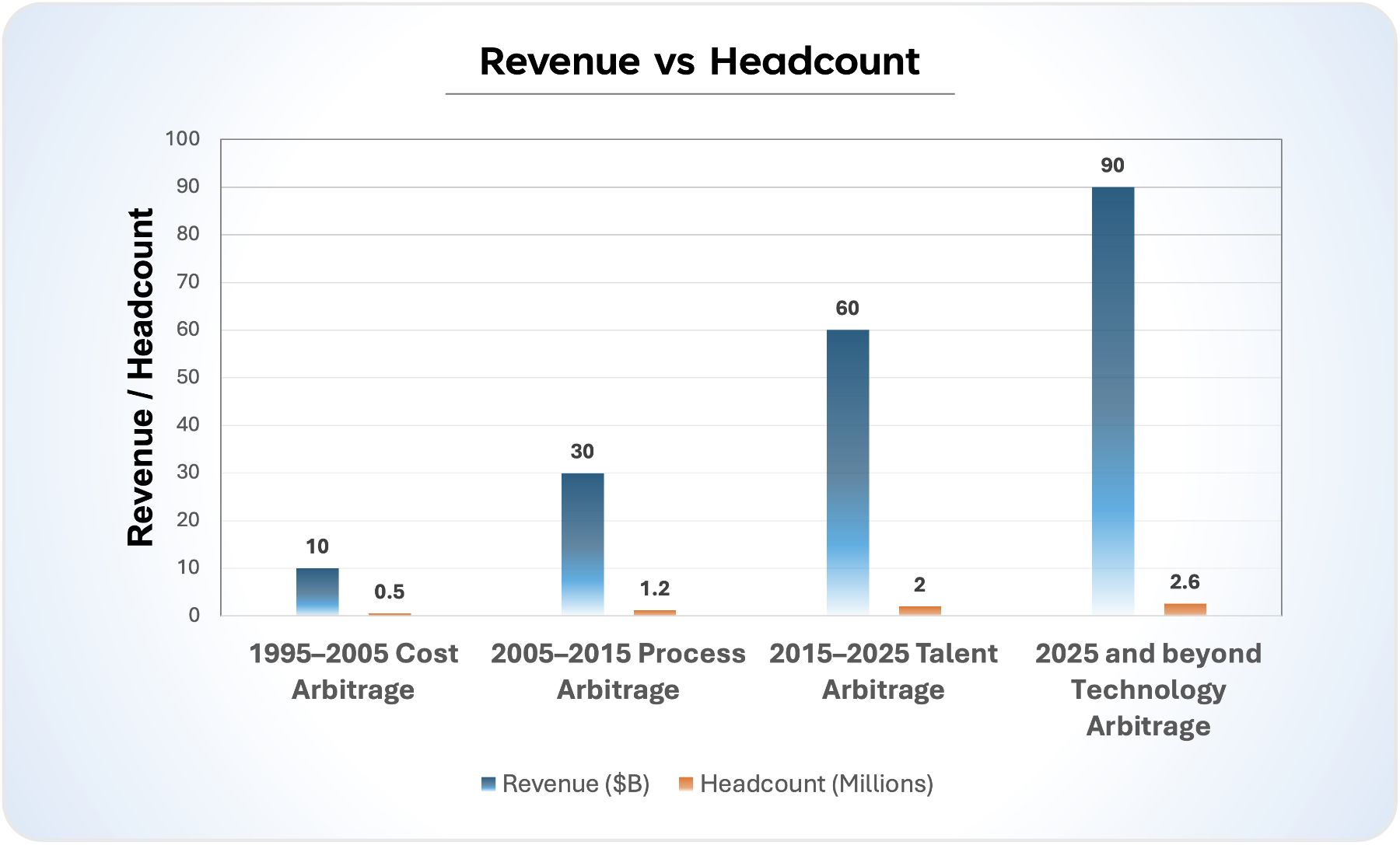
80% of new GCCs prioritize AI and ML capabilities, with India having the second-largest pool of AI talent globally and the highest AI skill penetration among GCC markets.
What Makes Today’s GCCs Different?
1. Tech-Led and Agile
Modern GCCs are built around technology-first principles and agile methodologies:
- They leverage cloud-native architectures, DevOps, and microservices to support rapid development and deployment.
- Agile squads and product teams operate in sprints, enabling faster innovation cycles.
- GCCs often serve as digital labs or innovation hubs for their parent firms.
Example: A PE firm’s GCC may host agile pods focused on building investor portals, automating fund operations, or developing ESG analytics platforms.
2. Multifunctional (IT, Finance, Legal, Compliance, etc.)
Unlike legacy BPO centers, today’s GCCs are multidisciplinary hubs:
- They support a wide range of functions including:
- Technology: Application development, infrastructure, cybersecurity.
- Finance: Fund accounting, Valuation, Trade bookings and settlements, corporate accounting, treasury, tax support, Audit support
- Legal & Compliance: KYC/AML, contract review, governance monitoring.
- HR Operations: Workforce administration and payroll processing, Benefits and compensation
- Procurement: Source to Contract, Spend Diagnostics, Category Research & Intelligence, Supplier Negotiation & Contract Management, Procure to pay, Supplier Performance Management
- Investor Relations: CRM platforms, data room management, LP servicing.
Impact: Enables end-to-end process ownership and cross-functional collaboration under one roof.
3. Value creation for portfolio companies
PE firms aim to contribute capital and work to improve the operational, financial, and strategic aspects of the companies in which they invest:
- PE firm’s GCC can create value for its portfolio companies by:
- Centralised back-office services in Finance, HR, IT, and Procurement help GCCs minimise duplication and overheads across portfolio companies.
- Economies of Scale: Pooling resources allows the GCC to secure better vendor deals and reduce costs for all portfolio companies.
- Domain Experts: GCCs employ experts in digital transformation, analytics, and cybersecurity.
- Training & Upskilling: The GCC can run training programs to upgrade the skills of portfolio company staff, ensuring they stay competitive and innovative.
- Benchmarking: GCCs can compare portfolio companies’ performance against each other and industry standards, identifying gaps and improvement opportunities.
- Best Practices Sharing: Successful strategies and processes can be disseminated rapidly across all portfolio companies via the GCC
- Rapid Expansion: GCCs provide scalable infrastructure, allowing portfolio companies to grow quickly without large upfront investments.
- Resource Agility: GCCs can reallocate talent and resources to support new initiatives, market entries, or product launches as needed.
Impact: Help portcos boost operations, enable digital transformation, cut costs, and innovate.
4. Integrated with Core Business Operations
GCCs are no longer peripheral support units—they are strategically embedded into the enterprise:
- They align with HQ functions, investment teams, and portfolio operations.
- Use shared platforms, governance models, and KPIs to ensure seamless integration.
- Participate in strategic planning, risk management, and transformation initiatives.
Impact: Enhances transparency, accountability, and strategic alignment across geographies.
5. Innovation-Driven (AI/ML, ESG Analytics, etc.)
Modern GCCs are designed to drive innovation, not just execute tasks:
- Host Centers of Excellence (CoEs) for emerging technologies:
- AI/ML: Predictive analytics, risk scoring, LP behavior modeling.
- ESG: Data aggregation, scoring frameworks, sustainability reporting.
- Automation: RPA, low-code platforms, workflow orchestration.
- Foster a culture of experimentation, prototyping, and continuous improvement.
Impact: Positions the GCC as a value creator and transformation engine for the enterprise.
How Private Equity Firms Leverage GCCs for Value Creation
Global Capability Centers (GCCs) serve as strategic hubs for delivering specialized, scalable, and cost-effective services across the private equity value chain. Below is a detailed view of how GCCs support various operational domains:
1. Technology & Data Infrastructure
GCCs serve as the backbone for digital transformation by managing centralized data warehouses, building ETL pipelines, and ensuring data governance. They provide 24x7 cloud support across AWS, Azure, and GCP, covering infrastructure provisioning, cybersecurity, and disaster recovery. Additionally, GCCs develop proprietary platforms for deal sourcing, investor portals, and portfolio analytics.
Impact: Accelerates digital transformation, reduces IT costs by 40–60%, and enhances platform reliability.
2. Fund Operations
GCCs centralize fund administration—including accounting, reporting, investor communication, compliance, and treasury—on a standardized platform. Automated workflows and technologies like RPA reduce manual errors and improve efficiency for tasks such as reconciliation and fee processing. Specialized teams ensure accurate financial statements and reports. GCCs also remain compliant with global regulations (e.g., AIFMD, FATCA, SEC), minimizing risk and audit issues. Impact: Cuts turnaround time by up to 50%, improves accuracy, and strengthens compliance.
3. Investor Services
By administering CRM and LP servicing platforms, GCCs enhance investor engagement through automated onboarding, capital call tracking, and secure data room management for fundraising and exits.
Impact: Improves LP experience, transparency, and scalability in fundraising.
4. Legal, Compliance, and Risk Support
GCCs execute KYC/AML workflows, contract review, and vendor risk assessments while integrating governance monitoring into compliance dashboards.
Impact: Reduces legal processing costs by 30–40% and improves risk visibility.
5. Portfolio Company Enablement
GCCs deliver shared IT services, ERP rollouts, and digital transformation initiatives across portfolio companies, enabling faster automation and analytics adoption.
Impact: Accelerates transformation timelines, reduces implementation costs, and enhances operational maturity.
One in three mid-market GCCs in India has been set up by a PE-backed firm, with 77 centers representing 65% of mid-market GCCs. These centers employ over 220,000 professionals and are projected to generate US$7.8B in revenue by 2026.
Unlocking Value: How GCCs Benefit PE Firms
1. Cost Arbitrage: Significant Savings through Offshore Talent and Operations
GCCs allow firms to tap into high-quality talent in cost-effective geographies like India, the Philippines, and Eastern Europe. This results in:
Example: A fund accountant in the U.S. may cost $100K annually, while the same role in India via a GCC may cost $35K–$40K.
2. Scale Efficiency: Supporting Rapid Growth and Multi-Entity Structures
PE firms often manage complex structures with multiple funds, SPVs, and portfolio companies. GCCs help by:
- Centralizing operations across entities and geographies.
- Standardizing processes and platforms for scalability.
- Enabling rapid onboarding of new acquisitions or fund launches.
- Shared resources and specialized expertise maximizing value for both the portfolio company and the private equity firm.
Impact: GCCs allow firms to scale operations without proportionally increasing costs or headcount in high-cost markets.
3. 24x7 Operations Support (follow the sun approach): Faster Turnaround and Continuous Service Delivery
With teams distributed across time zones, GCCs enable:
- Round-the-clock operations for critical functions like financial services, payment processing, and fund operations, investor servicing, and for technology issues, system monitoring, and incident management.
- Faster response times for LP queries, compliance checks, portfolio companies’ customers for enhancing service quality. and reporting.
- Reduced cycle times for NAV calculations, reconciliations, and regulatory filings.
- Continuous monitoring and response to security threats is essential, and GCCs often staff Security Operations Centers (SOCs) 24/7.
Impact: Improves service quality and responsiveness, especially during peak reporting periods.
4. Specialized Talent Access: Global Pools of finance, Legal, Tech, and Data Experts
GCCs provide access to niche skills that may be scarce or expensive in domestic markets:
- Fund accountants for private equity accounting principles, fund structures, and relevant software experience (e.g., Investran, eFront).
- Legal and compliance professionals for KYC/AML, contract review, and governance.
- Data engineers and analysts for fund performance dashboards and ESG analytics.
- Cloud architects and cybersecurity experts for portfolio IT enablement.
India alone has over 2 million professionals employed in GCCs, with deep expertise across finance, tech, and legal domains.
5. Innovation Platforms: Centers of Excellence (CoEs) for AI/ML, ESG Analytics, and Automation
Modern GCCs are not just delivery centers – they are innovation hubs:
- Build and deploy AI/ML models for predictive analytics, risk scoring, and LP behavior analysis.
- Develop ESG data platforms to support sustainable investing.
- Automate workflows using RPA and low-code platforms.
80% of new GCCs prioritize AI/ML capabilities, with India leading in AI skill penetration among GCC markets.
6. Strategic Control: Retaining Institutional Knowledge and Aligning with Firm Strategy
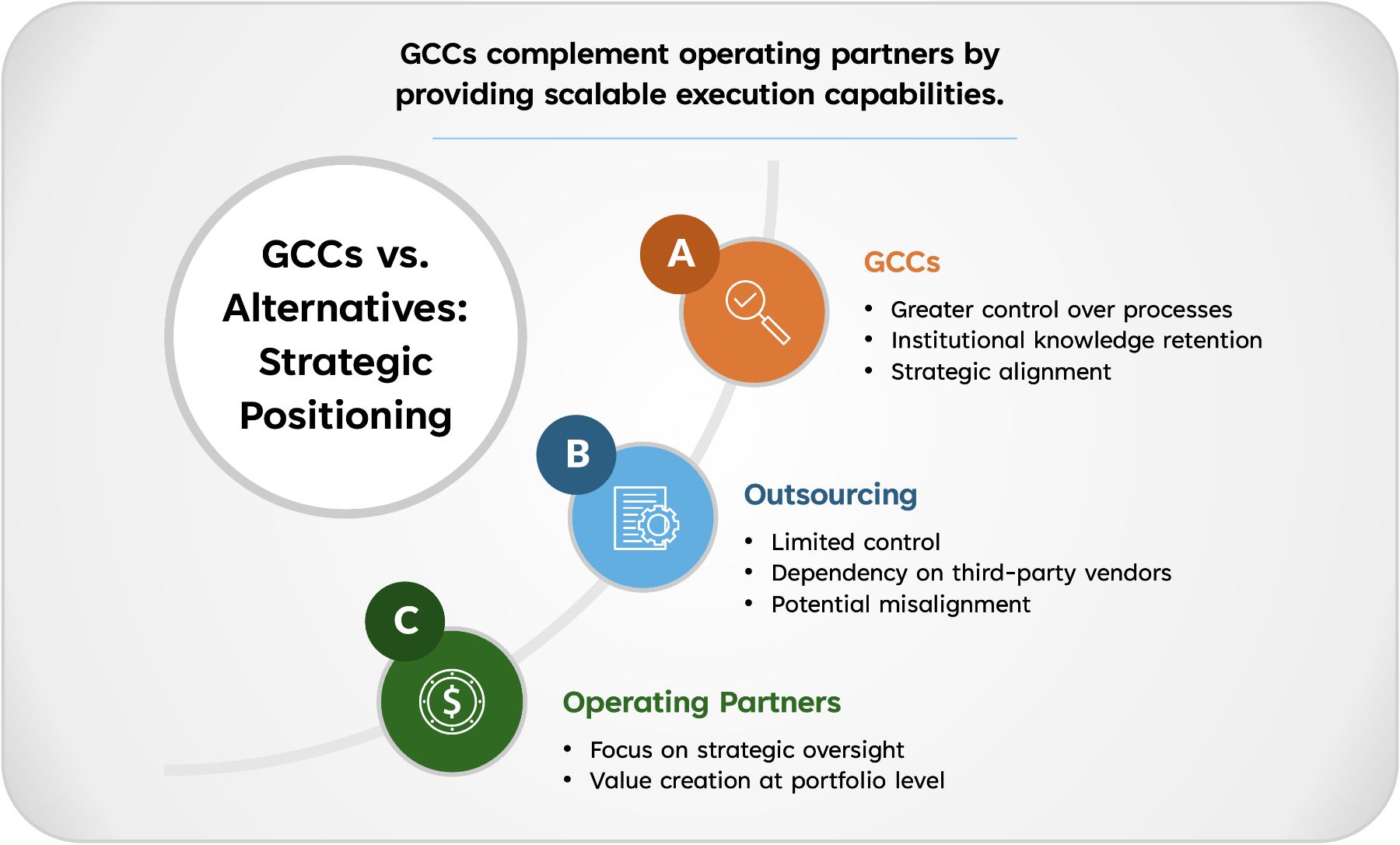
Unlike outsourcing, GCCs are owned and operated by the firm, ensuring:
- Long-term retention of domain knowledge and best practices.
- Alignment with strategic goals, investment philosophy, and compliance standards.
- Better governance, transparency, and cultural integration.
Impact: Enhances operational resilience and reduces dependency on external vendors.
Market Forces Shaping the GCC and PE Ecosystem
Private Equity firms are increasingly leveraging Global Capability Centers (GCCs) to address structural and operational challenges in a rapidly evolving market. Four key drivers are shaping this trend:
- Operational Complexity: Multi-strategy investment platforms, global asset portfolios and complex multi-entity structures demand advanced operational support that traditional models often cannot adequately provide.
- Cost Optimization: Post-pandemic recovery pressures and rising interest rates have intensified the need for leaner, more efficient operating models.
- Talent Constraints: Domestic markets face shortages in specialized skills—particularly in legal, IT, and data operations—making offshore talent hubs critical for scalability.
- Digital Transformation: PE firms are under pressure to adopt data-driven decision-making, platformization, and automation to remain competitive and deliver faster value creation.
- Strategic Implication: GCCs have emerged as a core enabler for operational resilience, cost efficiency, and digital innovation across the PE value chain.
India hosts over 1,800 GCCs, serving more than 50 countries and contributing US$68 billion in direct GVA—1.6% of India’s GDP. The market is projected to grow to US$99–105 billion by 2030, with 2,100–2,200 centers and a workforce of 2.5–2.8 million.
Success Stories in the Public: GCCs in Action
Leading capital markets firms are leveraging GCCs to deliver tangible business outcomes, from cost optimization and operational scale to faster innovation and improved risk resilience.
- Alternative asset management company based out of New York
GCC usage focused on IT and data operations supporting $1T AUM. Key benefits included 35–50% cost savings, scalable IT infrastructure, and enhanced data security. - Global private equity and investment company started in New York
GCC supported fund operations and compliance in Gurugram, enabling faster regulatory reporting, risk mitigation, and standardized processes. - Private equity firm from the West Coast focusing on technology companies
GCC centered on platform engineering and cybersecurity in Bangalore, driving accelerated product innovation, stronger cyber resilience, and improved time-to-market. - Alternative asset management firm originating from the Southwest
GCC handled centralized fund accounting and reporting in Hyderabad, resulting in streamlined financial operations, reduced errors, and improved EBITDA margins.
Challenges and Strategic Responses for Successful GCC Execution
While Global Capability Centers (GCCs) deliver significant strategic and financial benefits, their success depends on overcoming key operational and organizational challenges.
Change Management
Integrating GCC operations with headquarters requires cultural alignment and stakeholder buy-in. Resistance from onshore teams and unclear roles can derail progress. The solution lies in structured change programs, leadership exchanges, and positioning GCCs as strategic partners rather than cost centers.
Regulatory Compliance
Cross-border data handling exposes GCCs to complex regulatory frameworks such as GDPR and India’s DPDP Act. Early involvement of legal teams, robust data governance, and secure cloud infrastructure with region-specific controls are essential to mitigate compliance risks.
Talent Retention
High attrition in offshore markets threatens continuity. Building structured career paths, leadership development programs, and fostering a culture of innovation and recognition help retain top talent.
Technology Integration
Legacy systems and fragmented data models can hinder seamless connectivity. Adopting cloud-native platforms, standardizing data formats, and ensuring real-time synchronization across geographies enable smooth integration.
Governance Models
Ambiguity in ownership and lack of performance metrics can disconnect GCCs from strategic goals. A strong governance framework with clear KPIs, SLAs, and regular alignment reviews ensures accountability and enterprise visibility.
Strategic Outcome
Addressing these challenges through proactive planning and structured governance transforms GCCs into value-creation hubs, driving operational efficiency, digital innovation, and portfolio-wide synergies.
From Foundation to Transformation: The End-to-End Lifecycle of Global Capability Centers
Managed services companies act as trusted partners, providing end-to-end support for private equity firms to establish, operate, and scale their GCCs efficiently and compliantly, enabling global growth and operational excellence. Below are several ways in which managed services companies assist global private equity firms in establishing GCCs:
1. Strategic Planning: Enable rapid and seamless establishment of Global Capability Centers through expert local knowledge and resources.
- Business Case Development: Evaluate objectives, value, cost-benefit, and alignment with company strategy.
- Location strategy: Firms who have GCC capabilities should have a global footprint to work 24x7 across the world should come here
2. Legal and Regulatory Setup: Navigate complex legal, tax, and compliance requirements, minimizing risks for private equity firms.
- Entity Formation: Register the GCC as a legal entity, comply with local laws.
- Tax and Compliance: Structure for optimal tax efficiency and regulatory adherence.
3. Establishing the Physical “Brick and Mortar” Presence: Services providers helps in set up state-of-the-art office spaces and IT systems tailored to business needs.
- Location Strategy: Selection based on talent availability, cost efficiency, infrastructure, and geopolitical stability. Common hubs include India, Eastern Europe, and Southeast Asia.
- Infrastructure Setup:
- Real estate acquisition or leasing
- Compliance with local regulations
- IT infrastructure and cybersecurity frameworks
- Branding and Local Ecosystem Integration: Building employer brand, engaging with local academia, and participating in industry forums.
4. Designing Effective Staffing Models: Attract and onboard skilled professionals efficiently, leveraging established recruitment networks
- Talent Acquisition Strategy:
- Build vs. Buy: Fresh graduates vs. lateral hires
- Leveraging local recruitment partners and digital platforms
- Organizational Structure:
- Hub-and-spoke or functional verticals (e.g., Finance, IT, Analytics)
- Leadership hiring to ensure cultural alignment and governance
- Workforce Planning:
- Agile ramp-up plans aligned with business priorities
- Succession planning and career pathing to retain top talent
5. Implementing Operational Technologies: Implement best-in-class processes, governance frameworks, and continuous improvement initiatives.
- Digital Infrastructure:
- Cloud-first architecture
- Collaboration tools (e.g., Microsoft 365, Slack, Zoom)
- Automation & AI:
- RPA for repetitive tasks
- AI/ML for analytics, forecasting, and decision support
- Cybersecurity & Compliance:
- Data protection aligned with GDPR, HIPAA, etc.
- Role-based access and audit trails
- Performance Monitoring:
- KPIs and SLAs for operational excellence
- Real-time dashboards and reporting tools
6. Consultancy-Driven Capabilities and Solutions
- Strategic Alignment with PE Firms:
- GCCs as transformation hubs for portfolio companies
- Shared services for finance, HR, procurement, and IT
- Free up private equity firms to concentrate on core business and investment strategies while operational complexities are expertly managed by service providers
- Value Creation Playbooks:
- Cost optimization, digital transformation, and innovation labs
- Standardized operating models across portfolio companies of PE firm
- Change Management & Governance:
- Stakeholder engagement frameworks
- Agile governance models for rapid decision-making
- Deepen integration with global headquarters and business units.
- Mitigate Risks:
- Service providers can help in establishing robust business continuity, data security, and risk management protocols.
- Scalability & Exit Readiness:
- Modular design for scaling across geographies
- Enabling IPO or M&A readiness through operational maturity
Conclusion
GCCs are no longer just cost centers—they are strategic enablers of operational excellence and innovation in private equity. As PE firms seek to scale efficiently and transform digitally, GCCs offer a compelling model to unlock value across the investment lifecycle. With the right partner, such as Wipro, firms can build resilient, future-ready operations that drive competitive advantage.