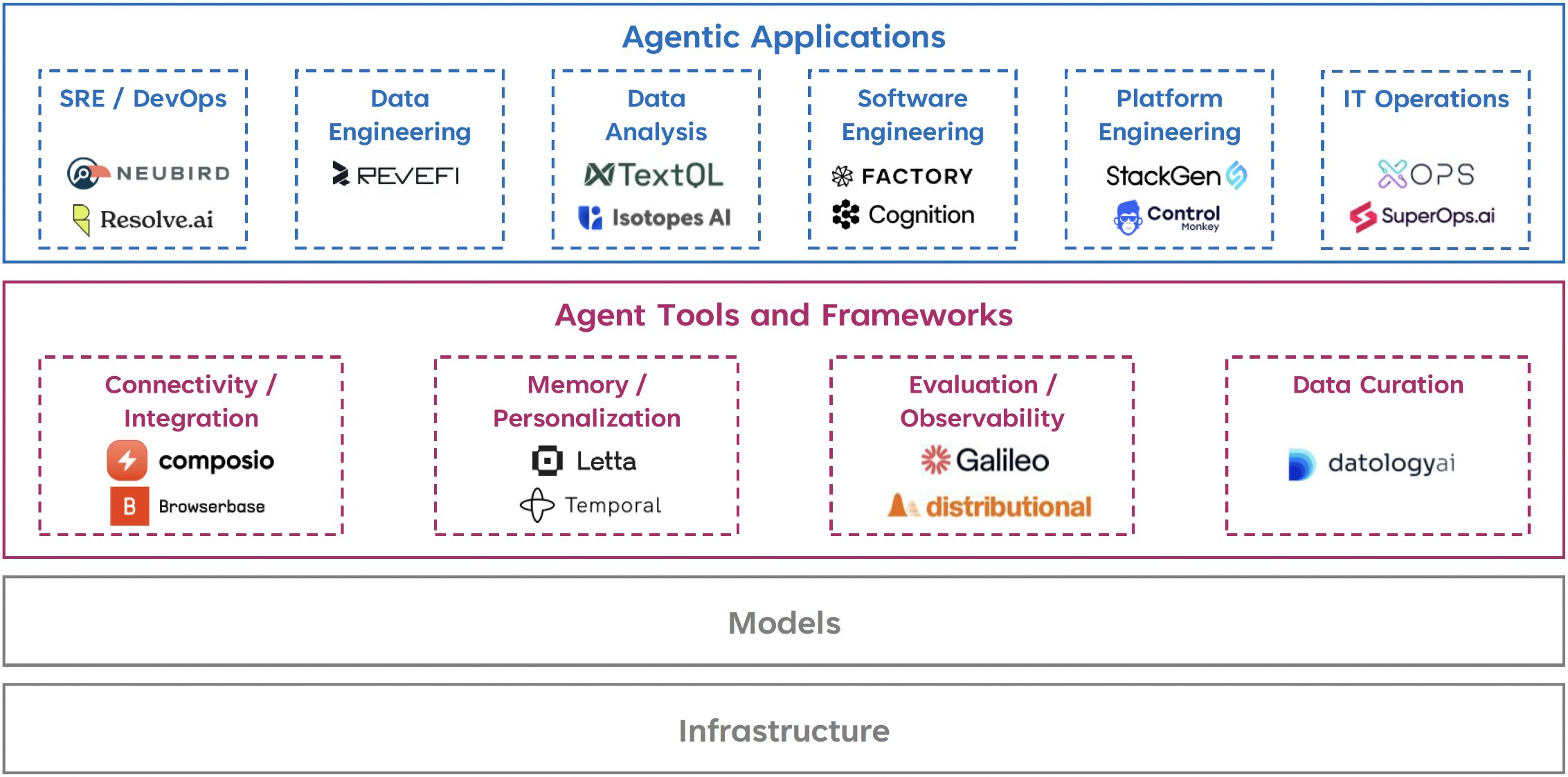





Over the past decade, Wipro Ventures has been fortunate to invest in and partner with early AI pioneers in their respective categories, from conversational AI with Avaamo, enterprise process automation with Kognitos, to agentic AI with Ema. As market adoption and new technical breakthroughs for AI accelerate, our team believes the bulk of AI’s market impact is still unrealized. Since I joined Wipro Ventures over two years ago, our team has frequently refreshed our perspectives on the AI ecosystem as new research and companies emerged almost every day. Looking back, our conversations have changed greatly given how much the latest AI applications and the underlying foundational models have matured.
Shifting Priorities in Adoption
The most significant change in enterprise attitudes toward AI adoption has been the shift from exploration to exploitation. Early conversations focused on identifying use cases, discussing adoption journeys, and addressing safety concerns. Leaders wanted to get started quickly, explore the breadth of possibilities with the new foundational AI models, and distributed resources to begin validating the value of emerging solutions in pilots.
Today there is less doubt in the transformative potential of AI solutions but more tactical focus on achieving consistent, reliable, and impactful outcomes for enterprise operations and customer experiences. Many early AI applications, initially derided as shallow LLM “wrappers” that simply exchanged user inputs and foundational model outputs, have evolved significantly and now foundational models are just one building block within the new stack of AI applications. The initial AI copilots have become AI agents that aren’t just conversational knowledge assistants but can also interact with other enterprise systems and applications, read and write to databases, and execute digital transactions.
Rush to Capture the Application Layer
As foundational AI labs have released new and more powerful models, there has been an explosive expansion in demand and supply of AI agents in the market. There is now an AI agent for every role in the enterprise organization, from sales to HR to data analysis to engineering. AI agents promise to augment and automate operations across business and IT functions and our teams within Wipro have observed strong enterprise demand for domain-oriented, ready-to-use agentic applications that can demonstrate clear impact to business outcomes.
The landscape for agentic AI solutions is extremely competitive and foundational AI companies (i.e. OpenAI, Anthropic, Google) have signalled their interest in building applications atop their models as well. With GPT, Claude, and Gemini models all converging in their capabilities and performance, the effectiveness of applications and automated workflows developed on top of these models have become critical for differentiation and retention with enterprise buyers.
Unbundling of Platforms and Infrastructure
The first generation of tooling for GenAI applications emphasized time-to-value – many were workflow builders that abstracted the complexity of stitching together enterprise data and AI model components while handling organizational concerns about security, privacy, and response accuracy. The latest agentic AI applications are now expected to provide more impactful, autonomous, and context-aware enterprise automation.
Emerging agentic capabilities include reasoning to process more complex user queries, two-way connectivity to relevant applications and interfaces, personalized interactions with users, and real-time engagement, all of which will continue to expand the reach and impact of AI agents. The proliferation and extension of AI agents will also consume significantly more computing resources, demanding improvements and innovation to current cloud infrastructure. In response, new categories of tools and infrastructure are being developed to improve the reliability, execution, and sustainability of agentic AI.