


Retail has become a real-time business. Customers expect shopping to be effortless, seamless, and always available, across channels, formats, and touchpoints. Yet decision-making has not kept pace. Demand signals move faster than traditional planning cycles, while many retail environments still rely on fragmented workflows, delayed insights, and disconnected execution. In that gap, value leaks: promotions arrive late, inventory rebalancing lags, and customer intent is missed. The next frontier for retail AI is not simply better insight. It is lower decision latency: moving from signal to decision to action with speed, consistency, and confidence.
In a real-time retail environment, delayed decisions become missed opportunities.
The Problem: AI Exists, but outcomes haven’t shifted at scale
Retailers are not short on AI investment. Most have piloted forecasting models, optimization engines, pricing analytics, or generative AI use cases. However, despite growing adoption, enterprise-wide impact remains uneven. McKinsey estimates that generative AI could unlock $240 billion to $390 billion in economic value for retailers, yet its survey of 52 global Fortune 500 retail executives found that only two had successfully scaled gen AI across their organizations. This gap exposes a core challenge: while AI has become increasingly effective at generating insights, many retailers still struggle to translate those insights into enterprise-wide action. The question is no longer whether AI can generate insights, but whether retailers can convert those insights into faster, more consistent decisions inside the operating core of the business. For retail leaders, the challenge is shifting from AI adoption to AI operationalization.
The Misconception: AI as a layer, not a business capability
AI under-delivers when deployed as an analytical layer on top of legacy processes rather than directly embedded into operations. Dashboards explain what happened and models predict what could happen, but if recommendations don’t reach planners, merchants, store managers, or supply chain teams at the point of decision, it creates another step instead of removing friction.
That distinction is critical. AI creates scalable value when it becomes part of how work gets done:
Embedded AI shifts the question from “What does the data say?” to “What should we do next, and how do we execute it safely?”
AI that sits outside the workflow adds complexity instead of reducing it.
The Shift: AI Embedded into Core Retail Workflows
Leading retailers are embedding AI directly where decisions are made, shifting from AI that merely informs to AI that executes.
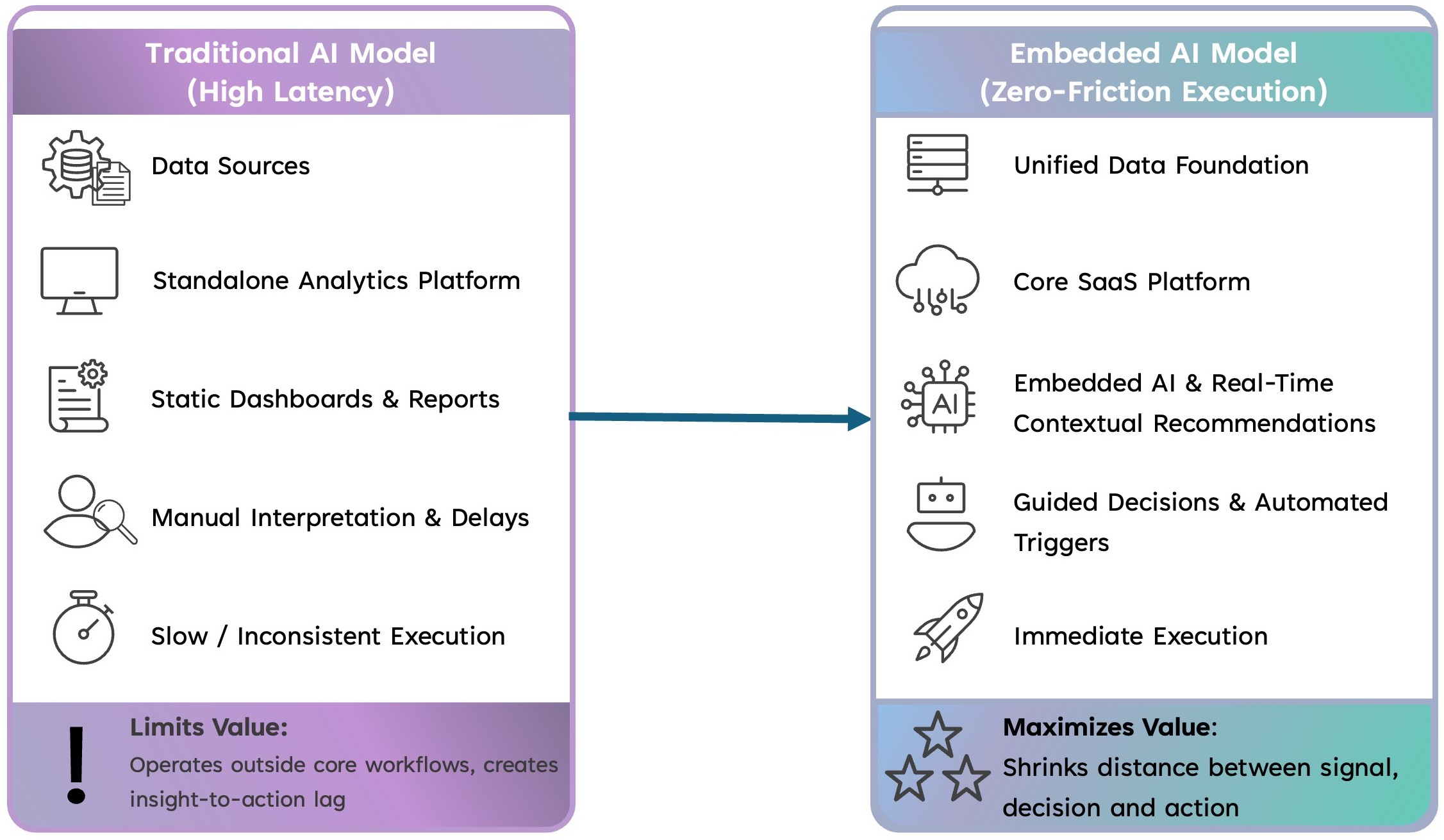
Why platform evolution matters
Embedded AI scales faster when the enterprise foundation is simplified, connected, and cloud-ready. Fragmented systems make it harder for AI to access trusted data, understand business context, and trigger cross-functional actions.
This is where SaaS and platform modernization become central to AI value. SaaS is not only a deployment model; it can also create a more standardized, continuously improving foundation across planning, merchandising, pricing, supply chain, finance and store execution. A connected platform architecture helps data move across planning, merchandising, pricing, inventory, supply chain, finance, stores, and customer engagement.
Embedded AI should not be viewed as the next phase after SaaS transformation. For leading retailers, SaaS modernization and AI adoption are increasingly becoming part of the same transformation journey.
Combined SaaS + AI Evolution Journey
A useful way for CIOs to assess progress is to look at SaaS and AI evolution together, not as separate programs. In practice, the retailers creating the most value are advancing both in parallel, using SaaS to simplify the operating foundation and embedded AI to accelerate decisions within it.
Most retailers today are operating between Stage 2 (SaaS Foundation) and Stage 3 (Unified Platform), making embedded AI the next logical priority for CIOs.
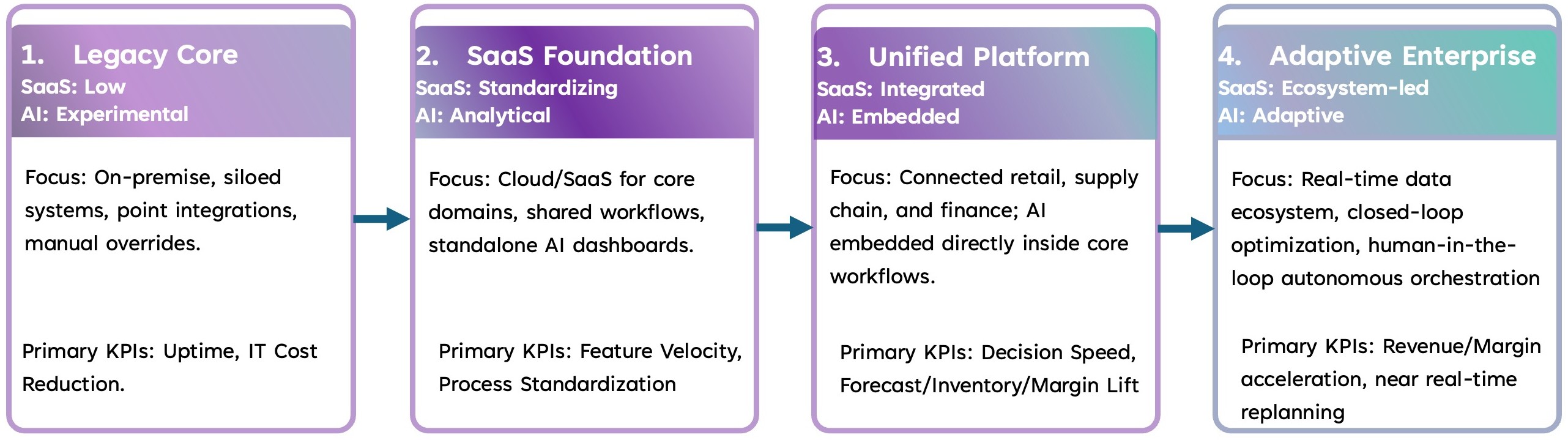
1. Legacy Core
Siloed systems, project-led delivery, and manual decisions. AI exists only in isolated pilots or analytical efforts outside core operations.
Primary KPI Focus: System uptime, IT cost reduction
2. SaaS Foundation
Core domains begin moving to cloud and SaaS, standardization improves, and AI appears mainly in dashboards or analytical support tools.
Primary KPI Focus: Feature velocity, Standard process adoption
3. Unified Platform
Retail, supply chain, and finance increasingly operate on connected platforms and shared data. AI becomes embedded within workflows, supporting forecasting, pricing, replenishment, and merchandising decisions at the point of action.
Primary KPI Focus: Decision speed, Forecast/inventory/margin lift
Stage 4 — Adaptive Enterprise
The organization moves toward continuous orchestration, more autonomous decisioning, and AI-assisted re-planning at near-real-time speed with human oversight remaining essential.
Primary KPI Focus: Revenue/Margin acceleration, Near real-time re-planning
The highest-value path is not SaaS first and AI later. It is advancing the SaaS foundation and embedded AI together.
Measuring Stage 3 Success
Transitioning to Stage 3 shifts focus from IT standardization to operational speed and financial performance. Success is measured across two core pillars:
1. Decision Speed:
2. Forecast, Inventory, and Margin Lift:
In Practice: Oracle as the Unified Platform
A connected, cloud-native SaaS foundation is essential for embedding AI at scale. Oracle’s suite of retail applications is a clear example of Stage 3 execution:
1. Unified Data Foundation: Oracle breaks down legacy silos, unifying data across critical domains like merchandising, supply chain, planning, and finance. This creates the single source of truth necessary for effective AI.
2. Embedded AI in Core Workflows: Instead of presenting AI as a separate bolt-on, Oracle embeds intelligence directly into core workflows
3. Quantifiable Outcomes: By providing a unified platform with embedded intelligence, Oracle empowers retailers to hit the core KPIs of Stage 3—translating AI investments directly into faster cycle times, higher forecast accuracy, and improved gross margins
The Real Differentiator
AI technology alone is no longer a differentiator. Most retailers will have access to similar models and tools. What will separate leaders is how effectively they embed intelligence into daily decisions and how consistently those decisions improve outcomes.
The next generation of retail leaders will not be defined by how much AI they deploy, but by how effectively they embed intelligence into everyday decisions
For CIOs and CTOs, the mandate is clear now: move beyond experimentation. The challenge is no longer selecting use cases - it is creating the platform, data, and operating model foundation that allows intelligence to scale across the enterprise. Achieving this requires the right technology partner - one that can combine technology expertise, industry experience, and execution discipline to scale change across the enterprise.
AI in retail is entering a new phase. The winners will not be the retailers with the most pilots or dashboards. They will be the retailers that reduce decision latency, moving from insight to execution faster than the market around them.
About the Author

Alexandra Pinto
Global Head Retail Industry – Oracle Practice
Wipro
Alexandra Pinto is a seasoned executive with over 20 years of leadership across IT and Retail, spanning food, fashion, wholesale, franchising, and pure retail. With deep expertise in Business Development, Program Management, and Enterprise Architecture, she has led transformative initiatives across global organizations. Alexandra brings a unique perspective on how technologies are converging and reshaping the retail landscape—driving agility, personalization, and operational excellence. A dynamic speaker and strategic thinker, Alexandra is known for challenging the status quo, inspiring teams, and building strong client partnerships.