




Enterprise AI needs governed context, not just more content
Enterprise AI programs are accelerating across industries. Organizations are applying generative AI to customer support, knowledge management, software development, operations, risk analysis, and decision-making. Yet as many AI initiatives move from experimentation to production, a common challenge is emerging: access to information is not the same as access to trusted knowledge.
Most of the business context that AI systems require resides in unstructured data, including documents, presentations, contracts, emails, reports, meeting transcripts, images, and policies. These assets contain the institutional knowledge that helps organizations make decisions and execute operations. However, much of this information remains fragmented, duplicated, outdated, difficult to discover, or disconnected from the business context required to use it responsibly.
As a result, the next constraint on enterprise AI is not the availability of content. It is the ability to provide governed, relevant, current, and context-rich knowledge. Enterprise AI does not primarily suffer from a shortage of information. It suffers from a shortage of governed context.
Why traditional governance is no longer enough
For decades, data governance has focused primarily on structured data. Organizations have invested in catalogues, lineage, schemas, data quality controls, and stewardship processes designed around databases, reports, and analytical assets.
Unstructured data presents a fundamentally different challenge.
The meaning of a document often depends on who authored it, when it was created, the business purpose it supports, the policies governing its use, and its relationship to other pieces of information. A single document may contain multiple levels of sensitivity, varying degrees of relevance, and different levels of authority.
This becomes particularly important for AI systems. Modern retrieval architectures often break documents into smaller content fragments before they are indexed and consumed. While these fragments preserve text, they may lose critical contextual details such as provenance, ownership, validity, regulatory obligations, or business intent.
Traditional file permissions and classifications remain necessary. However, they are no longer sufficient. AI systems require richer signals that help determine not only whether information can be accessed, but whether it should be used, how much trust it deserves, and in what context it remains relevant.
Four barriers standing between content and intelligence
Organizations frequently encounter four interconnected challenges when preparing unstructured data for AI consumption.
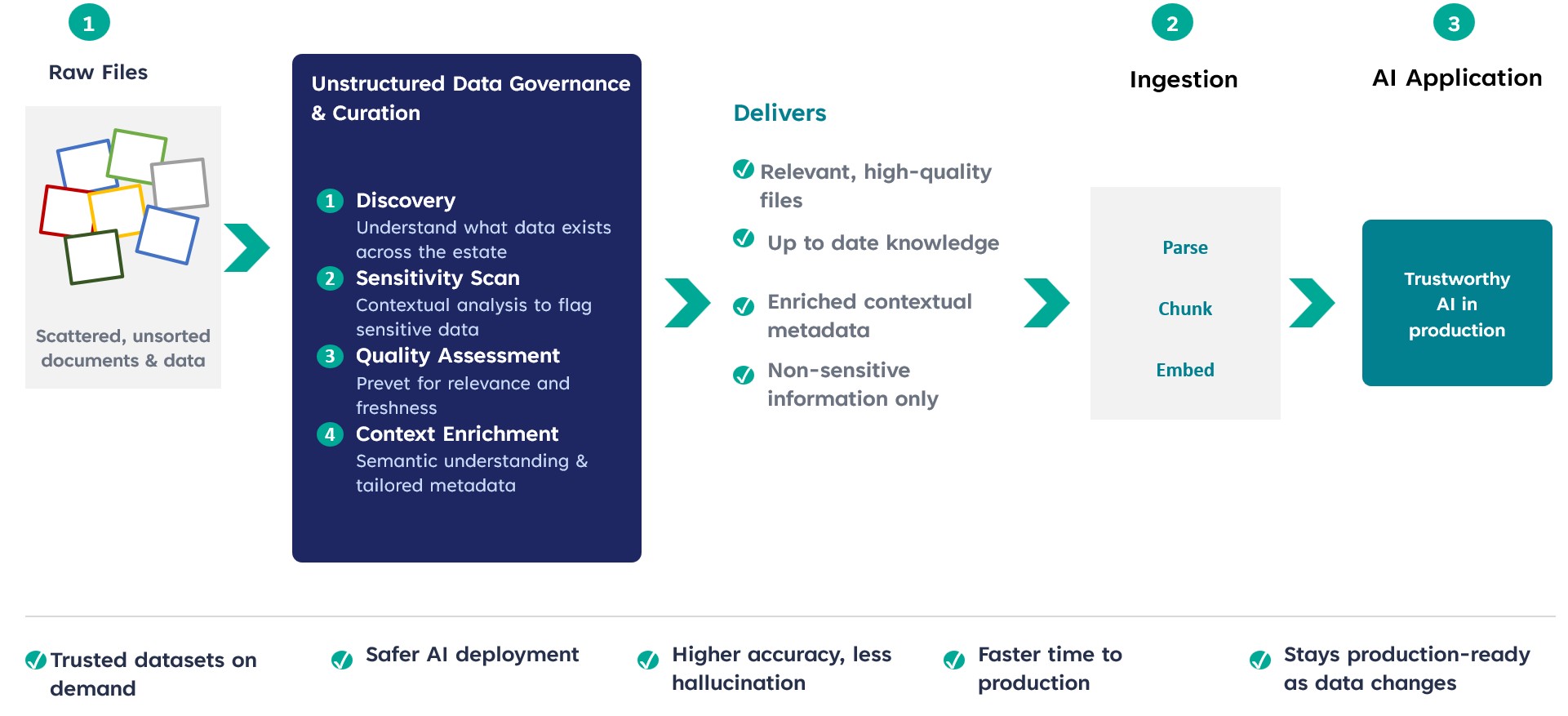
The first is discovery. Valuable knowledge exists across hundreds of repositories, making it difficult to identify authoritative sources and distinguish them from outdated or duplicate versions.
The second is sensitivity. Confidential, regulated, proprietary, or personal information often exists within broader documents and cannot always be identified through keywords or file-level metadata alone. Context matters.
The third is quality. Incomplete, obsolete, contradictory, or redundant content can weaken AI outputs and create uncertainty about which information should be trusted.
The fourth is context. Content without semantic metadata, business meaning, provenance, ownership, or intended-use information leaves AI systems with limited ability to determine relevance and authority.
These challenges rarely exist in isolation. Weak discovery contributes to duplication. Missing context reduces retrieval accuracy. Uncertain sensitivity increases compliance concerns. Poor quality erodes trust in AI-generated responses. Collectively, they slow AI adoption and increase operational complexity.
From data products to knowledge products
Addressing this challenge requires organizations to rethink how unstructured information is managed.
Rather than treating documents as passive files, enterprises must begin governing them as knowledge products.
A knowledge product is a governed and reusable collection of unstructured information enriched with context, quality indicators, policies, provenance, ownership, and semantic relationships that enable both humans and AI systems to use it confidently.
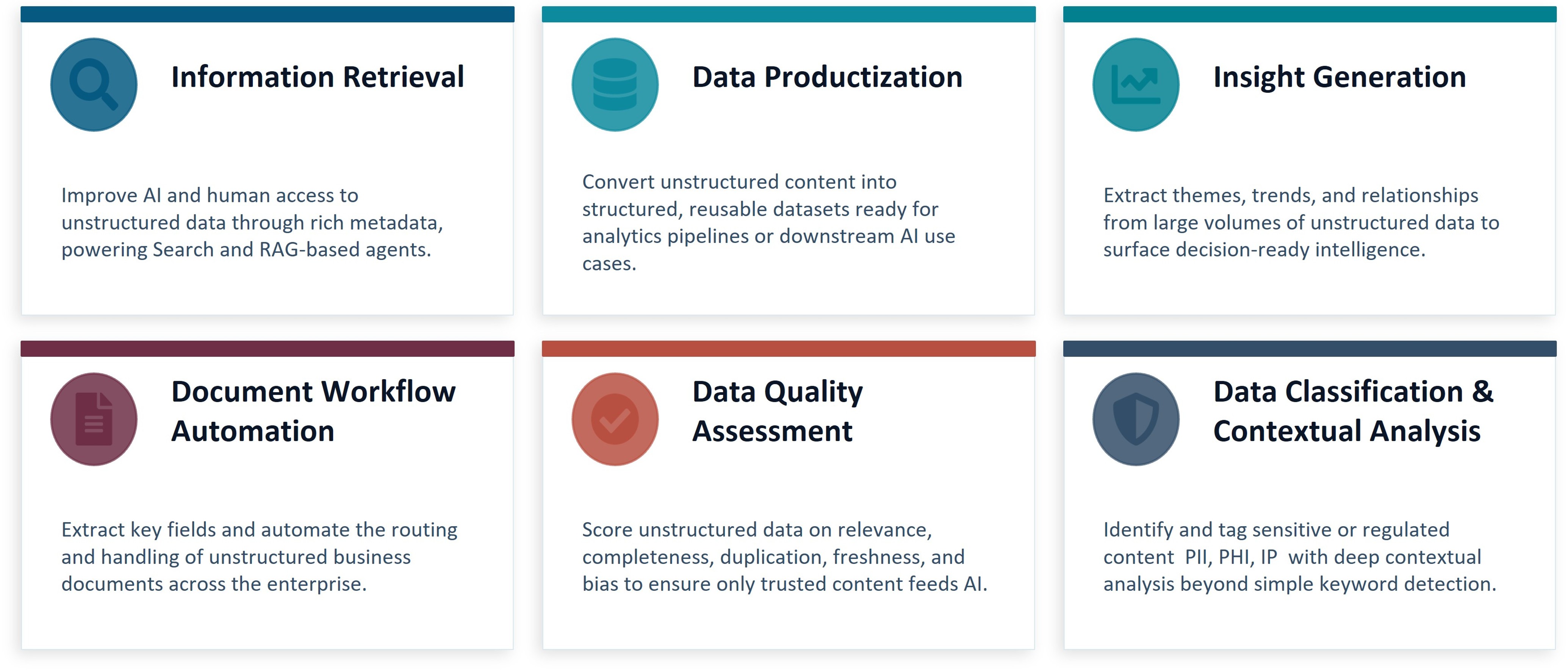
Knowledge products transform unstructured content into trusted, reusable enterprise assets using semantic metadata. They enable intelligent search, copilots, AI agents, and reusable data products while improving analytics and decision making. By uncovering insights, trends and relationships across enterprise content they help drive faster and better business outcomes. They also automate document-centric processes through content extraction, classification and workflow orchestration. Combined with data quality, privacy, and compliance controls, knowledge products create a trusted foundation for AI, governance and enterprise-scale automation
Structured, semantic metadata describing unstructured content unlocks high-value enterprise capabilities as below: