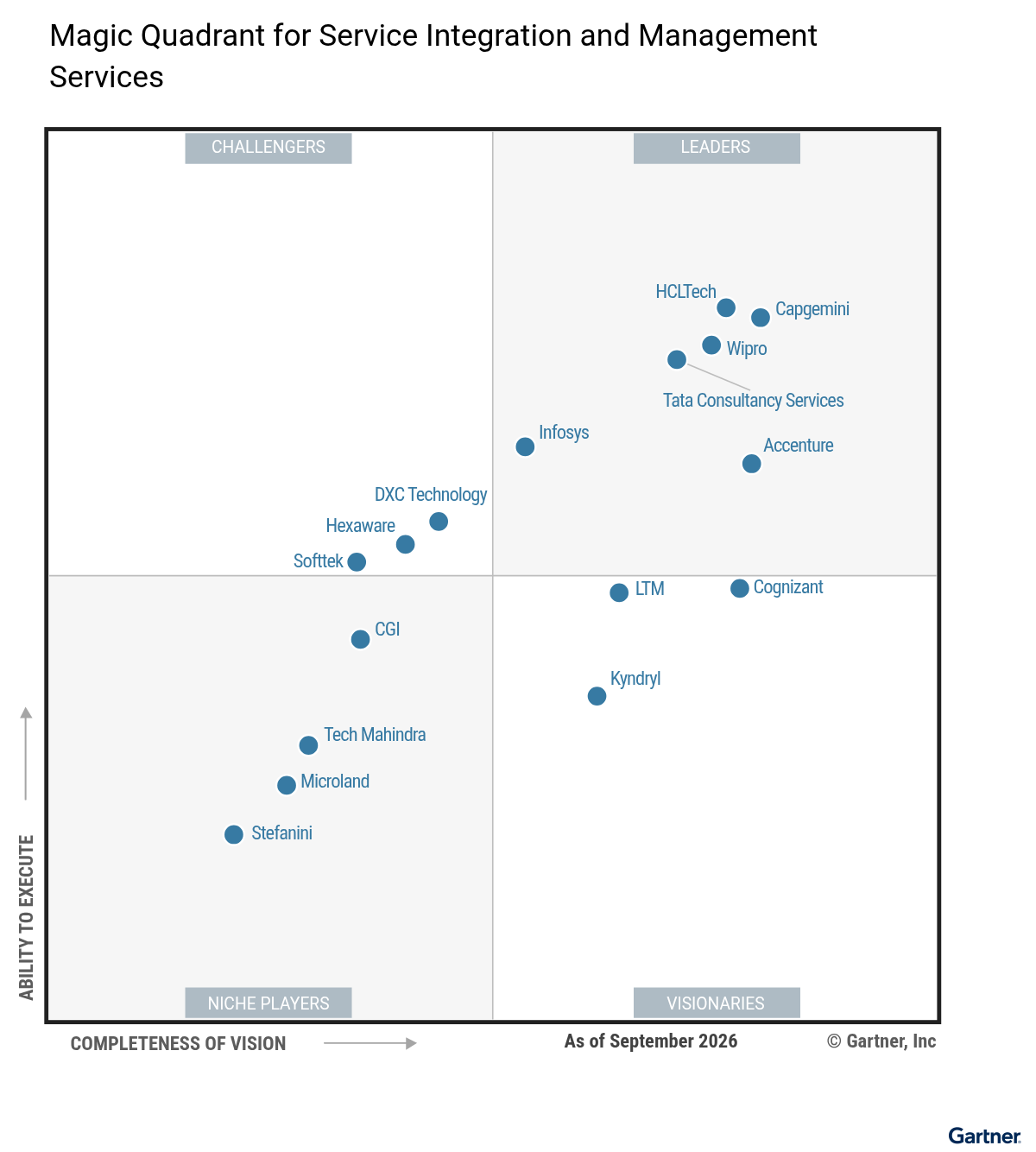


As enterprises navigate increasingly complex IT environments spanning multiple service providers, cloud platforms, and AI-driven technologies, service integration and management is becoming critical to achieving consistent service delivery, operational efficiency, and business outcomes. Organizations are looking for partners that can unify fragmented service ecosystems, strengthen governance and accountability, and enable greater automation and continuous improvement across their IT operations.
Against this backdrop, Wipro has been evaluated in Gartner® Critical Capabilities for Service Integration and Management Services, 2026. We believe this research highlights the growing importance of AI-powered service orchestration, end-to-end performance visibility, effective multivendor governance, and outcome-oriented service delivery in helping enterprises manage complex IT ecosystems.
Wipro brings together deep Service Integration and Management (SIAM) expertise, AI-powered operations, and integrated service management capabilities to help enterprises improve service performance across multivendor environments. Through its WINGS AI platform, Wipro enables automated SLA breach detection, AI-driven root cause analysis, and proactive incident elimination. Its capabilities span performance management, standardized governance, platform integration, and continuous service improvement to support more resilient, transparent, and efficient IT operations.
Wipro also embeds an exit-by-design approach into its SIAM engagements, designed to provide clients with greater sourcing flexibility. The report highlights Wipro’s use of its delivery acceleration and sourcing framework, including automated test scenarios intended to facilitate provider transitions and multi-supplier replacement.
To us, the report reflects a SIAM market moving beyond traditional supplier management toward ecosystem-wide orchestration, experience- and outcome-oriented service models, advanced integration platforms, real-time monitoring, and stronger governance. It evaluates providers on their Ability to Execute and Completeness of Vision as enterprises seek greater accountability and consistency across increasingly complex, hybrid and multi-supplier environments.