


Our Perspective

As generative AI evolves into agentic AI, we are witnessing a profound shift—from conversational models to autonomous systems capable of orchestrating decisions and actions without human intervention. This transformation demands a rethinking of governance: not just rules for machines, but frameworks for human–AI collaboration.

Governance must now address the relationship between human and artificial intelligence, where agents perform tasks traditionally reserved for people. Privacy, security, and trust are no longer optional—they are foundational. Embedding these principles into the very code of agentic systems is essential for responsible deployment.
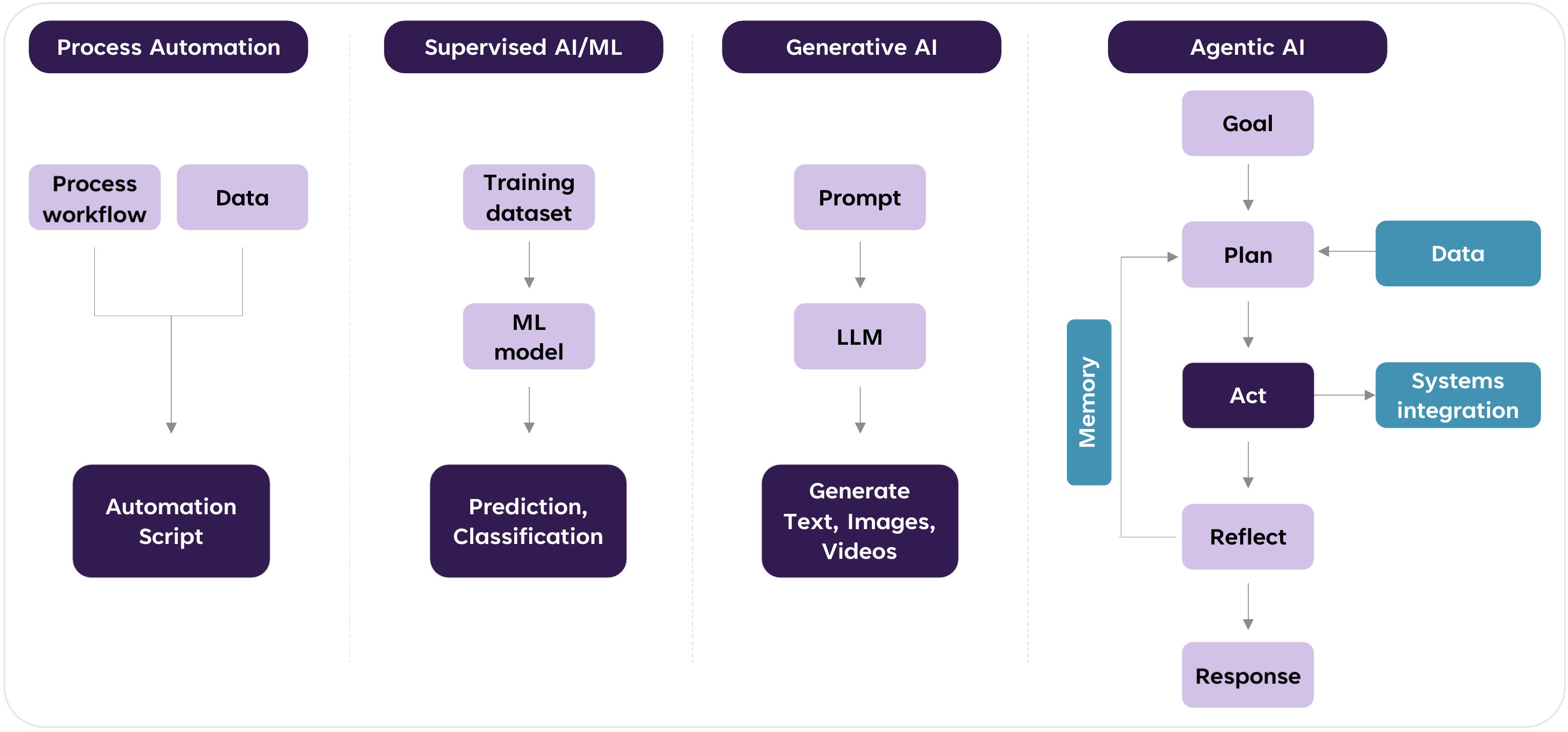

Understanding How AI Is Evolving

At the heart of generative AI are large language models (LLMs), trained to respond to queries with human-like fluency. But their scope is limited to the data they’ve seen. Agentic AI goes further—enabling multi-agent systems that decompose tasks, assign responsibilities, and adapt dynamically.

As Anindito De explains:

“In Agentic AI, you have a multi-agent system acting as an orchestrator. It decomposes tasks, assigns them to agents, monitors execution, and reallocates based on success or failure—all without human input.”

The journey from traditional AI to Agentic AI

This evolution introduces new risks. Executives across legal, IT, and regulatory domains are asking: How do we govern systems that think and act?

Ivana Bartoletti emphasizes:

“AI governance isn’t just about compliance. It’s about foresight. Anticipating ethical dilemmas, building trust, and earning the social license to operate.”

Assessing the Most Critical Factors

The rise of agentic AI challenges our assumptions about human agency.

As Josey George V notes:

“We’re reshaping the relationship between machines and humans. That means embedding security, liability, and data protection into AI systems from the ground up.”

Accountability becomes complex. With LLMs, errors can be traced to datasets or prompt design. But agentic systems gather data, make decisions, and act—often without transparency. What happens when an agent’s actions conflict with an organization’s values?

Ivana Bartoletti shares a real-world concern:

“A client in Australia asked: if an agent veers from our foundational beliefs, how do we realign it? We may need agents to monitor each other.”

How Do You Build Good Governance?

Governance must be proactive, embedded, and adaptive. We propose a three-tiered framework:

  1. Acceptability Criteria
    Purpose Alignment: Agent goals must reflect business intent and ethical standards.
    Human-in-the-Loop: Escalate decisions when confidence is low or risk is high.
    Agent Boundaries: Define clear limits—no financial transactions or personal data access without explicit permission.

  2. Developmental Governance
    Security-by-Design: Embed controls for access, encryption, and privacy.
    Ethical Alignment: Bake fairness and transparency into agent objectives.
    Role-Based Access: Restrict sensitive data and tool integrations.
    Behavior Documentation: Clearly define agent capabilities and fallback protocols.
    Root-Cause Analysis: Investigate failures to prevent recurrence.

  3. Monitoring and Validation
    Real-Time Telemetry: Detect root causes of failures.
    Continuous Learning:  Track performance of agents and retrain for improvements.
    Scenario Testing: Simulate edge cases to assess resilience.
    Optimization: Refine algorithms and resource allocation.
    Drift Monitoring: Detect behavioural changes over time.
    Audit Trails: Maintain logs for traceability and incident response.
As Ivana Bartoletti concludes:
“Being legally right isn’t enough. Clear, fast, credible communication is key. That’s where Wipro can help.”

Need Help?

If you're building or scaling an AI governance program, Wipro’s consultants are ready to partner with you. From strategy to implementation, we help organizations embed trust, transparency, and resilience into their AI systems.

About the Authors

Ivana Bartoletti

Global Chief Privacy and AI Governance Officer, Wipro. A leading voice in responsible AI, Ivana advises governments and enterprises on privacy, ethics, and regulation.

Anindito De
Practice Head, AI Technology Services, Wipro. Anindito leads innovation in agentic systems, orchestration frameworks, and enterprise AI deployment.

Josey George V
Director, AI Strategy & Risk, Wipro. Josey specializes in AI risk modeling, governance frameworks, and regulatory alignment.