Why Single Sourcing? 

In this cyber age, information is in demand. All of us need information now! In addition, the information needs to be consistent, correct and useful. If information cannot be accessed it means that it is not being managed, and cannot be reused, therefore is less valuable. It is this drive towards recovering the value of content that leads organizations to consider single-sourcing strategies.

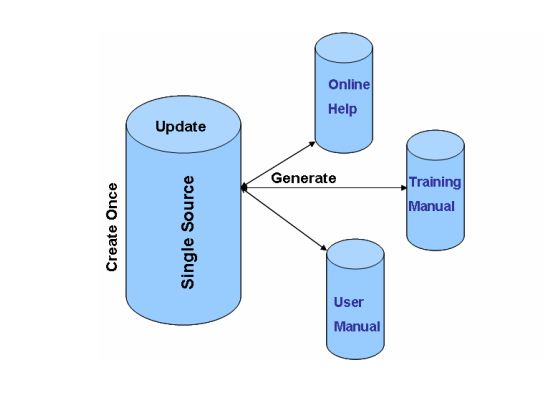
Single sourcing allows us to use the same content in different documents, and in various formats. (Web, Online Help, Print, CD, etc.) Single sourcing is generally used for projects that include large volume of data.

Single sourcing is more than just representing a document in a different medium. It is complex, but it has its advantages. The advantages are listed in the next section.

Advantages

Single sourcing has proven to be advantageous for the following reasons:

  • Easy Generation
  • Eliminate Duplicate Content
  • Maintenance Cost Reduction
  • Improves Consistency

Easy Generation

Allows you to reassemble documents quickly and easily. You can modify your documents to meet new requirements over time. The idea is to record information only once and then generate various formats as needed from that information. 

Eliminate Duplicate Content

To cite an example--in the documentation for related products, which share the same features, instead of updating several separate documents; writers update only the single source file from which the documents are generated. 

Maintenance Costs Reduction

Any document goes through the following phases: Write, format, review, publish. When this applies to multiple documents the effort is multiplied. Hence, there is a saving in time and effort. 

Improves Consistency

If there is more than one writer involved in a project, single sourcing ensures consistency across a set of documentation.

What is Single Sourcing? 

In single source documentation, the writers define the elements required for the documents. All the elements of a document are written in one single source file. The elements may include sentences, paragraphs or entire sections. Typical examples of elements are: 

  • Table of Contents
  • Introduction
  • Step
  • Definition
  • Note 
  • Chart, table
  • Screen
  • Concept
  • Title
  • Explanation
  • Picture 
  • Tip
  • Warning, Caution
  • Field definition
  • Example
The Basics

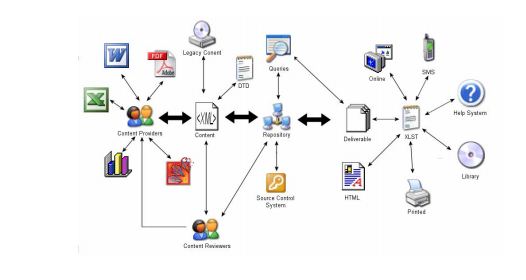
Write content once and store it as an element. Use the element as a base every time you need to convey the information. Then assemble the elements into information products. Use content management software to track and maintain the database of elements. Use a tagging language (XML is widely used) to identify the elements. These tags are used to control the format and assemble the content for different forms of output

Phases of Single Sourcing 

Single sourcing involves identifying all information requirements up front, and then developing them. This is generally done in phases. Following are some of the phases of single sourcing:

Analysis

Analysis is the first step towards single-sourcing. Gather clarity on why you want to single-source. Some reasons for analysis could be: 

Do you want to reduce maintenance?

Is information becoming out of synch in different information products?

Are you using different tools for developing the same content?

Are you catering to multiple platforms?

Audience Analysis

As we cater to a varied audience in different environments, it is important to perform an analysis of the audience. You would need the answers to the following questions:

Who are the users?

What do they need to know?

What platform are the users using?

What are their limitations of the platform?

Information Analysis

Analyze your existing data and identify the following: 

  • Structure of information
  • Content of information
  • Potential areas of single sourcing
  • Potentially missing information

Single sourcing Plan

Determine a plan to manage your data and content. Identify grains of data and modify them to make it simple. Spend some considerable time in planning and designing. Your plan could include details about:

  • The set of documentation deliverables
  • Structure and content of individual information products
  • The writing process (the elements and attributes to use, nomenclature etc.)
  • The flow of information
  • Version control
  • Testing and validating information products

Identify Tools

Identify the tools. The aim is to ensure that all outputs are usable and the key is user focus.

Single Sourcing Tools

Following are some of the Single Sourcing tools:

  • Author IT
  • WebWorks
  • RoboHelp
  • XML

Conclusion

Customization based on the needs of customers has always been one of the main goals of organizations. There is no magic solution. While single sourcing can help organizations reduce costs and improve quality, implementing it requires proper attention, research and planning.

About the Author

Amitha Kini is a technical writer with 9 years of experience and with Wipro technologies since December 2003. She is a part of the Technical Publications Practice in the Product Engineering Support Group. She belongs to the EMCC group and is currently working with the Customer Contact Center Business Unit (CCBU) for Cisco ODC.